
Ukiyo-e
Sudden Shower over Shin-Ōhashi Bridge and Atake
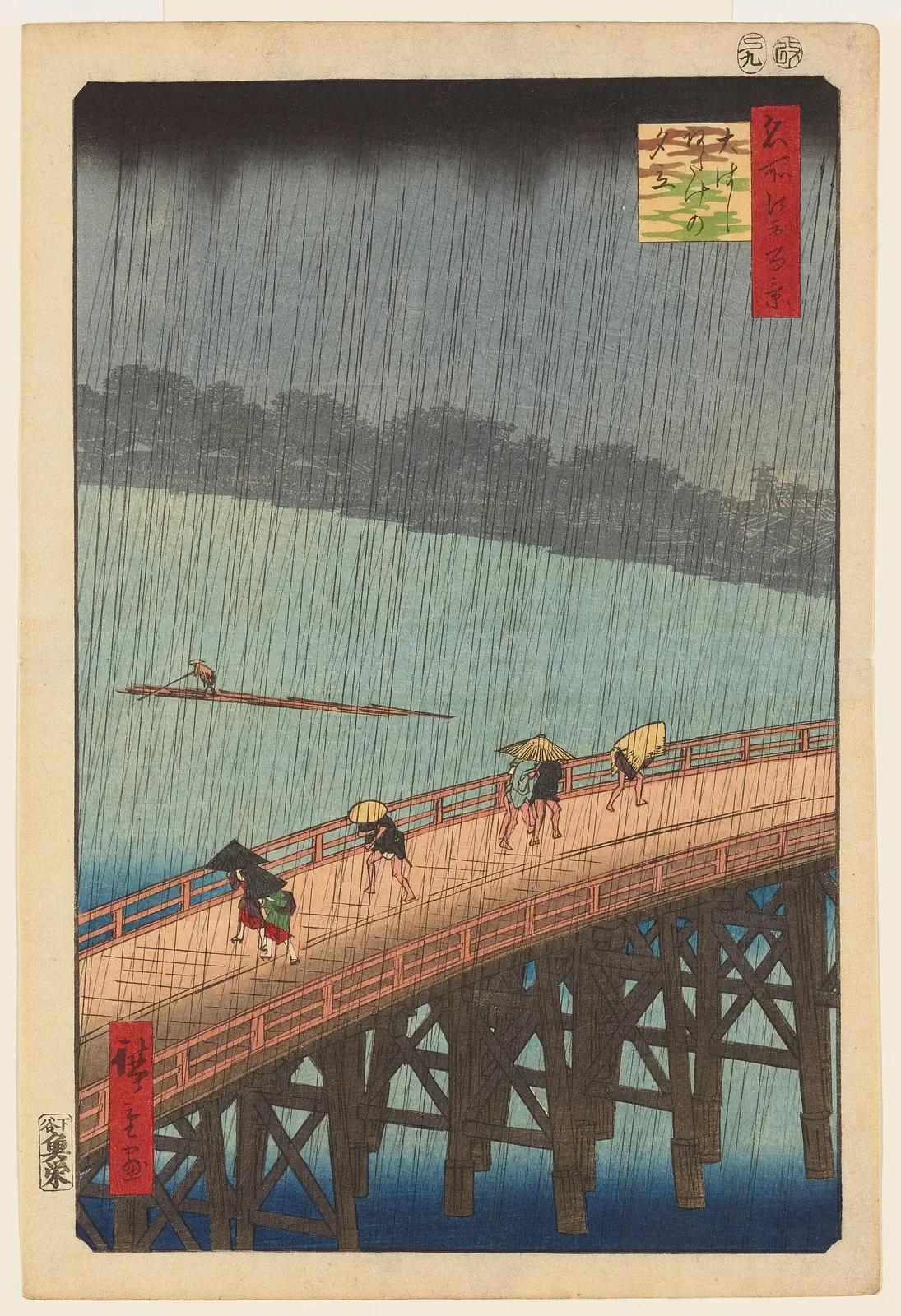
Rain becomes the main character before you even notice the people. In this 1857 print, Utagawa Hiroshige converts weather into structure: diagonals set pace, umbrellas register reaction, and the bridge turns climate into urban choreography.
Edo, 1857: a city seen through sudden weather
Sudden Shower over Shin-Ōhashi Bridge and Atake belongs to One Hundred Famous Views of Edo, a late series in which Hiroshige maps the city through season, route, and atmosphere. The scene is local and ordinary, but the visual treatment is highly engineered.
That combination is central to ukiyo-e culture: familiar places, repeatable prints, and compositional invention that transforms daily transit into visual event.
What the image shows, concretely
A bridge crosses the river, figures rush under umbrellas, boats move below, and dense diagonal lines cut the surface from upper left to lower right. The storm does not sit in the background. It occupies the same visual rank as architecture and bodies.
The bridge stabilizes the scene while the rain destabilizes it. You read order and urgency at once, which is why the print feels immediate even at small scale.
How Hiroshige builds motion with minimal means
Hiroshige limits palette and detail so the oblique rain can dominate perception. Those lines accelerate the eye and compress duration into a single glance. Instead of narrating before-and-after, the sheet traps you inside a weather interval.
Human figures are reduced but not generic: posture and umbrella angle are enough to signal decision, discomfort, and adaptation. The print reads as a study of behavior under environmental pressure.
A useful comparison inside Japanese print culture
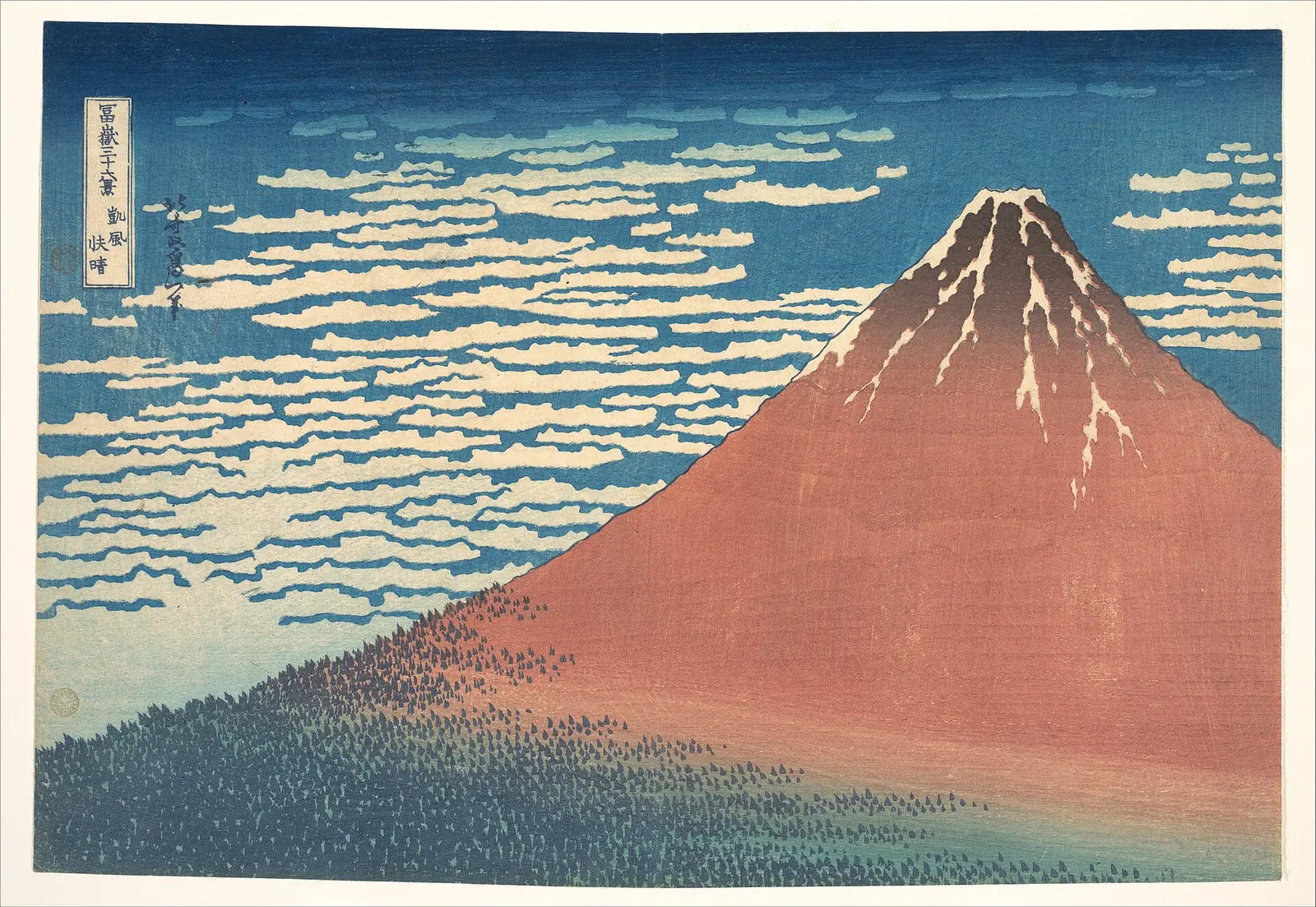
Set this image beside Red Fuji by Katsushika Hokusai. Hiroshige uses rain diagonals to create sudden urban time; Hokusai uses chromatic shift to create slow geological time. Both are weather images, but their tempos are opposite.
Why this print traveled so far
The sheet became influential beyond Japan because it solved a technical and perceptual problem with unusual economy: how to render heavy rain as directional, dense, and believable without over-modeling forms. That solution was studied by European artists, including Vincent van Gogh.
It is also important that this was a publishable urban image, not an isolated court object. Edo print buyers recognized the location, the bridge traffic, and the seasonal pattern. That familiarity made formal innovation easier to absorb: viewers could trust the place while learning a new way of seeing weather.
In contemporary terms, the image still reads like high-efficiency visual communication: maximum temporal effect from limited elements. For deeper context, continue with Hiroshige's artist page, then test recognition in the art quiz.
The rain is not a setting; it is the composition's engine.
Explore more
Related works
Primary sources
Frequently asked questions
The decisive move is the diagonal rain system. It controls speed, direction, and emotional pressure across the whole sheet.
It belongs to late Edo serial print culture, where famous places were repeatedly reinterpreted through season, weather, and urban circulation.
Compare with Red Fuji and The Great Wave to track different atmospheric tempos in Japanese prints.