
Baroque
The Supper at Emmaus
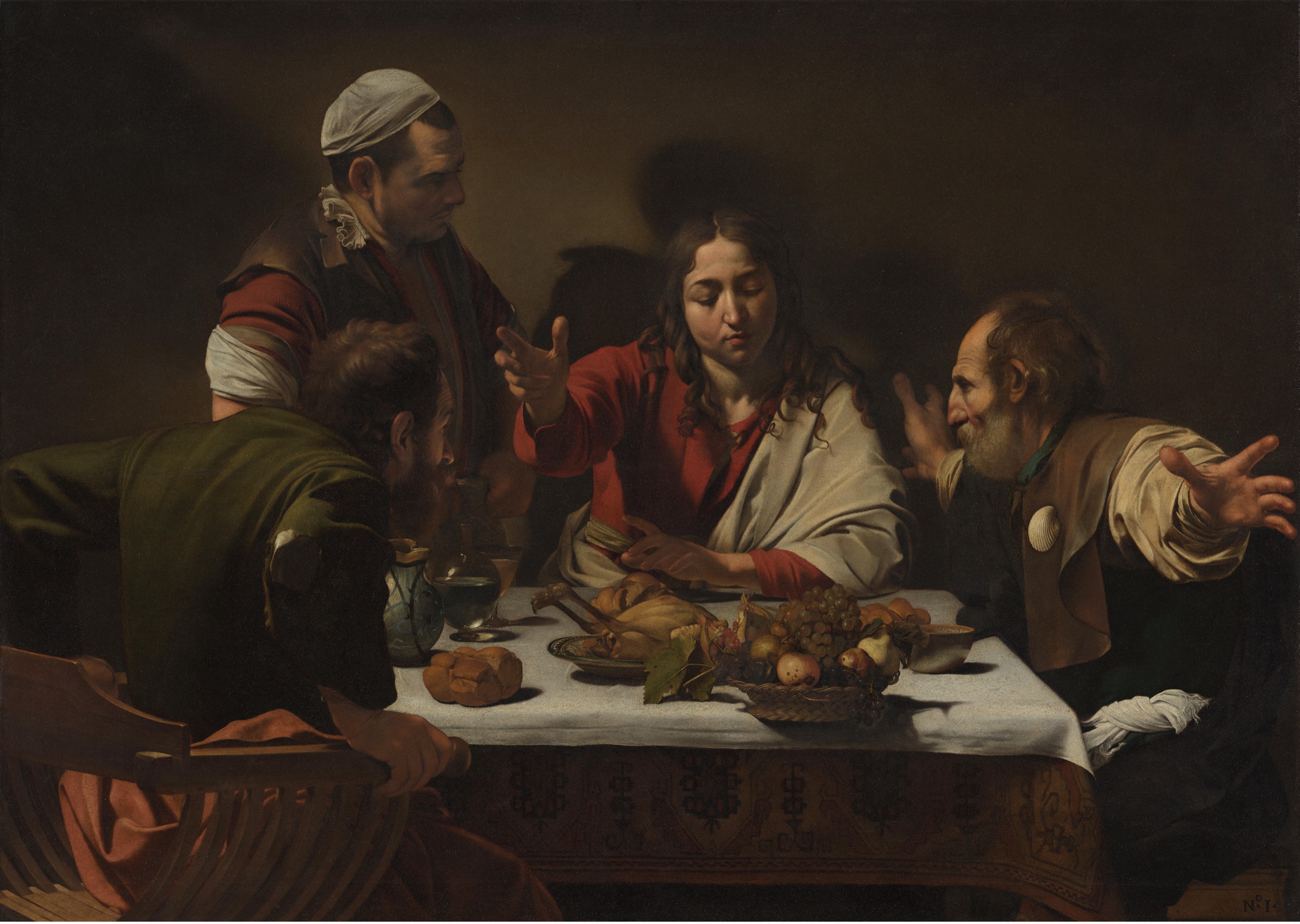
A basket of fruit tilts over the table edge just as recognition breaks open the meal. In The Supper at Emmaus, Caravaggio turns a biblical revelation into a physical event. The resurrected Christ sits in an ordinary room, blesses bread, and is suddenly known by two disciples who had failed to recognize him on the road. The miracle is not placed far above daily life. It erupts at table height, near bread, wine, sleeves, elbows, and a chair kicked into motion.
A resurrection scene made immediate
The painting was made in 1601 for Ciriaco Mattei, one of Caravaggio's Roman patrons and protectors. The National Gallery identifies the work as oil on canvas, 141 x 196.2 cm, now inventory NG172 in London. Its Gospel source is Luke 24: after the Crucifixion, two disciples travel toward Emmaus, meet a stranger, invite him to eat, and recognize the risen Christ when he blesses and breaks the bread.
Caravaggio does not build the subject as a remote sacred tableau. He chooses the instant when recognition has just happened. One disciple throws his arms wide. Another pushes back from the chair. The innkeeper behind Christ watches without understanding. The viewer is placed at the fourth side of the table, close enough for the basket, the tablecloth, and the shadow to enter our space.
What the painting shows
Christ sits at the center, young, calm, and strangely solid. His right hand blesses the bread while his left hand opens outward, making the gesture both liturgical and spatial. The disciples are built from reaction: spread arms, bent elbows, twisting shoulders, a chair seen from behind. Their bodies make the shock visible before the mind can name it.
The still life in the foreground is not a decorative pause. Fruit, chicken, bread, wine, and white cloth turn the table into a threshold between image and viewer. The basket's shadow does not quite match its form, and the fruit seems dangerously close to falling. Caravaggio uses that instability to make recognition feel unstable too: the world has not changed shape, but its meaning has shifted completely.
Caravaggio's method is to make revelation depend on ordinary matter. The intention is not merely to illustrate a biblical episode. He makes the viewer experience recognition as pressure inside a believable room, where food, hands, and furniture carry the same dramatic force as faces.
Light, table space, and Baroque address
The light is softer than the severe shaft in The Calling of Saint Matthew, but it performs the same structural work. It selects bodies, clarifies gestures, and compresses spiritual time into a single readable instant. The background stays dark so that table, hands, and faces become the entire world of the painting.
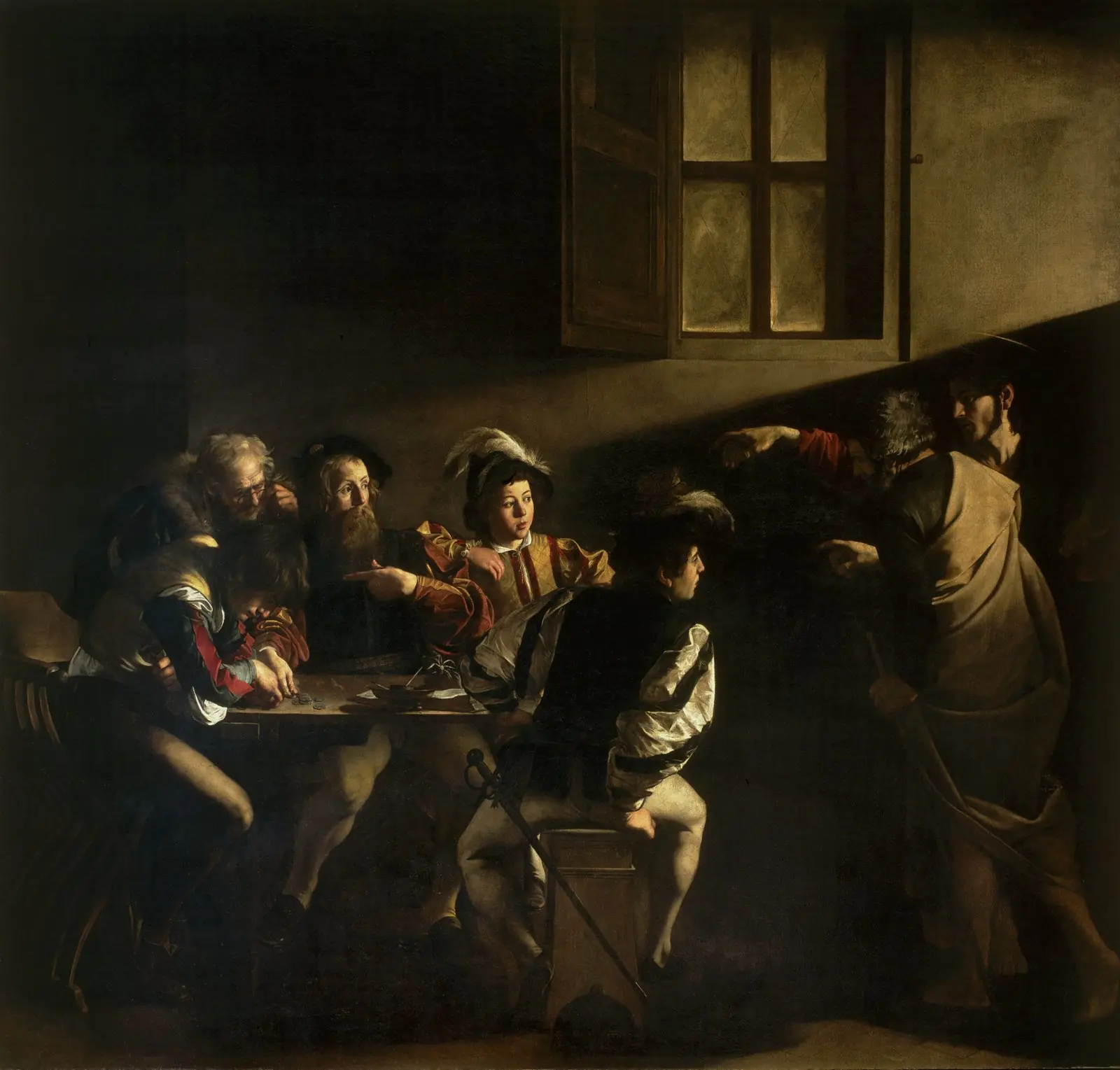
This is why the painting belongs so strongly to the Baroque. It does not simply depict an event. It assigns the viewer a position inside the event. The table projects outward, the disciple's arms widen the picture, and the foreground still life tests the boundary between painted world and real space.
Against Leonardo's ordered table
A comparison with The Last Supper clarifies Caravaggio's shift. Leonardo organizes the apostles along a long table, making psychological reaction legible through measured groups and perspective. His room is stable, rational, and architecturally controlled. The viewer reads the drama through order.
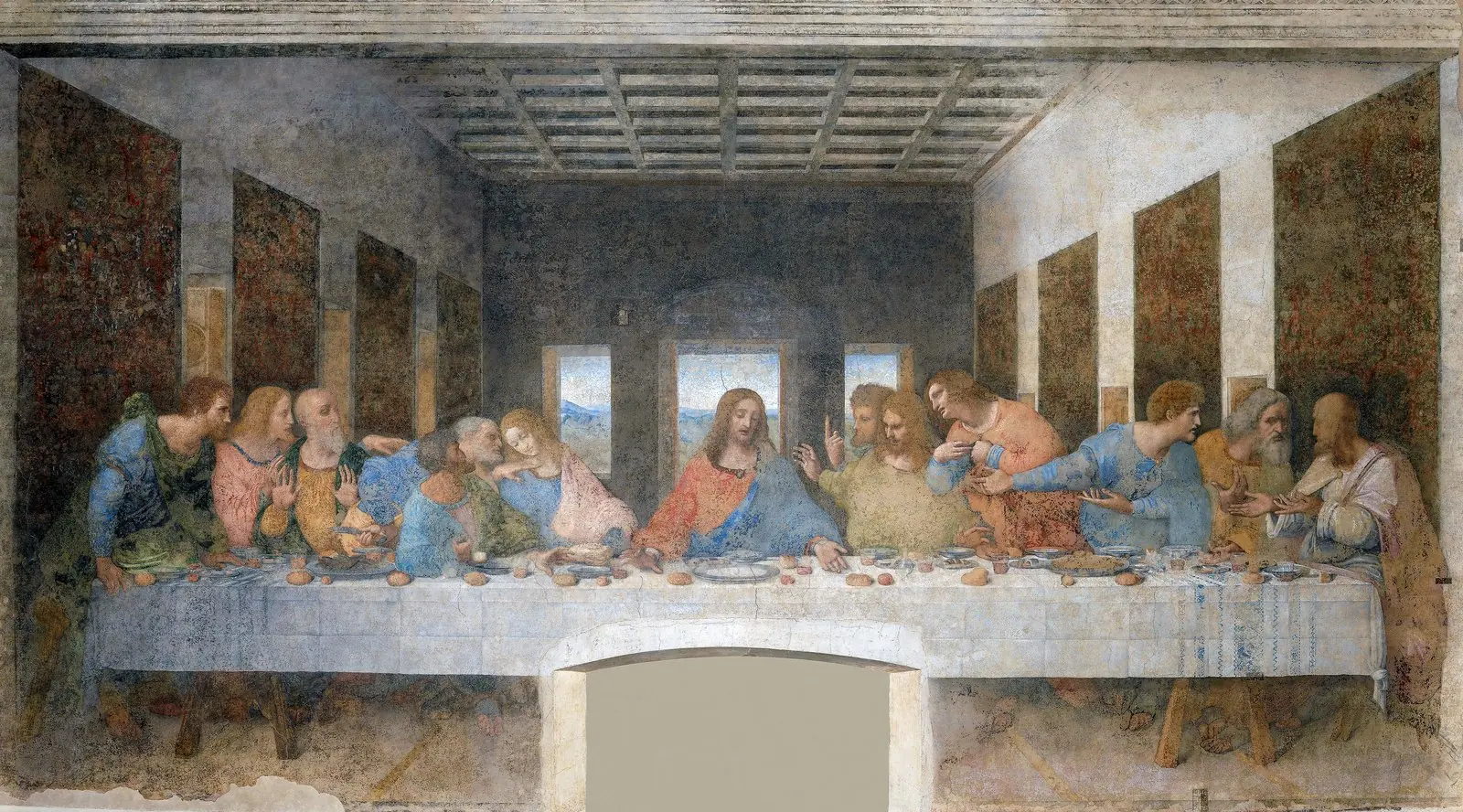
Caravaggio abandons that distance. His table is cropped, near, and slightly threatening. The scene is not a diagram of reactions but a burst. The fruit basket and the chair make the viewer feel the table as an object occupying space, so recognition becomes less a story remembered than an encounter happening now.
Patronage, collection, and museum life
The Mattei commission places the work inside Caravaggio's early Roman success, when private patrons and church commissions were responding to his new realism. The National Gallery traces the painting from the Mattei circle to the Borghese collection, then to George Vernon, who presented it to the Gallery in 1839. Its public life therefore begins as elite devotional and collector culture before becoming one of the National Gallery's central Caravaggios.
That route affects how we read it now. In a museum, the picture no longer functions as a private devotional object, but its original force remains intact because its composition continually recruits the viewer. Standing before it, you occupy the missing side of the table.
Why the painting still feels startling
The Supper at Emmaus keeps its force because it makes a theological claim through concrete perception. Recognition is not an abstract belief added after the image. It is built into posture, light, food, furniture, and nearness. The miracle becomes visible as a change in attention.
From here, follow Caravaggio through The Calling of Saint Matthew for conversion as decision, then move to Baroque to see how later artists use proximity, directed light, and compressed space across church, court, and civic images.
Continue from Caravaggio
Comparison path
Then try the art quiz.
Primary sources
Frequently asked questions
Caravaggio shows the instant when two disciples recognize the resurrected Christ as he blesses and breaks bread at Emmaus.
The 1601 painting is in The National Gallery, London, inventory number NG172.
The basket pushes the painting toward the viewer's space. Its unstable edge turns still life into a device of immediacy, making revelation feel physically close.