
Post-Impressionist Painting
The Sleeping Gypsy
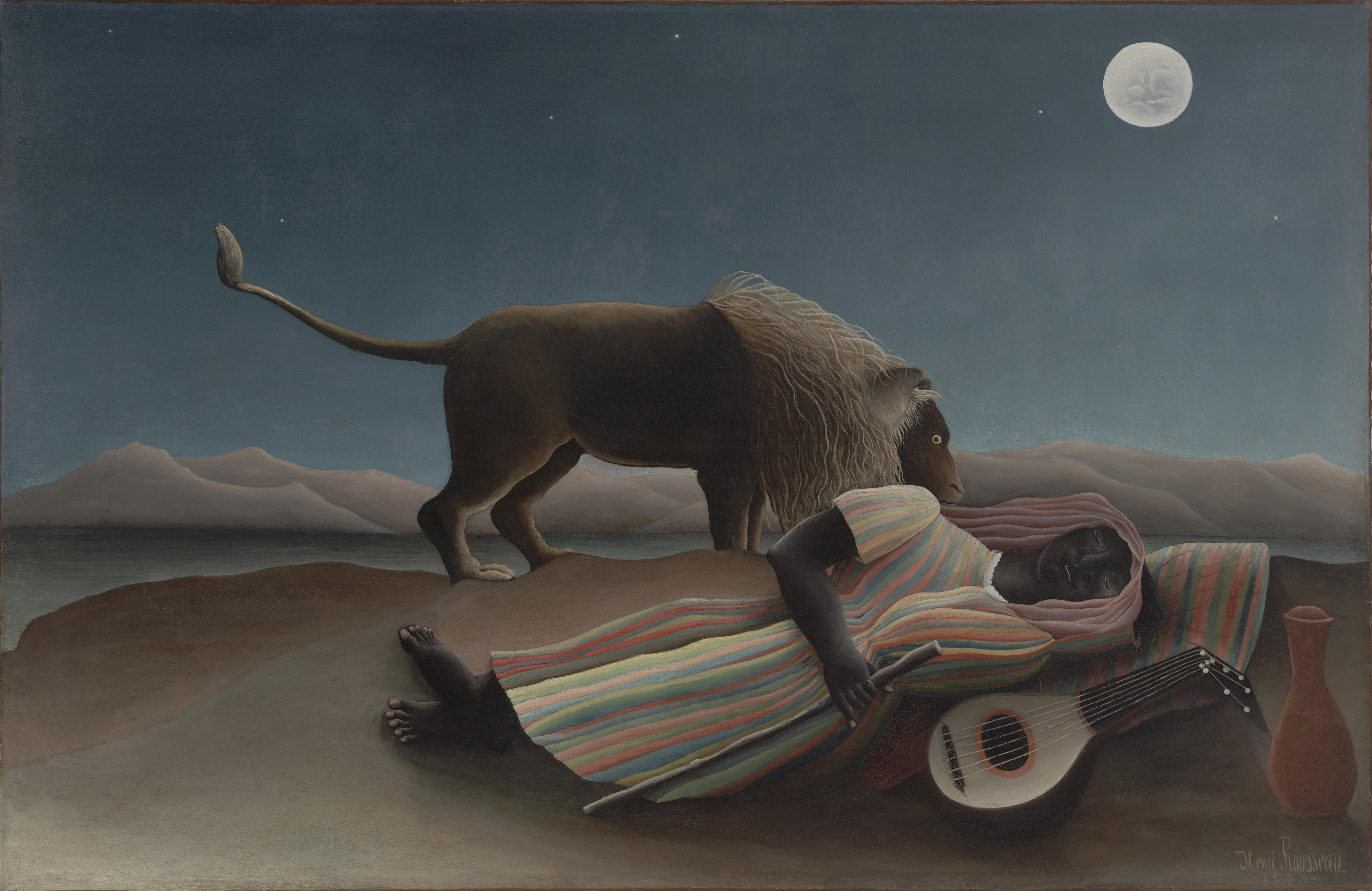
A lion pauses beside a sleeping traveler under a moon so still that the whole desert seems to hold its breath. In The Sleeping Gypsy, Henri Rousseau does not build danger through movement, noise, or attack. He builds it through suspension. Everything is clear, almost simple, yet the image feels impossible to settle because the scene is too calm for what it contains.
1897: an invented night, not a travel report
Rousseau exhibited the painting at the Salon des Indépendants in 1897, by which point he had already become one of Paris's strangest artistic presences: a self-taught painter, mocked by many critics, yet increasingly noticed by younger artists. The historical title uses the word "gypsy," a nineteenth-century exoticizing label rather than an ethnographically precise description. Rousseau is not documenting a known people or a real journey. He is arranging a scene of otherness, sleep, and exposed stillness.
That matters because the painting is not trying to persuade you that it records a witnessed event. Rousseau had not traveled to a North African desert. Like many of his exotic scenes, the picture is assembled from imagination, museum culture, printed imagery, and the broader Parisian appetite for distant worlds. The result feels less like reportage than like a lucid dream that has taken visible form.
What the painting actually shows
A dark-skinned sleeper lies on a striped cloth with a mandolin, a walking staff, and a water jar nearby. Behind her stretch low hills and a bare horizon. A lion bends its head toward her shoulder. Above them hangs a full moon in a clear, hard sky. The composition is almost severe in its economy. Rousseau gives you only the elements he needs, and each one stands out with unusual clarity.
The first surprise is that nothing breaks the silence. The lion has arrived, but it has not leapt. The sleeper is exposed, but not startled awake. Even the accessories beside her feel less like anecdotal details than like pieces laid out on a stage. Rousseau removes every secondary distraction so that the viewer is left with one unnerving question: how long can this pause last?
Rousseau paints stillness as pressure
The painting's strangeness comes from its method. Rousseau uses hard contours, flattened space, and a polished surface that refuses painterly agitation. The sand does not ripple with wind. The sky does not flicker. The lion's mane is described, not exploded into brushwork. This exactness is why the scene feels uncanny. A more dramatic painter would have made the danger obvious. Rousseau makes it quiet enough to feel mentally contagious.
This is also why the lion does not need to attack. The image already contains its own tension. The animal's pause is more disturbing than a violent climax would be, because the whole painting has been organized around held breath. Rousseau makes danger readable as distance held in suspense: one body asleep, one body alert, a narrow strip of space between them.
Dream image, not naturalist image
Rousseau is often called naive or primitive, but those labels can hide how deliberate this picture is. The geometry is controlled. The intervals are measured. The moonlight is less observed than distributed. He wants the picture to feel clear enough to accept and strange enough not to explain away. That combination is one reason later avant-garde artists found him so fertile.
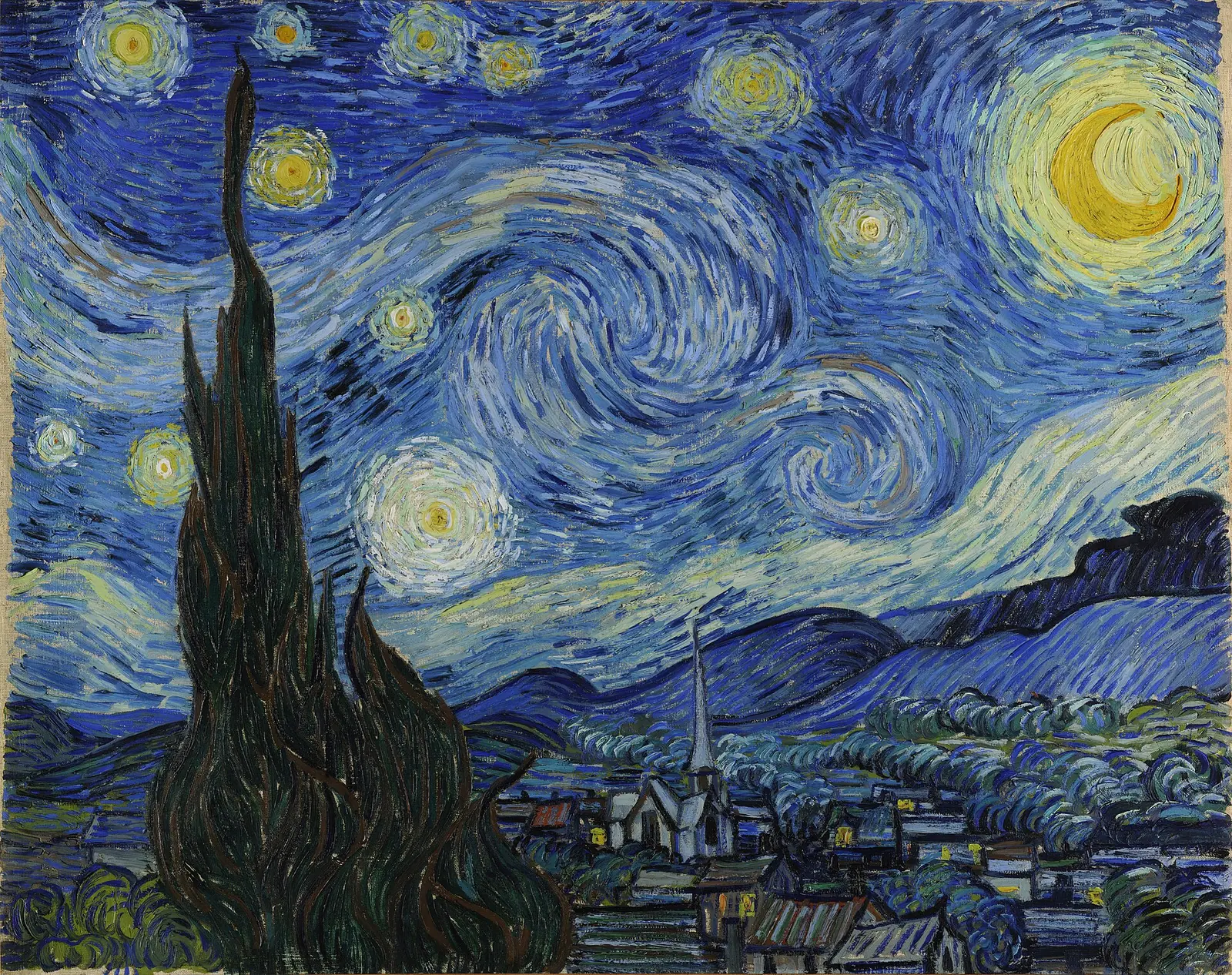
Set the painting beside The Starry Night and the contrast becomes sharp. Van Gogh turns night into turbulence, rhythm, and outward motion. Rousseau turns night into suspension. Both belong to Post-Impressionism, but they prove that the movement does not need one common surface. It can intensify experience through agitation or through eerie calm.
Where the painting sits in modern art
The Sleeping Gypsy matters because it shows one path out of Impressionism that does not pass through broken touch or scientific color. Rousseau keeps his contours firm, his space simplified, and his drama almost motionless. The painting reads less as an optical impression than as a constructed proposition about dream, exposure, and the visible world remade by imagination.
The work later attracted artists and writers interested in dream logic because it already behaves like a modern image that answers to an inner necessity rather than to ordinary realism. Rousseau does not dissolve reality into fantasy. He makes fantasy stand there, fully lit, and asks the eye to accept it.
Explore more
Then try the art quiz.
Primary sources
Frequently asked questions
Because Rousseau builds suspense through suspension rather than action. The lion sniffs and pauses, which makes the scene stranger than a straightforward attack would.
No evidence suggests that he did. Rousseau built exotic scenes from Paris museums, botanical gardens, printed images, and imagination rather than firsthand travel.
No. It was painted in 1897, long before Surrealism. But its dream logic and uncanny stillness helped later artists see Rousseau as a precursor.