
Post-Impressionist Artist
Henri Rousseau

Rousseau makes impossible scenes look calm enough to believe. The Sleeping Gypsy, the jungle paintings, the moonlit silences, the flat clarity of his figures: none of them depend on painterly turbulence or academic illusion. Henri Rousseau builds modern strangeness through stillness, contour, and simplified space. He belongs to Post-Impressionism, but he takes it in a direction very different from Van Gogh or Cezanne. Where they intensify painting through pressure, rhythm, or reconstruction, Rousseau often intensifies it by making dream logic look perfectly legible.
From the Paris toll service to the Salon des Indépendants
Henri Rousseau was born in Laval in 1844 and spent most of his adult life in Paris. He did not come through the official schools that shaped so many nineteenth-century painters. He worked for the city's toll service, which later helped give him the nickname "Le Douanier," even though he was not a frontier customs officer in the strict sense. That detail matters because Rousseau's outsider status is real, but it is easy to exaggerate it into folklore. He was not an untouched innocent painting far from the modern city. He was a Parisian who studied, copied, exhibited, and stubbornly inserted himself into the artistic life of his time.
The key public setting was the Salon des Indépendants, where artists could show work outside the official Salon system. Rousseau exhibited there repeatedly. Critics often mocked him for stiff figures, strange scale, and apparently awkward drawing. Younger artists looked more carefully. They could see that the same features also gave his paintings an unusual force. Rousseau was not failing to imitate academic finish. He was producing another kind of pictorial order, one that made the visible world feel both precise and improbable.
Why "naive" is never enough
Rousseau is often filed under labels such as naive, primitive, or self-taught. Some of that history is unavoidable, but none of those labels explains the pictures on its own. The strongest thing in Rousseau is not simplicity as such. It is control. He uses hard outlines, frontal clarity, and flattened intervals to remove the small transitions that usually make a scene feel ordinary. A face can stay blanker than expected. A moon can hang too cleanly. A tree or an animal can feel cut out and absolutely present at the same time.
His paintings stay modern because they do not seduce through virtuoso brushwork. They hold the eye by making each element look settled while the whole scene remains mentally unstable. You understand what is in front of you at once, but you do not understand why it feels the way it does. Rousseau turns legibility into unease.
A decisive case: The Sleeping Gypsy
The clearest work on Explainary is The Sleeping Gypsy. A sleeping traveler lies in a desert while a lion bends toward her shoulder. The moon is full, the space is bare, and almost nothing happens. Yet the picture is intensely tense. Rousseau does not create suspense by showing attack. He creates it by refusing to let the attack begin. The whole composition is organized around delay.
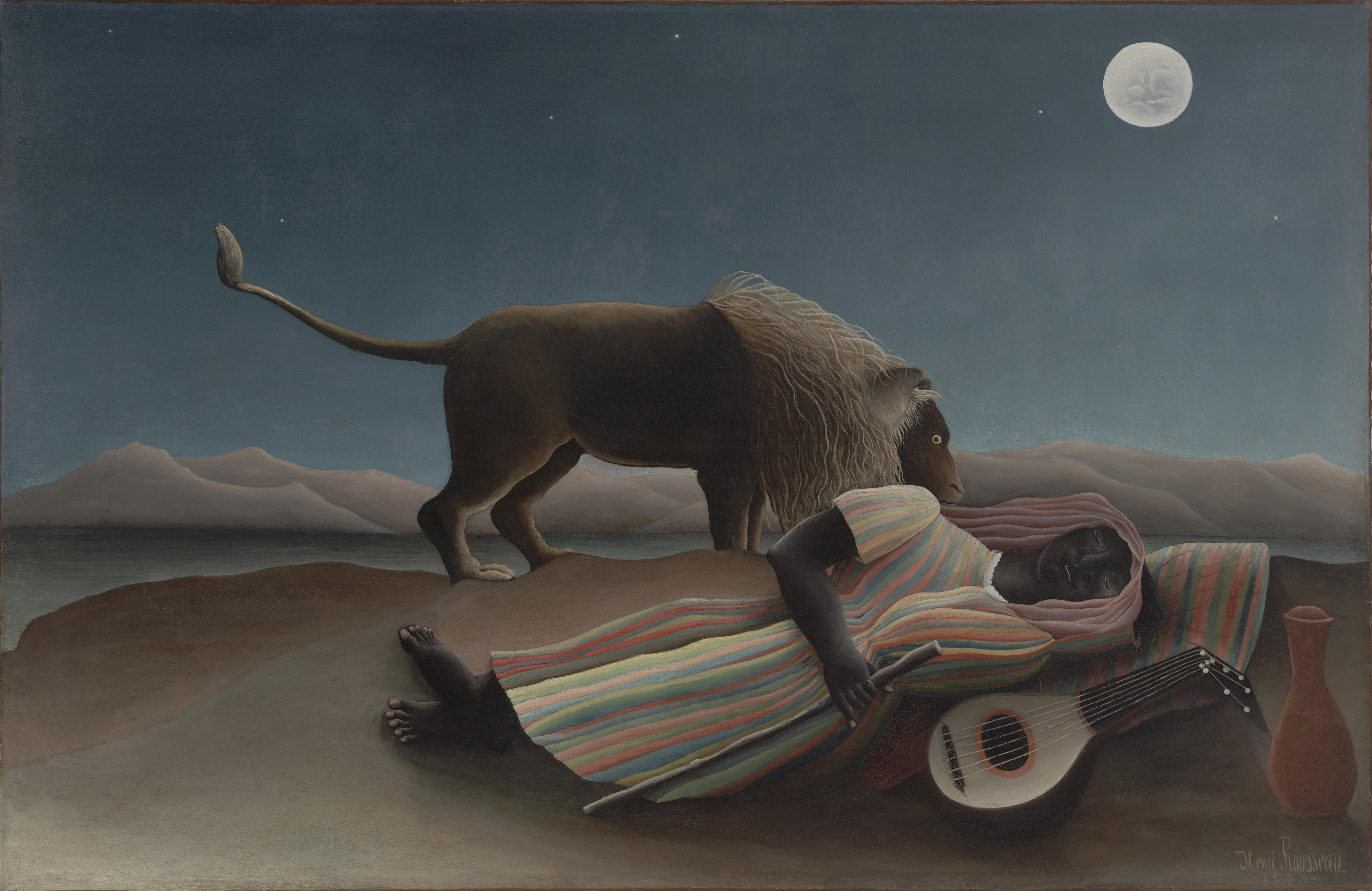
That painting also shows why Rousseau cannot be reduced to eccentricity. The scene is rigorously edited. There is no anecdotal clutter, no atmospheric confusion, no naturalist overflow. The image works because Rousseau knows exactly how much to leave in: sleeper, lion, moon, desert, objects. He gives dream imagery the severe economy of an icon.
Invented jungles, modern imagination
Rousseau never traveled to tropical forests, and that fact is central to how his jungle paintings work. They are not records of direct travel. They are constructed images built from Paris museums, botanical gardens, illustrated material, colonial displays, and imagination. The point is not geographic accuracy. The point is to create a world that feels visually coherent even when it is assembled from secondhand fragments.
That method helps explain his place in modern art. Rousseau shows that painting can abandon strict realism without becoming vague. His scenes are invented, but they are not blurry fantasies. They are controlled fabrications. In this respect he belongs to the same modern century as The Starry Night and, from another direction, to older dream images such as The Nightmare. Van Gogh makes night move. Fuseli makes dream panic theatrical. Rousseau makes dream still enough to seem undeniable.
Legacy: why Rousseau lasts
Rousseau's legacy begins with later artists who saw that invention could look structurally serious. Picasso admired him. Surrealists later recognized in him a precursor, not because he shared their program, but because he had already shown how a painting could answer to inner necessity without dissolving into pure abstraction. He kept objects, bodies, plants, moons, and animals fully visible. He simply rearranged their logic.
Rousseau still feels fresh because he offers one of the clearest examples of a modern picture that is readable on the surface and strange in its core. The more calmly the image presents itself, the more it unsettles the viewer. That combination is rare, and it keeps Rousseau far from the margins of nineteenth-century painting.
Reading paths from Rousseau
A strong route is simple: read The Sleeping Gypsy, widen out to Post-Impressionism, then compare Rousseau's calm dream logic with the pressure of The Starry Night. Then try the art quiz.