
Dutch Golden Age
View of Delft
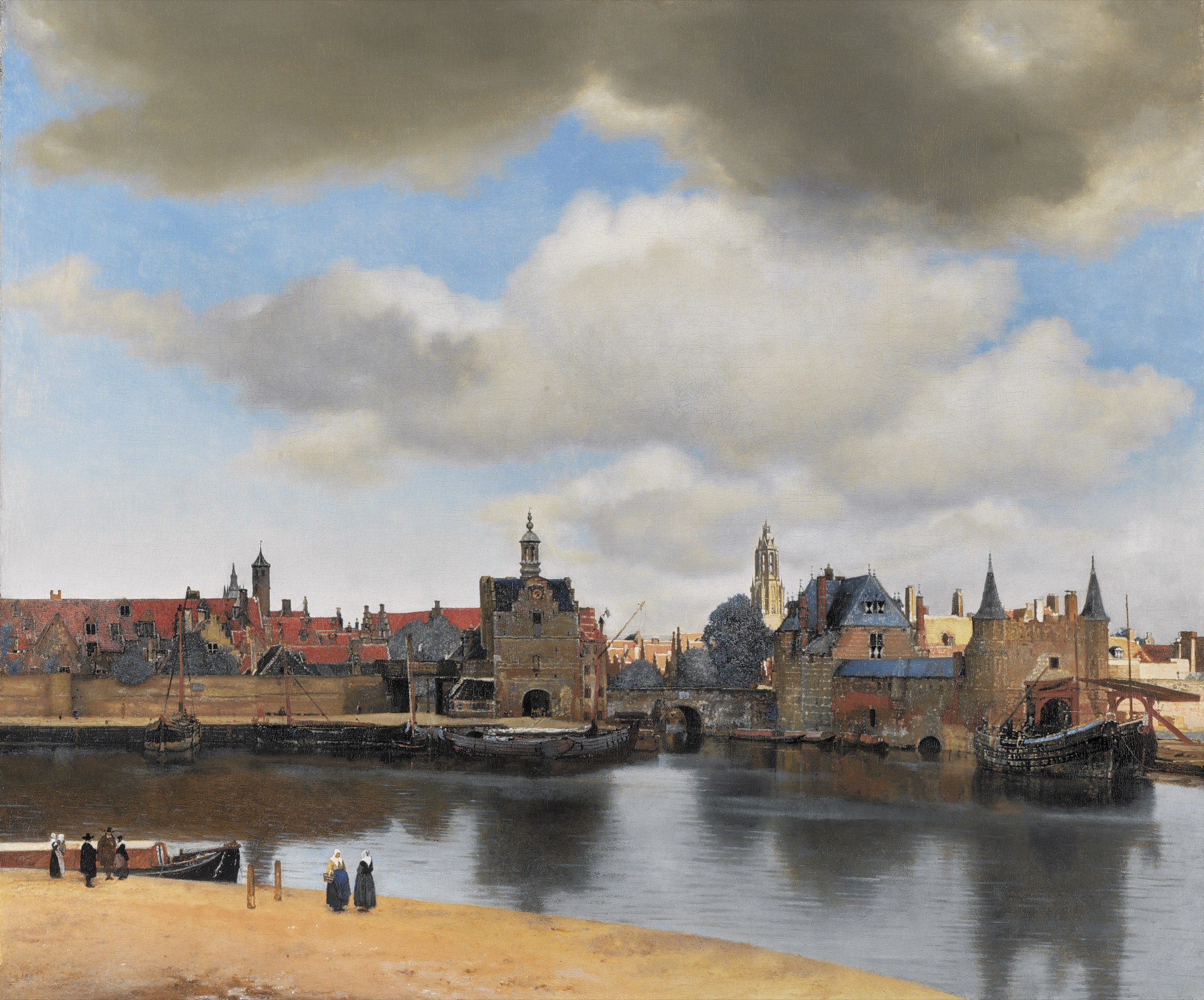
Vermeer paints Delft between sunlight and cloud: brick walls, quiet water, a few small figures, and a city that seems to hold its breath. What matters here is not a full record of the city, but the balance between weather, reflection, and civic space. For readers who know Johannes Vermeer mainly through interiors such as The Milkmaid or Girl with a Pearl Earring, this canvas shows that the same discipline works in open air.
A city held between sunlight and cloud
The viewpoint is set across the water to the south of Delft. Vermeer does not take us into crowded streets. He stays at a measured distance, letting the harbor basin, quay walls, gates, towers, barges, and rooflines line up across the canvas. That choice matters. The city arrives first as a stable silhouette and only then as a place of individual activity.
Once you slow down, the scene is fuller than it first appears. Tiny figures move near the waterfront, boats rest in the basin, and masonry changes from shadow to light in carefully staged intervals. Vermeer is not building a panoramic survey. He is selecting one profile of Delft and making it visually legible with unusual restraint.
The sky and water do half the work
The painting would lose its force if you looked only at the buildings. The cloud mass occupies nearly half the composition, and the water below repeats the city's forms in a softer register. That pairing is essential. The skyline is not pinned into a dry architectural record; it is suspended inside a changing atmosphere.
This is where Vermeer's patience becomes visible. Sunlight does not flood the whole city evenly. It isolates certain walls and towers, then lets others sink back into shade. The painting therefore holds two times at once: the durable time of brick and urban construction, and the passing time of weather. That tension is one reason the canvas feels so calm and so alive at the same time.
Vermeer outside the interior
Put the painting beside The Milkmaid and the shift is clear. In that kitchen scene, Vermeer concentrates attention inside one room, on bread, pottery, wall texture, and one pouring gesture. In View of Delft, he redistributes the same care across quays, roofs, clouds, and reflections. The scale changes, but the method does not.
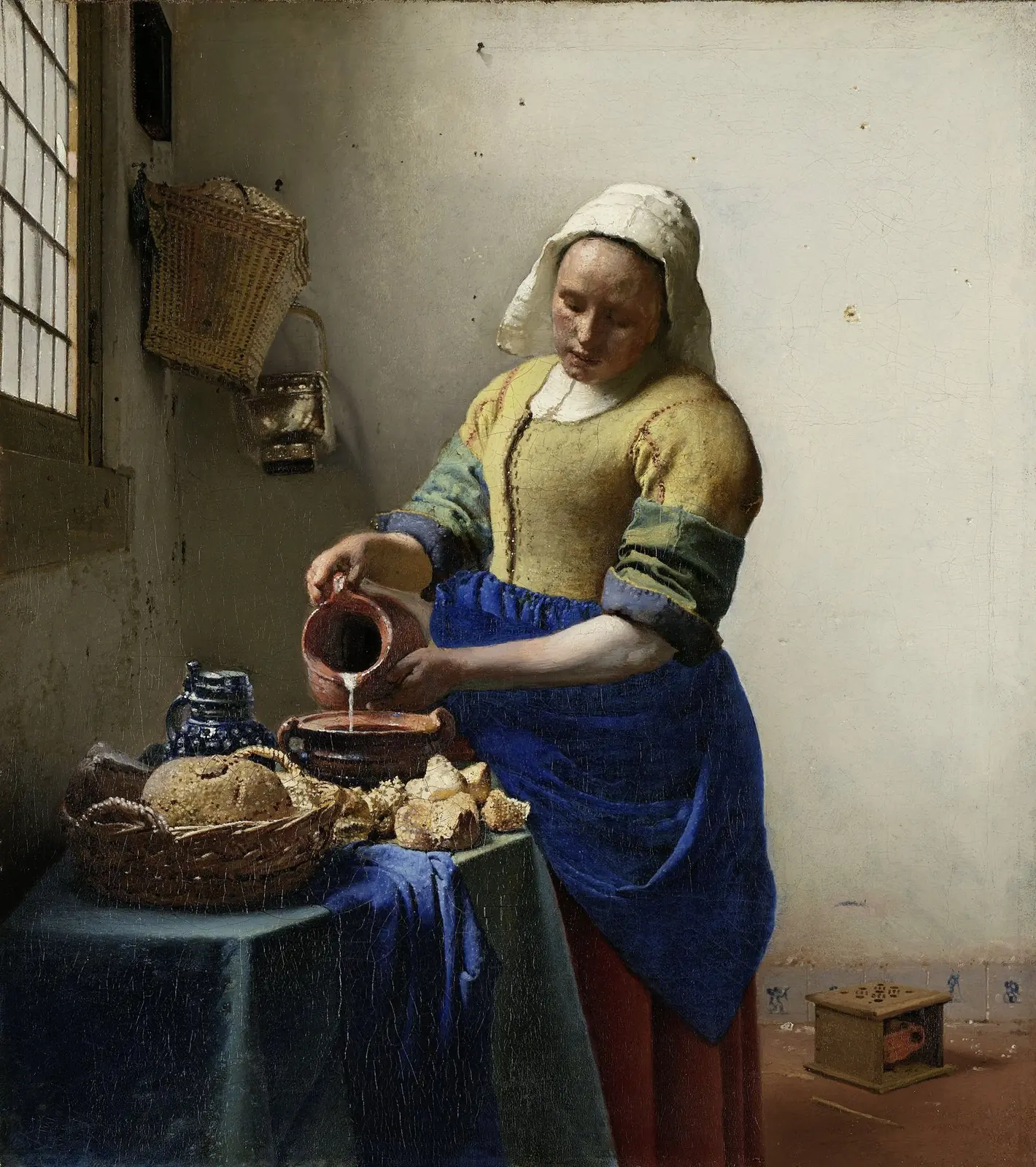
This expands Vermeer without changing what makes him distinctive. He is not only the painter of silent rooms and half-turned faces. He can make an urban exterior hold still with the same concentration. In both interior and city view, narrative is reduced so that light, interval, and measured looking carry the real argument.
Civic pride without official spectacle
View of Delft also clarifies something larger about the Dutch Golden Age. In a republic shaped by trade, municipal identity, and market culture, public meaning does not need a king on horseback. A skyline, a gate, a harbor, and a patch of weather can do the work. The city becomes a subject not because it is grand in the courtly sense, but because it is lived, recognized, and shared.
That is why this painting is more than a pleasant cityscape. It makes civic space feel weighty without turning it into propaganda. Vermeer does not shout about prosperity or local pride. He lets built form, water, and atmosphere carry them quietly. Read beside the domestic concentration of The Milkmaid and the broader tradition of Dutch civic portraiture, the canvas helps map the wider range of Dutch painting: interior, city, and collective life rendered with different kinds of seriousness.
If that structure is clearer now, try the art quiz and see whether you can recognize Vermeer quickly beyond his most famous interiors.
Explore more
Related works
Primary sources
Frequently asked questions
Vermeer splits the image between sunlit masonry, heavy cloud, and reflective water, so the city feels both stable and momentary at once.
The painting is rooted in a recognizable profile of Delft, but Vermeer edits and organizes the view to create clarity, rhythm, and atmospheric balance rather than simple topographical report.
Compare it first with The Milkmaid to see Vermeer move from interior concentration to urban stillness, then with The Night Watch to feel two very different ways Dutch art can picture collective life.