
Movement Guide
Suprematism
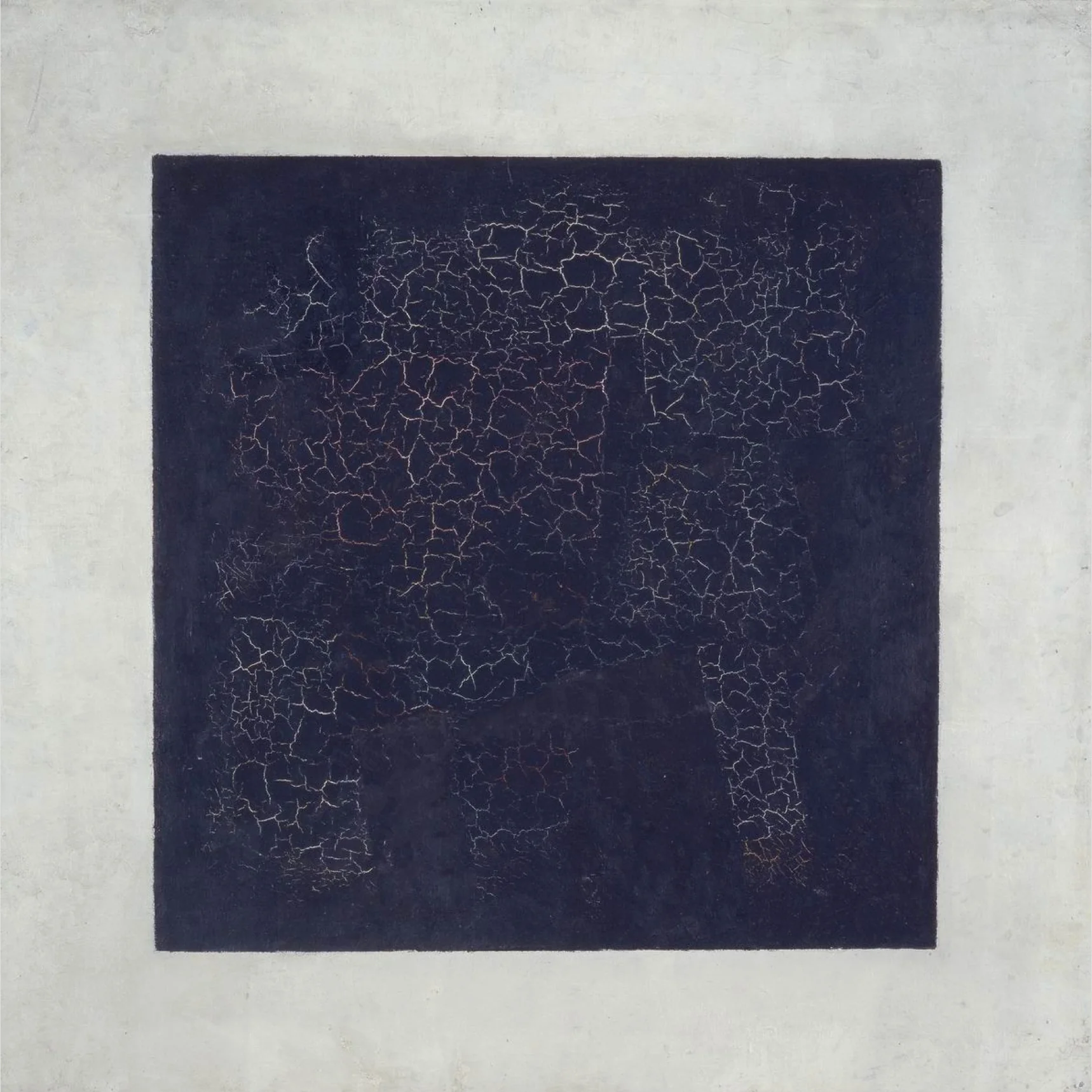
Suprematism asks what painting can still do once it abandons the duty to describe objects. In Malevich's hands, geometry is not a decorative simplification but a wager: can interval, tilt, field, and weight carry the emotional and intellectual force that representation once carried?
That wager matters because Suprematism is small in corpus yet huge in consequence. It turns abstraction into declaration and forces viewers to take minimal relations seriously.
What defines it
- Non-objective composition built from geometric relations rather than depicted objects.
- Extreme economy of means used to intensify interval, tilt, and field pressure.
- A shift from narrative depiction to disciplined perceptual tension.
Why it emerged
Suprematism emerged when the Russian avant-garde pushed abstraction past experiment and into program. Under the pressure of war, theory, and revolutionary expectation, Kazimir Malevich argued that painting could break with the object and rebuild itself from pure spatial relations.
That context matters. Suprematism is not an isolated studio style; it belongs to a moment in which artistic language, political upheaval, and institutional redesign were all in motion at once.
Suprematism as a rupture strategy
The movement is often reduced to Black Square, but its real claim is broader: pure form can carry the full intellectual and emotional load of painting. This is why Suprematism should be read not as a neat geometry lesson, but as a rupture strategy.
Once representation is suspended, orientation, interval, and pressure become the primary material. The picture no longer describes the world; it stages a new kind of attention.
Reading Suprematism beyond the cliché
The cliché says "simple shapes." Close reading says the opposite. In White on White and Black Square, tiny changes in tilt, edge, contrast, and field pressure reorganize the whole experience of the canvas.
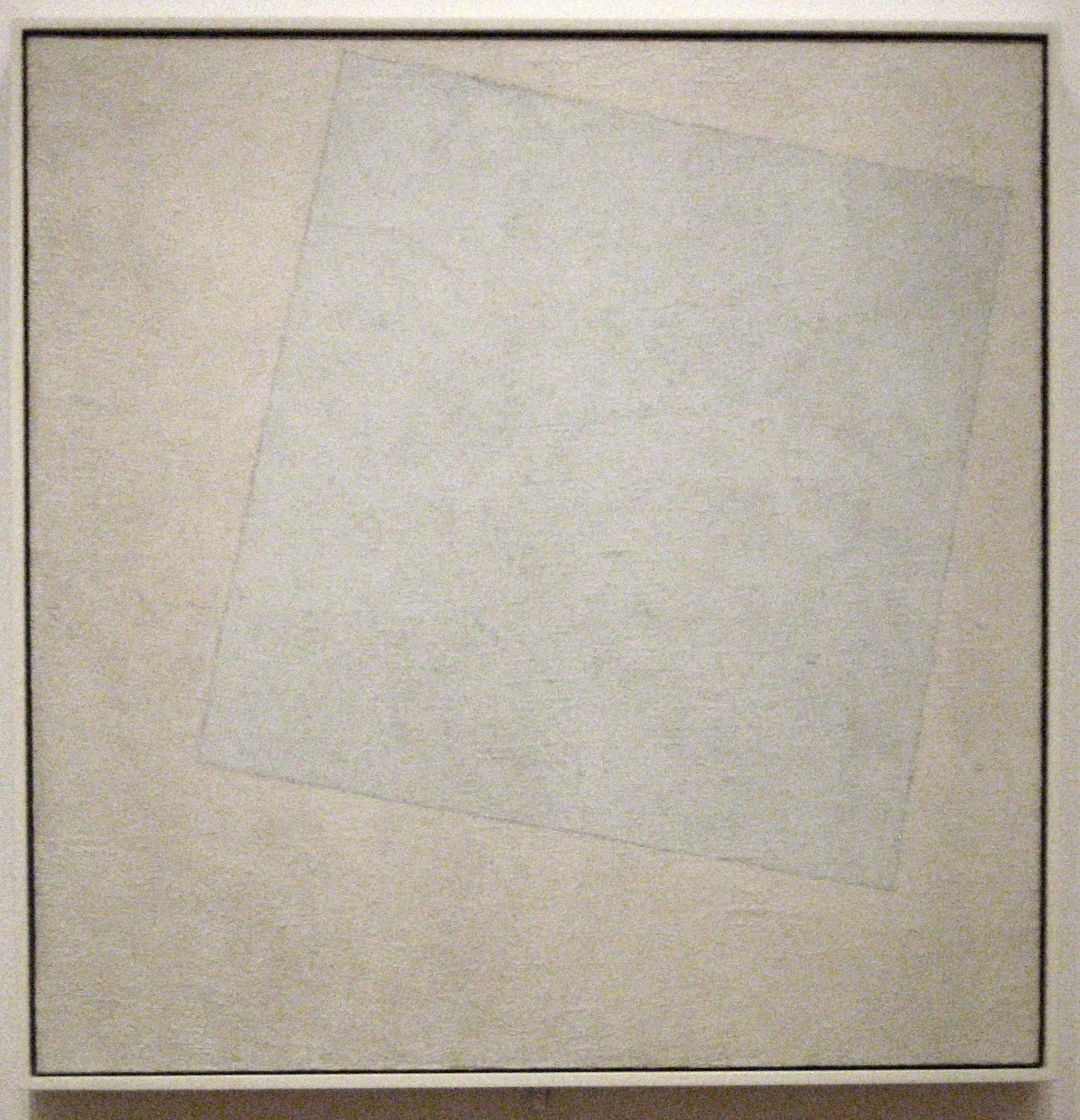
A practical method is to test directional vectors first, then ask what the ground is doing: neutral, luminous, resistant, or unstable. In Suprematism, the background is never mere emptiness; it is part of the structure.
Beyond the myth of pure geometry
Malevich wrote about "pure feeling," but the movement's force also depends on historical rupture. These paintings reject the old contract between image and object at a moment of war, revolution, and institutional redesign. Geometry here is charged, not neutral.
Read Black Square with White on White: the interval between them shows Suprematism moving from frontal declaration to finer tonal ambiguity.
Afterlives and limitations
Suprematism influenced design pedagogy, exhibition architecture, and later minimal vocabularies, but it was never a full substitute for other abstract paths. Compare it with Kandinsky or Mondrian: each reduces form differently and expects a different kind of attention.
That limitation is part of its usefulness. Suprematism clarifies one extreme case: how much can be built from very little?
It also explains why Suprematism still anchors serious surveys of modernism. The movement compresses a decisive question into very few means: what remains of painting when depiction is removed but intensity must survive? That pressure keeps these works historically sharp and pedagogically useful. It is a short movement with an unusually long intellectual afterlife.
How to read a movement without flattening it
Use this page as a calibration tool. If a canvas seems empty, ask whether relational tension has truly disappeared or whether it has become harder to detect. Then test that answer on the linked works.
Move from movement to artist to artwork and back. The point is to see reduction as a disciplined strategy, not as an absence of content. Use the art quiz as a quick check: can you still distinguish Suprematist reduction from other abstract systems once the vocabulary becomes minimal?