
Abstract Art
Composition VII by Wassily Kandinsky
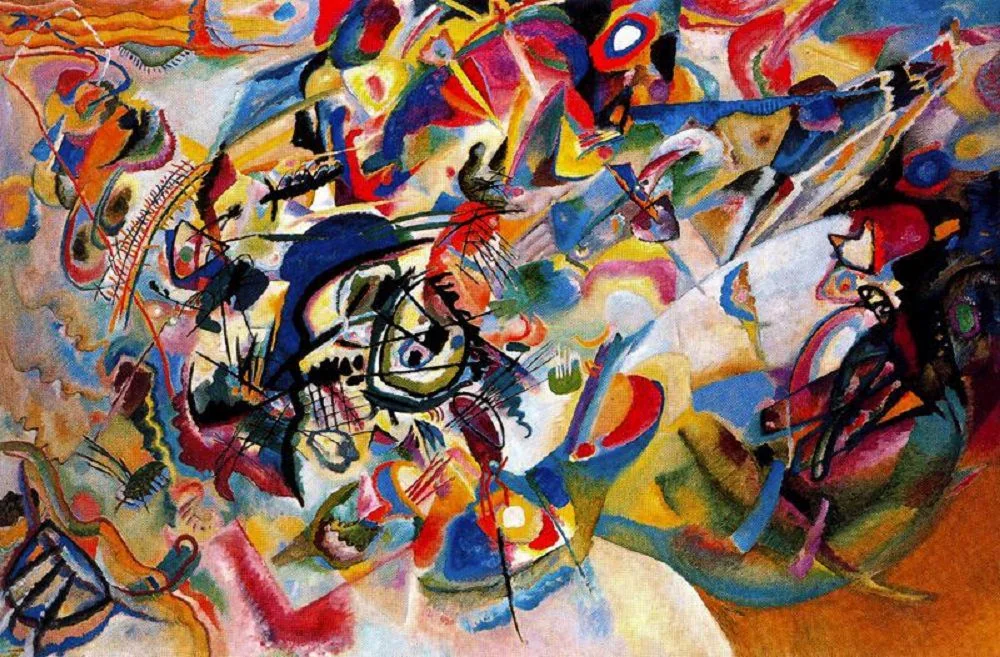
Composition VII by Wassily Kandinsky is often described as chaotic. This landmark 1913 abstract painting only feels disorderly if you look for objects first. Kandinsky asks for a different sequence: rhythm first, relation second, meaning third. In practice, that sequence turns apparent disorder into a precise argument about modern vision.
What the painting is doing, not showing
There is no stable narrative scene here. Instead, Kandinsky builds a field of directional forces: arcs, diagonals, vortices, and interruptions. Color zones expand and collide like musical phrases entering and exiting a score. The painting behaves less like a window onto the world and more like a system that generates events as you scan it.
That shift is decisive for abstraction. Representation asks "what is depicted?" Kandinsky asks "what relations are activated?" Once you switch to that question, the image stops feeling random and starts reading as highly controlled complexity.
Why 1913 is a critical moment
In 1913, European painting was already experimental, but most avant-garde works still retained recognizable anchors. Kandinsky pushes further by claiming that color and line can carry emotional and spiritual force without literal objects. This argument emerges from Symbolism, Theosophical currents, and close thinking about music as a non-representational art.
He had tested these ideas in earlier Improvisations and Compositions, but Composition VII is the most concentrated synthesis: maximal density, minimal descriptive certainty, and a clear belief that abstraction can be legible if viewers adopt a new viewing protocol.
Structure beneath apparent turbulence
The canvas looks explosive, yet recurring scaffolds hold it together: dominant diagonals, circular counters, and chromatic zones that organize movement across the surface. Warm bursts often serve as accelerators; cooler passages slow and redistribute attention. Kandinsky uses these contrasts to choreograph eye movement in waves.
This is why the painting rewards repeated passes. A single glance captures intensity; multiple passes reveal architecture.
Spiritual ambition without illustration
Kandinsky wanted painting to address inner life directly, not through anecdote but through formal correspondences. In his theoretical writing, he compares chromatic effects to tonal resonance in music. Composition VII should be read within that ambition: a work trying to produce spiritual and emotional states through pure relation.
Importantly, "spiritual" here does not mean vague mysticism. It means disciplined sensitivity to how form affects perception, mood, and attention. The painting is intense because it is methodical.
How it sits within abstraction’s plural history
Kandinsky remains central, but he is not a solitary origin story. Compare this canvas with Hilma af Klint's The Ten Largest, No. 7 and Malevich's Black Square. Each proposes abstraction differently: Kandinsky through layered dynamism, af Klint through symbolic diagramming, Malevich through radical reduction.
That comparison clarifies what is specific here: abstraction as polyphonic overload, not minimal purification.
From Kandinsky to modern visual systems
The painting's afterlife is practical as much as historical. Contemporary visual culture is saturated with non-figurative systems - interfaces, data maps, signal dashboards, animated states - where color, direction, and proximity carry information before language does. Kandinsky anticipated that literacy at high artistic intensity, which is why Composition VII still functions as a reference point for complex visual cognition.
Its specific lesson is not "abstraction equals freedom," but that dense images can remain legible when rhythm is organized. Flow vectors, chromatic pacing, and crossing nodes create order without narrative objects. This is exactly what links the canvas to later design and media grammars.
In Composition VII, abstraction means organized intensity, not visual noise.
Explore more
For method-focused context, continue with How to Understand a Painting and Why Art Goes Viral.
Related works
Use the art quiz as a quick check: can you connect Composition VII to Wassily Kandinsky when the options are mixed?