
Abstract Art
White on White by Kazimir Malevich
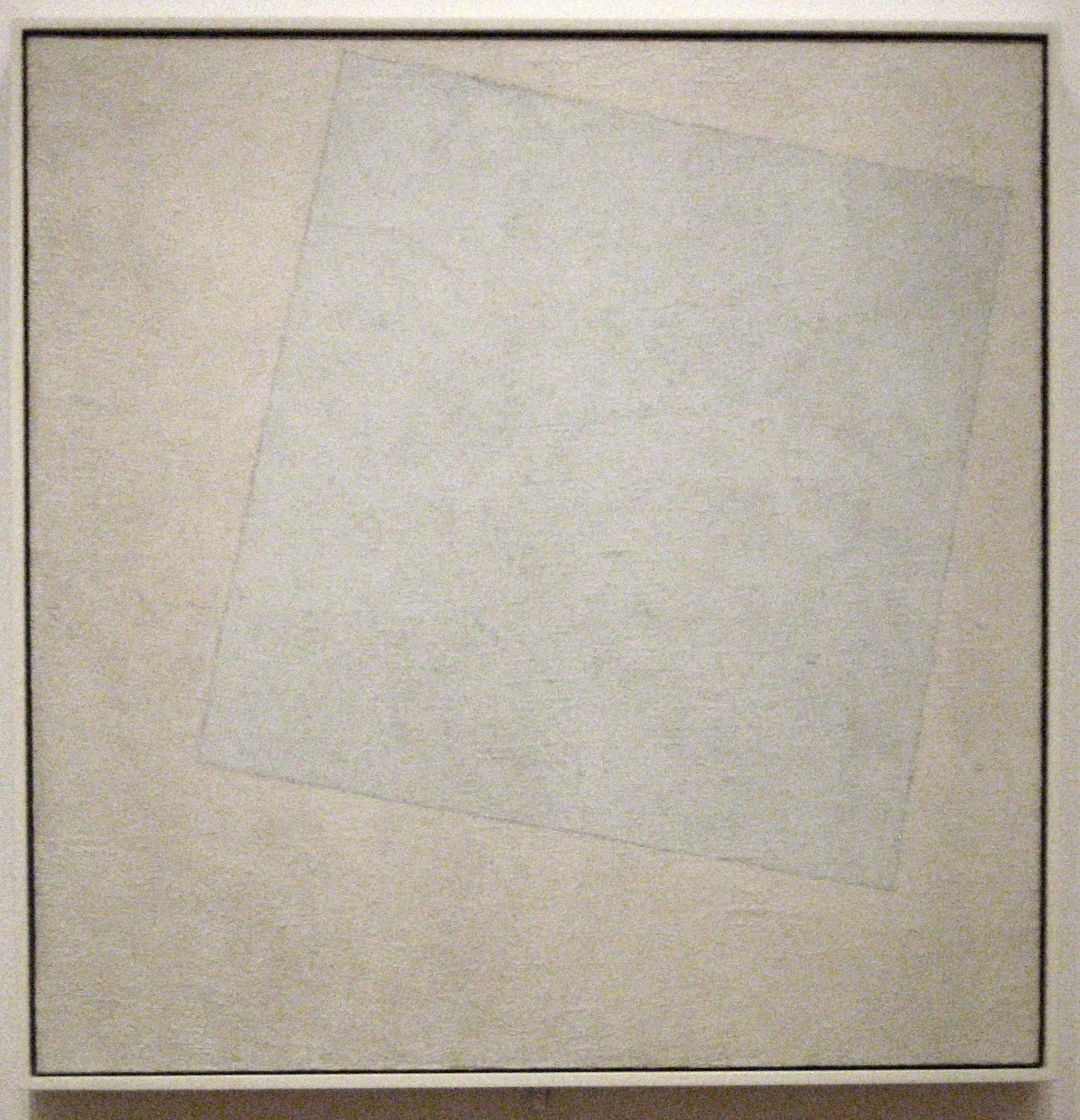
White on White by Kazimir Malevich looks almost blank at first, but that is the point. This 1918 Suprematist painting makes tiny shifts in angle, tone, and spacing carry the full weight of the image, turning near-erasure into a precise experiment in perception.
From manifesto to near-erasure
If Black Square is Malevich's declaration, White on White is his stress test. Painted in 1918, during revolutionary upheaval, it keeps the square format but removes almost all contrast. The question is no longer "can painting reject representation?" but "what remains when difference is reduced to the minimum?"
What the canvas shows when you look closely
The tilted square is not mathematically neutral: edges soften and sharpen unevenly, brush directions stay visible, and white tones shift in temperature. From afar the form nearly disappears; from near range it reasserts itself as a slightly unstable body in space. Those micro-variations are the work's real subject.
Malevich's intention: perception as content
Within Suprematism, Malevich wanted non-objective form to carry intensity without narrative motifs. White on White pushes that ambition to the edge: attention, orientation, and interval replace depiction. The painting asks viewers to work with distance, tempo, and tonal sensitivity, making perception itself the site of meaning.
Competing interpretations and useful comparisons
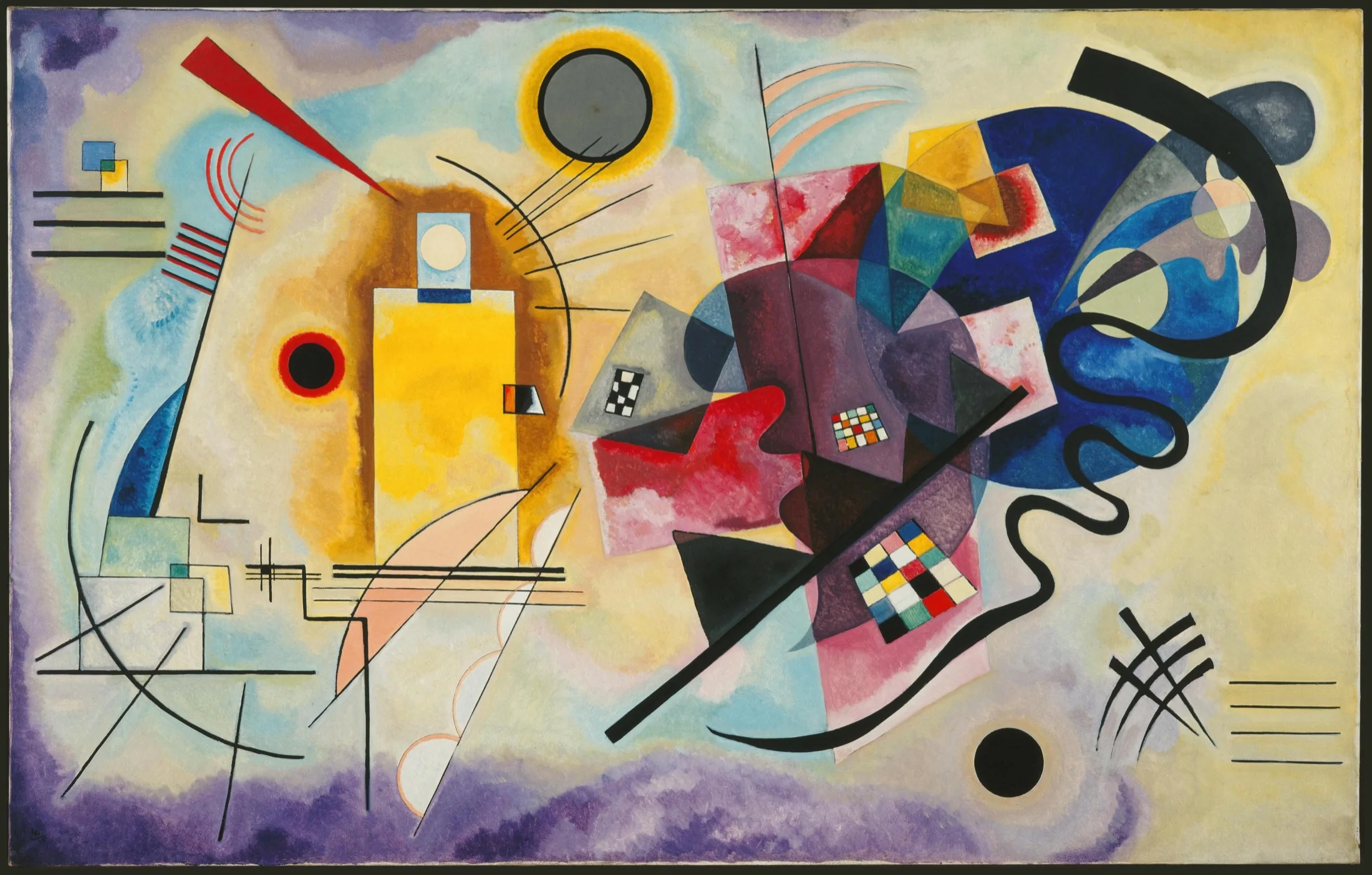
Art historians read the work as utopian purification, spiritual withdrawal, or radical austerity; all three remain plausible because the painting resists a single doctrinal message. Compared with Mondrian and Kandinsky, Malevich chooses subtraction rather than orchestration. Read beside Yellow-Red-Blue, the contrast is direct: Kandinsky builds intensity through chromatic complexity, Malevich through near-disappearance.
What changes when you see the painting in person
Reproductions usually flatten the picture into a near-blank square. In front of the original, you notice that the background white and the tilted white form are materially distinct layers. Brush drag, edge vibration, and slight tonal drift give the surface a quiet but persistent movement. The painting is not an empty panel; it is an arrangement of near-equivalences held in tension.
Lighting conditions also matter more than in many figurative works. Under different museum light, the square appears to advance or sink, and the angle can feel more or less stable. That perceptual instability is central to the work's argument. Malevich is effectively demonstrating that minimal means can produce maximal interpretive activity when the viewer is forced to calibrate slowly.
From Suprematism to later minimalist traditions
The painting's influence is often summarized too quickly as "a precursor to minimalism." More precisely, it established a model in which relation, interval, and framing become the primary content of a work. Later twentieth-century artists developed that lesson in different ways, but Malevich's formulation is distinctive because it remains tied to a metaphysical and historical horizon rather than pure formal neutrality.
That is why the work is best read with context pages, not in isolation. The Suprematism overview explains the movement's ideological stakes, while the broader Abstract Art page places Malevich alongside alternative trajectories. Seen in that network, White on White is neither an endpoint nor an empty gesture. It is a precise claim about how painting can continue after representation by making attention itself the medium.
This makes the work unusually resilient over time. Even viewers who reject Malevich's theoretical vocabulary can still test the painting empirically through distance, light, and duration, and discover that perception itself becomes the narrative.
In that sense, the painting remains less a relic of 1918 than a recurring experiment activated by each new viewer.
Here abstraction is not less meaning. It is meaning carried by orientation, interval, and attention.
Explore more
Related works
After this reading of White on White, open the art quiz to test if you can separate Kazimir Malevich's work from close visual look-alikes.