
Dutch Baroque / The Met
Aristotle with a Bust of Homer
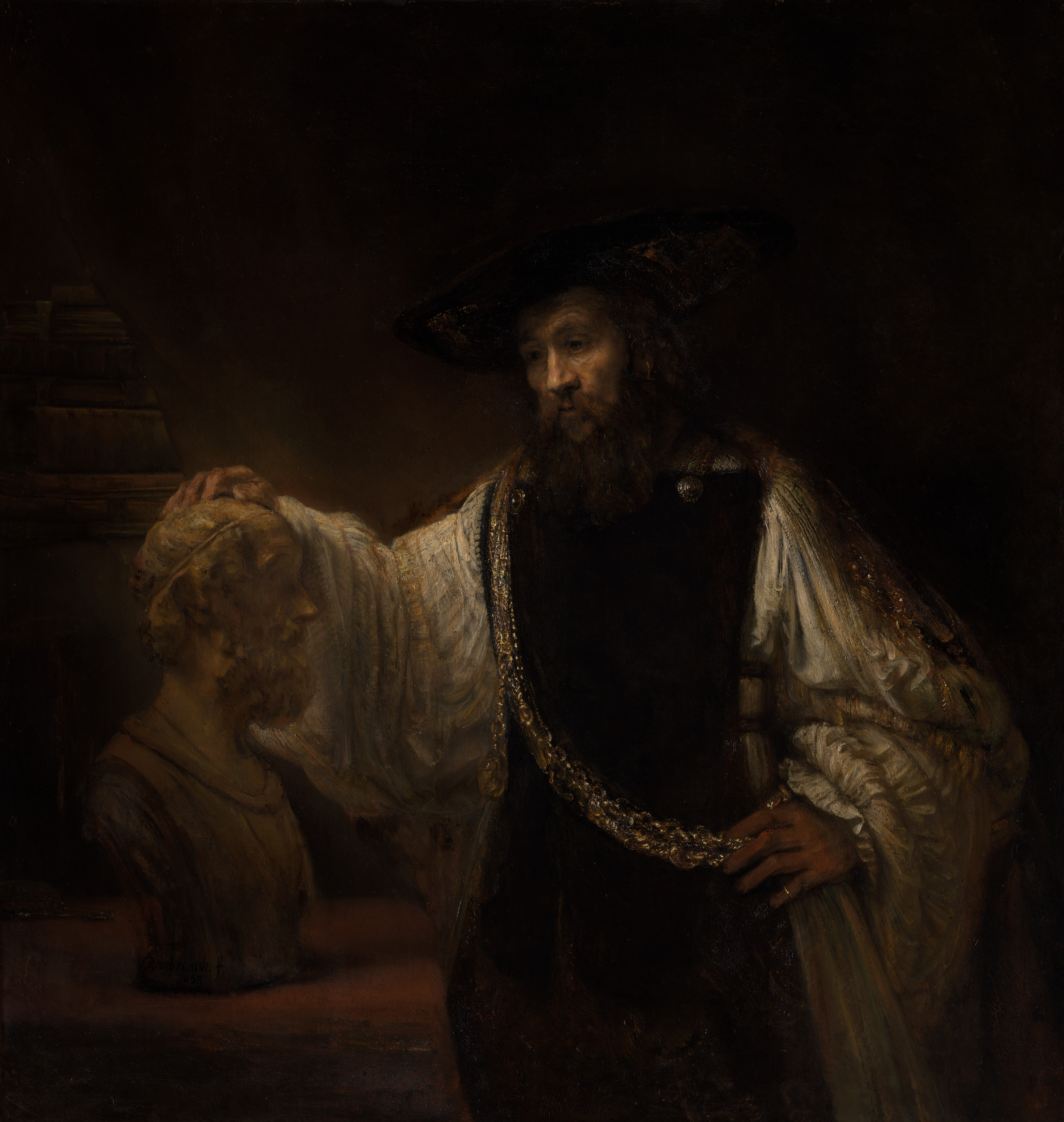
Aristotle's hand rests on Homer's marble head while a gold medallion of Alexander the Great hangs against his dark clothing. In Aristotle with a Bust of Homer, painted in 1653 and now at The Metropolitan Museum of Art, Rembrandt van Rijn turns three kinds of fame into one quiet encounter: poetic memory, political conquest, and philosophical judgment.
Three presences in one dark room
The painting is often described as a portrait of Aristotle, but Rembrandt makes it more unstable than a simple likeness. Aristotle stands alive, richly dressed, and inwardly absorbed. Homer is present only as a bust, blind and silent, yet his poetry has survived empires. Alexander appears as a small image on a medallion, close to Aristotle's chest, a reminder of worldly power and royal education.
Those three presences make the painting a meditation on value. Homer has no body but enduring fame. Alexander has political glory but appears reduced to jewelry. Aristotle has learning, touch, and consciousness, but also hesitation. Rembrandt does not tell us which form of greatness wins. He paints the moment of weighing.
Rembrandt's method turns touch into thought
Rembrandt's method is to make a philosophical problem visible through a hand, a medallion, a bust, and uneven light. He does not explain Aristotle's thought with inscription or narrative action. He builds a situation in which touch, memory, wealth, and shadow do the thinking.
The most important action is almost nothing: Aristotle touches the bust. The gesture is gentle, not possessive. His fingers do not grasp Homer's face; they rest on it, as if thought had become physical contact. Rembrandt makes the hand bright enough to read, but not so bright that it becomes theatrical. The meaning sits in restraint.
That restraint changes the emotional tone. A lesser painting might have staged Aristotle as a triumphant philosopher surrounded by attributes. Rembrandt gives him doubt, weight, and pause. The eyes do not address the viewer directly. The head turns slightly. The hand touches the past while the medallion pulls toward worldly success. The whole canvas becomes a conflict between inheritance and ambition.
Rembrandt's surface and the question of fashion
The Met notes that the painting was made for a Sicilian patron when Rembrandt's dark palette and thickly built paint were beginning to fall out of fashion in Amsterdam. That context sharpens the image. A painting about lasting fame is itself made by an artist negotiating reputation, market taste, and distance from current fashion.
Look at the surface and that tension becomes visible. The gold chain catches light, the sleeve absorbs it, the bust emerges from darkness, and Aristotle's face sits between material richness and mental withdrawal. Rembrandt's paint does not polish doubt away. It lets light accumulate unevenly, so intelligence feels less like clarity than pressure.
A quieter form of Baroque drama
Set the painting beside The Night Watch and the change in scale is striking. In the civic portrait, Rembrandt turns a militia company into public motion, with hands, weapons, costume, and light pushing outward. In Aristotle with a Bust of Homer, the drama is compressed into touch and thought. The light still directs attention, but the event happens inside a mind.
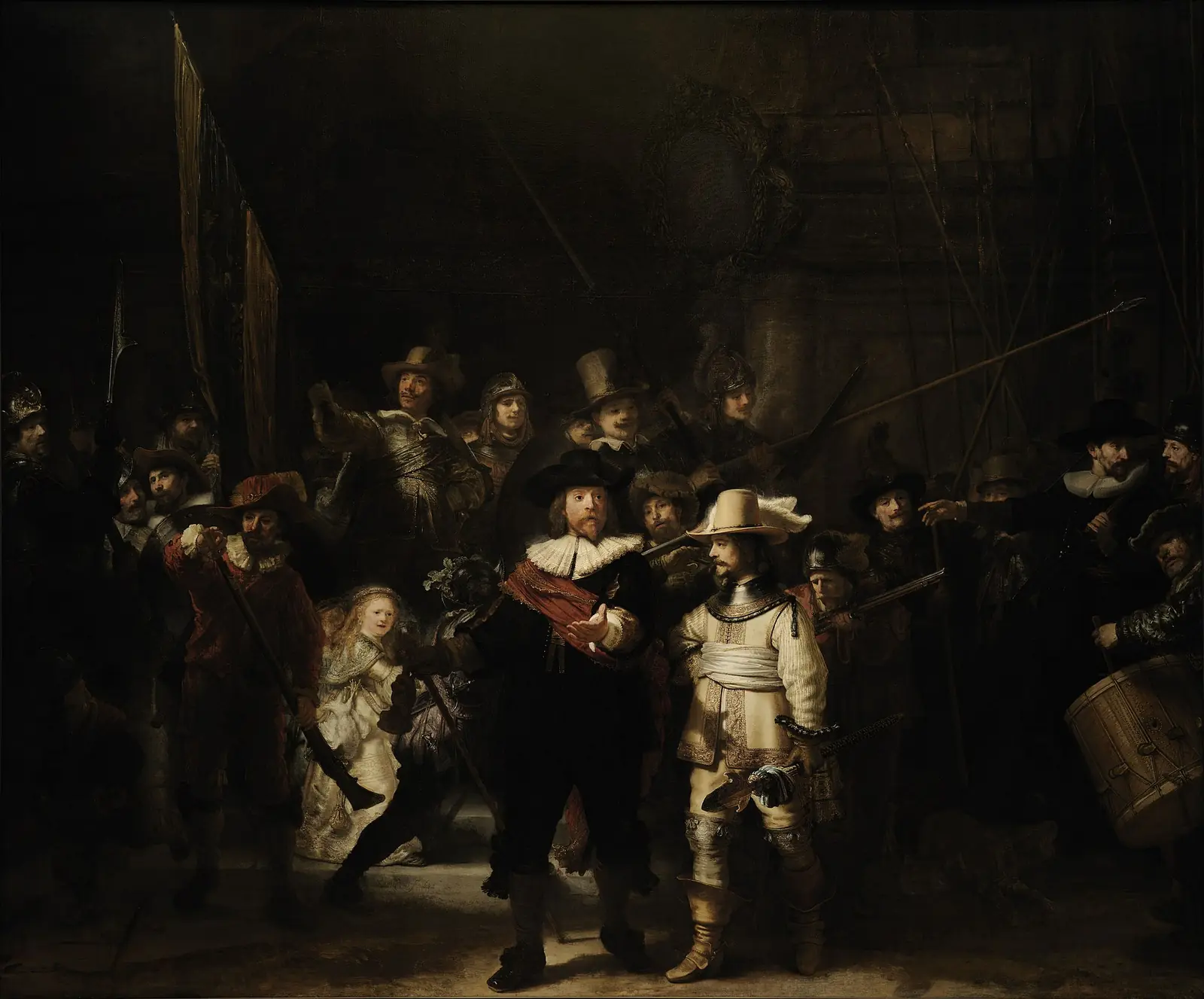
The comparison shows why Rembrandt belongs both to the Baroque and to the Dutch Golden Age. He can use light for public action, religious pressure, printmaking experiment, or psychological inwardness. This painting takes Baroque direction of attention and turns it into a philosophical pause.
A Met work visitors should slow down for
For a Met route, Aristotle with a Bust of Homer fills a gap that a list of large public icons cannot cover. It is not monumental because of scale alone. It is monumental because it gives a museum visitor time to think about what museums preserve: bodies, names, poems, power, touch, and the fragile hope that intellectual work might outlast political noise.
It also pairs well with The Death of Socrates. David turns philosophy into public moral theater; Rembrandt turns philosophy into private uncertainty. Together they make the Met a place where thought can appear as gesture, body, light, and consequence.
Then try the art quiz.
Explore more
Related works
Primary sources
Frequently asked questions
Aristotle with a Bust of Homer is a 1653 oil-on-canvas painting by Rembrandt van Rijn, now at The Metropolitan Museum of Art in New York. It shows Aristotle touching a bust of Homer while wearing a medallion of Alexander the Great.
The painting stages a meditation on fame. Homer represents poetic immortality, Alexander represents worldly power, and Aristotle stands between them, weighing intellectual life against political success.
The painting is in The Metropolitan Museum of Art, New York, where it belongs to the European Paintings collection.