
Post-Impressionism
The Bedroom in Arles
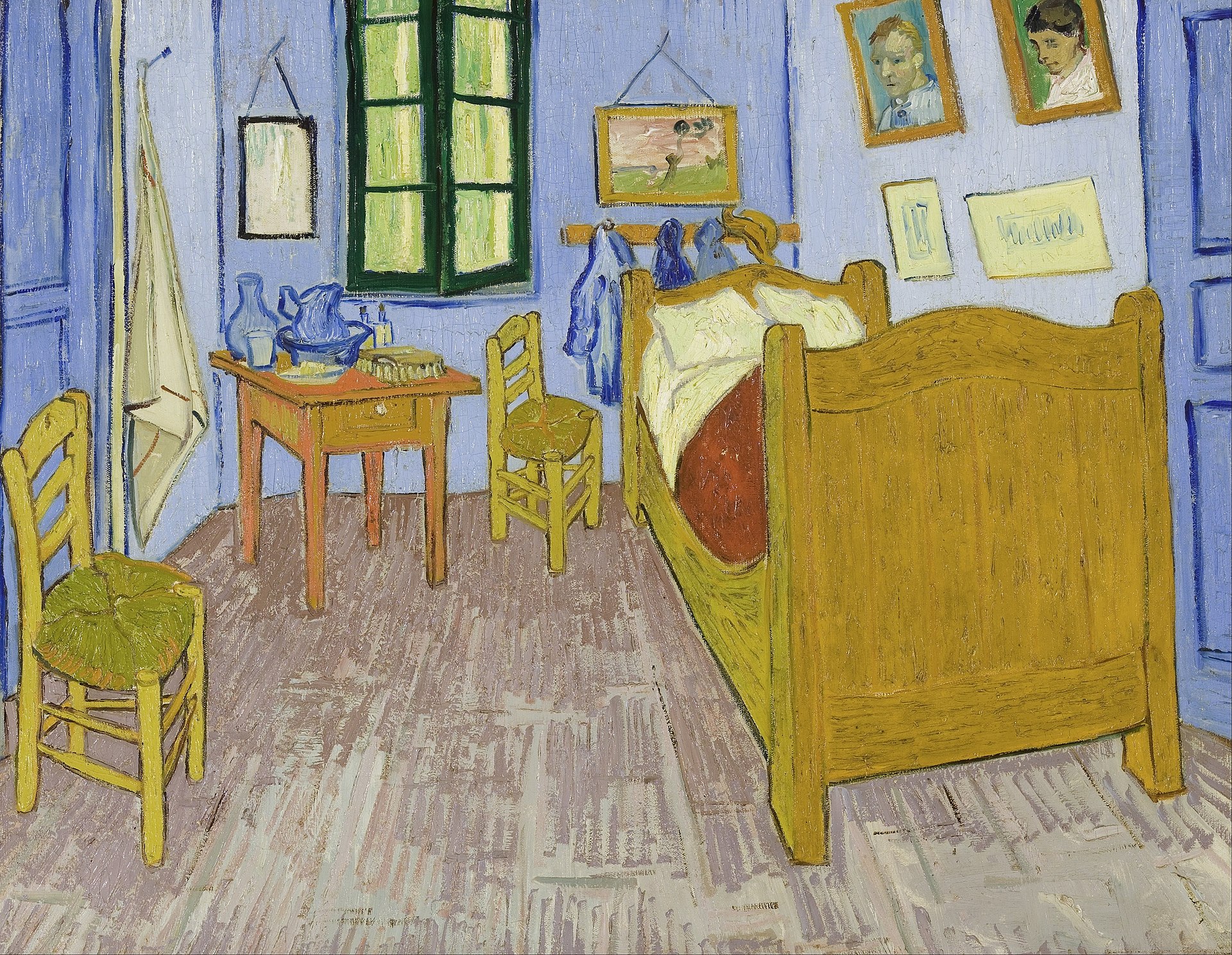
The bed tilts forward, the chairs sit at uneasy angles, and the room seems to lean toward us. Why does this interior feel soothing and unsettled at the same time? Vincent van Gogh does not seek calm through perfect perspective or muted color. He composes it with a bed, two chairs, a table, a window, a few portraits, and broad fields of blue, yellow, green, and red.
The Bedroom in Arles offers a concrete explanation of Van Gogh's Post-Impressionism. He does not paint the room as a neutral record. He rebuilds an ordinary interior so that its furniture and colors carry an emotional purpose. The space is welcoming, but a quiet imbalance keeps it visually awake.
A room in the Yellow House, repainted in 1889
Van Gogh first painted his bedroom in the Yellow House in Arles in October 1888. The house mattered because he hoped to turn it into a shared southern studio, soon joined by Paul Gauguin. The room was therefore more than a subject. It was part of a larger hope: an ordered place where work, friendship, and daily life might hold together.
The Musée d'Orsay canvas is not the first version. After water damage affected the original, Van Gogh painted another full-size version and then this smaller repetition for his mother and sister. He made the Orsay painting at Saint-Rémy in September 1889. Measuring 57.3 by 73.5 cm, it condenses the room into a family image: intimate, recognizable, and carefully remade from memory and prior work.
What the painting shows
The room is almost empty, but every object is legible. A sturdy bed occupies the right side. Two wooden chairs hold separate positions in the foreground and near the wall. A small table carries a pitcher and simple toiletries. Portraits hang beside the bed. A window closes the back wall, while doors open at the edges of the composition.
Van Gogh organizes the room through repetition and contrast. The bed frame, chairs, doors, and picture frames echo one another in thick outlines. The red blanket presses against yellow wood. Pale green walls meet a blue door and a blue-violet floor. Nothing is richly furnished, yet the painting never feels empty. Color gives each ordinary thing a distinct presence.
A perspective that refuses to sit still
The unusual perspective is not a mistake to be corrected. The walls narrow toward the back, but the floorboards, bed, chairs, and table do not submit to one calm vanishing point. The room feels both shallow and stretched. Objects tilt toward us as if each one insists on being seen separately.
Van Gogh's method is selective rather than academic. He simplifies outlines, suppresses cast shadows, enlarges color areas, and lets the room keep its awkward angles. His intention is direct: the interior should communicate stillness through relationships between colors. The room is quiet, but it is not inert.
Color carries the emotional structure
The room would lose much of its force if translated into neutral tones. Blue and yellow do more than identify walls, doors, and wood. They organize the mood. Red accents on the blanket and floor sharpen the quieter fields around them. Thick dark contours separate the objects, making the interior read almost like a sequence of signs.
In a letter to Theo, Van Gogh linked the bedroom explicitly to tranquillity and sleep: he wanted the relationships between colors to produce the sensation. This is where he moves beyond an Impressionist record of light. The painting is not about one fleeting atmospheric effect. Color becomes structure and feeling.
The colors visible today are probably not exactly those Van Gogh placed on the canvas. Research on the bedroom series shows that some pigments changed over time: the walls and doors, for example, were originally more purple than blue. The shift does not alter the essential point. Van Gogh wanted color to do the main work.
Japanese prints and the power of simplification
Van Gogh collected Japanese prints and studied the way they used clear contour, flattened space, strong color areas, and unexpected viewpoints. The Bedroom in Arles is not an imitation of a single print, but it shares that visual confidence. The floor rises, depth compresses, and objects become more readable because they are less fully modeled.
Read the room alongside ukiyo-e and the simplification stops looking naive. Van Gogh is testing how much a painting can remove while remaining vivid. He gives up conventional spatial polish in exchange for a more direct visual rhythm.
Where to look first
- Begin with the bed. Its strong diagonal pulls the room toward the foreground.
- Let your eye move to the two chairs. They echo one another, but their angles do not fully agree.
- Pause at the back wall: the window, portraits, and door keep the space legible despite the tilted geometry.
- Follow the color from yellow wood to blue doors, pale walls, and the red blanket. It sets the emotional rhythm.
- Finally, step back. The room feels simple and personal, held between repose and a gentle visual tension.
From Sunflowers to The Starry Night
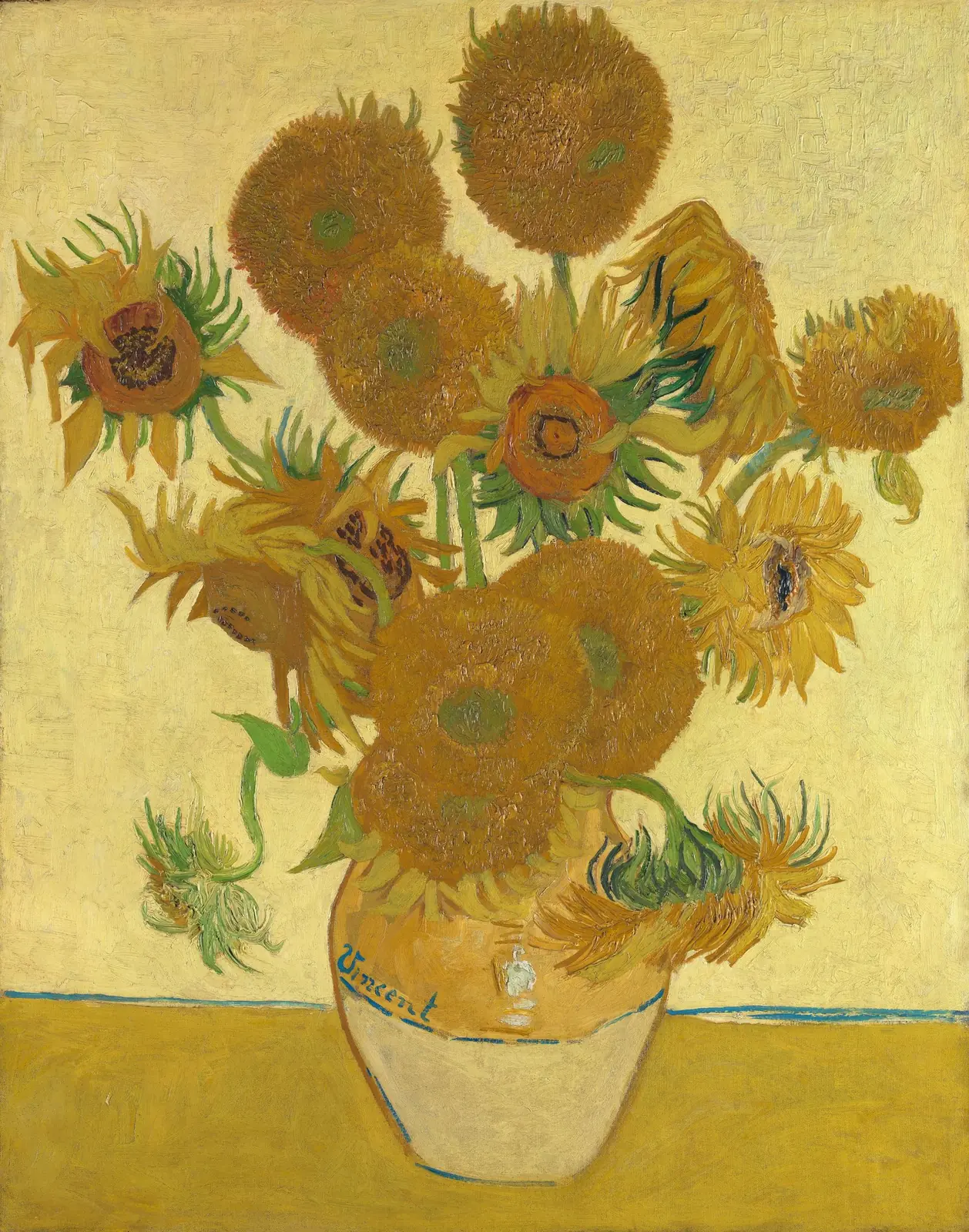
Sunflowers offers a useful comparison. It was also connected to the Yellow House and Van Gogh's hope of welcoming Gauguin. In the still life, a limited range of yellows turns flowers, vase, and background into a concentrated chromatic experiment. In the bedroom, the experiment expands into lived space: color does not decorate the room; it holds the room together.
The Starry Night, painted at Saint-Rémy in 1889, pushes movement much further. It should not be confused with Starry Night Over the Rhône, painted at Arles in 1888. The Saint-Rémy sky rotates and surges; the bedroom holds its energy in reserve. Both paintings show the same deeper method: Van Gogh alters visible reality so that line, color, and rhythm can carry an inner state without dissolving the subject.
Why the room still holds attention
The Bedroom in Arles remains powerful because it makes a modest room carry more than description. The furniture is plain. The composition is easy to recognize. Yet the space never becomes merely cozy. The bed advances, the chairs separate, the floor rises, and the colors keep the quiet scene alert.
That gentle tension is the painting's strength. Van Gogh does not paint passivity. He makes a room where calm must be assembled object by object and color by color. The ordinary interior becomes a self-portrait without a figure: not an image of the artist's face, but an image of how he wanted a place to feel.
Van Gogh does not simply record a bedroom. He uses color and tilted space to build the feeling of a refuge.
Continue from Van Gogh
Primary sources
Frequently asked questions
The painting shows Vincent van Gogh's room in the Yellow House in Arles: a wooden bed, two chairs, a small table, portraits, a window, and a few everyday objects arranged in a simplified interior.
Van Gogh does not try to correct every angle into a stable academic perspective. The tilted walls, bed, chairs, and floor make the room feel personal and constructed, while color carries the idea of rest.
The version discussed here belongs to the Musée d'Orsay in Paris. Van Gogh painted three versions of the bedroom; the Orsay canvas is the smaller 1889 repetition made for his family.