
Movement Guide
Ukiyo-e
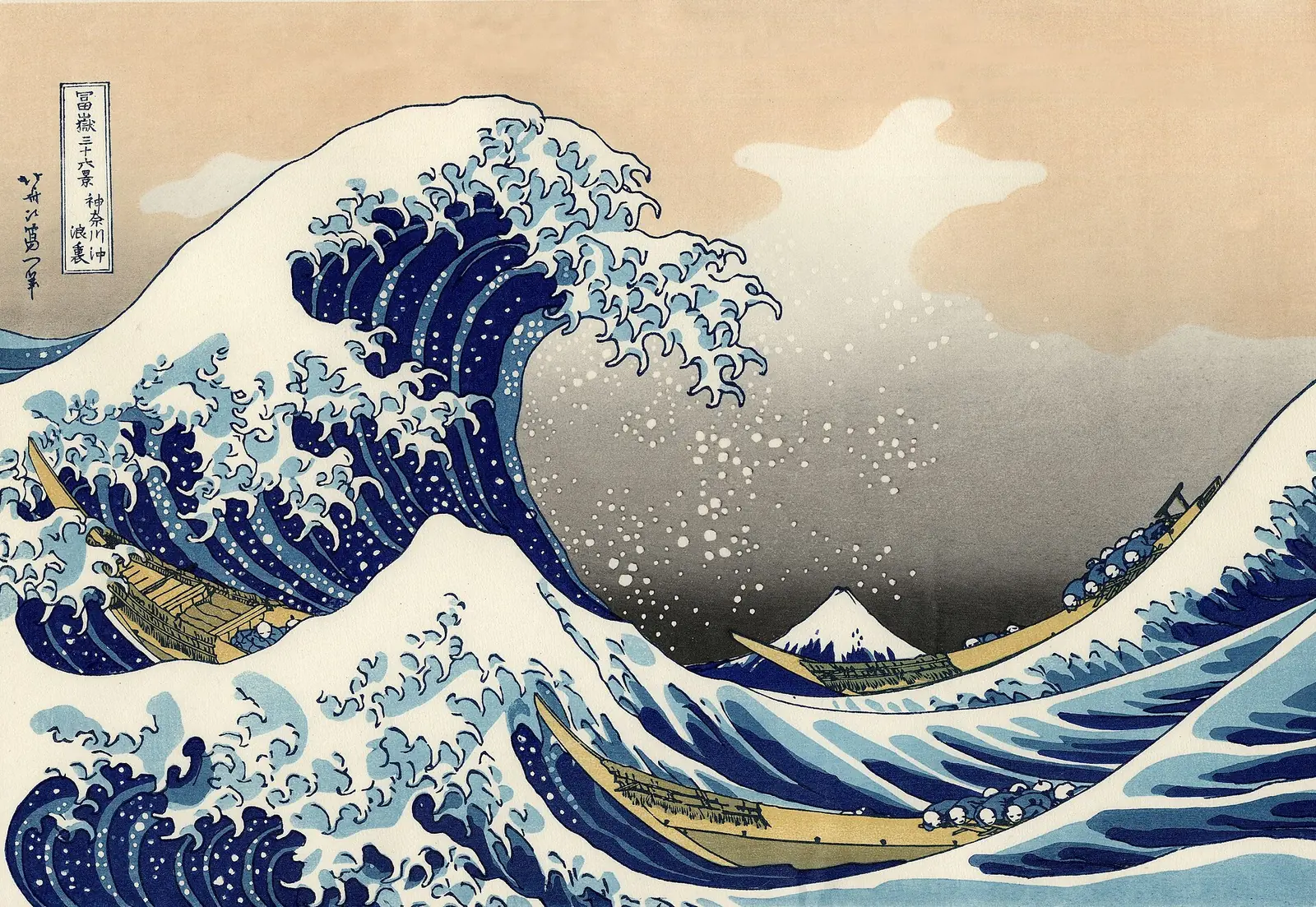
An ukiyo-e print is not drawn directly onto the sheet you buy. A publisher commissions it, an artist designs it, a carver cuts it into wood, and a printer builds the image color by color. That collaborative chain explains the contour, the flat color, and the repeatable quality of the finished print.
Ukiyo-e is usually translated as "pictures of the floating world." The term belongs to the urban culture of Edo, the shogunal city that later became Tokyo: theaters, pleasure districts, seasonal fashions, travel routes, famous places, and the pleasures of looking. It can also include paintings, but most readers use it to mean the color woodblock prints published for an urban audience in Edo Japan.
How an ukiyo-e print is actually made
The process is collaborative from the start. The publisher decides that a subject will sell. The artist produces the design. The carver turns that design into blocks. The printer pulls the impressions. A famous sheet by Hokusai or Hiroshige is therefore the result of coordinated labor, not a single hand working alone on a single object.
- Publisher: finances the project, commissions the design, and manages distribution.
- Artist: draws the composition in brush lines on thin paper.
- Carver: pastes that drawing face down onto wood and cuts the key block that fixes the contour.
- Printer: inks multiple blocks, aligns the sheet, and pulls the image with water-based pigments on damp paper.
The sequence is concrete. The original drawing is pasted onto a cherrywood block and cut into the first block, so the drawing is destroyed in the process. Proofs from that block guide the carving of additional blocks for each color. The printer places damp washi paper against kento registration marks and rubs the back with a baren so the pigments transfer cleanly. Gradations such as bokashi are printed by hand, not added later as effects.
Crisp contour begins in the key block. Flat color is built block by block. Differences between impressions are normal, because pigments, block wear, re-carving, and later printings can all change the sheet.
The Edo world behind the prints
Ukiyo-e belongs to the Edo period, roughly 1603 to 1868, when the Tokugawa shogunate ruled from Edo, the city now called Tokyo. Cities expanded, literacy was relatively high, and merchant audiences supported a large market for affordable images. These were not unique court objects made for one palace wall. They were edited, sold, collected, and reprinted in a commercial publishing world.
The earliest famous subjects are actors, courtesans, and erotic prints tied to the "floating world" of entertainment districts. By the late eighteenth and nineteenth centuries, the field widens: beautiful women, warriors, ghosts, city views, birds-and-flowers, famous places, and travel routes. Full-color nishiki-e, often called "brocade prints," made that market visually richer and commercially stronger.
What woodblock printing does to the image
Woodblock printing does not mechanically produce a style, but it rewards certain decisions. Strong outline survives carving and repeated printing. Clear color zones read fast. Cropping and asymmetry keep a sheet alive even when it has to work instantly in a crowded visual market.
Figures are clipped by the edge, diagonals cut across the page, weather becomes structure, and empty space carries weight instead of waiting to be filled. These choices still make ukiyo-e look strikingly modern. These are not decorative habits. They are formal solutions built for legibility, pace, and repetition.
Series are the real unit of meaning
Ukiyo-e is easy to flatten into a handful of isolated masterpieces, especially because The Great Wave off Kanagawa became one of the most famous prints in the world. But the medium thinks in series. Publishers sell sets, artists vary a motif across multiple sheets, and viewers learn to read repetition as a way of testing weather, labor, season, or viewpoint.
Hokusai makes that logic obvious across the Fuji prints. Read The Great Wave with Red Fuji, Kajikazawa in Kai Province, The Fuji from Kanaya on the Tokaido, and Mishima Pass in Kai Province. The mountain remains, while scale, weather, work, and distance keep changing. For a longer explanation of that group of prints, continue with How Mount Fuji Became a Global Icon in Art.
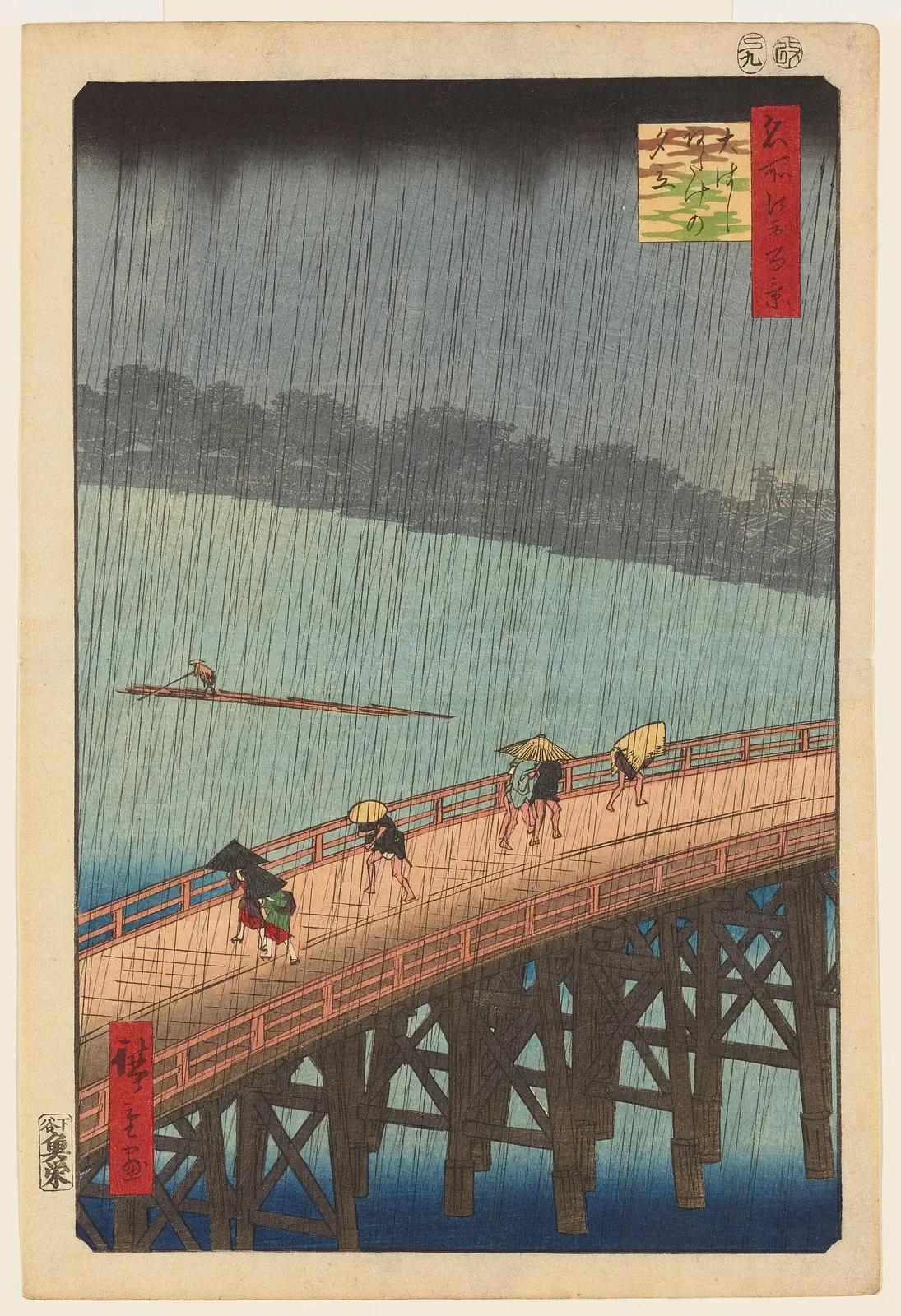
Hiroshige pushes the same serial logic toward route, weather, and passing time. In Sudden Shower over Shin-Ōhashi Bridge and Atake, rain is not just a subject. It becomes the visual rhythm of the page.
Beyond Hokusai: actors, courtesans, travel, weather
The global canon overweights landscapes, partly because they fed nineteenth-century Japonisme so effectively. Edo viewers, however, also bought prints of kabuki actors, courtesans, erotica, wrestlers, warriors, urban fashions, and newsworthy events. Ukiyo-e moves easily between celebrity culture, urban pleasure, travel, and landscape without changing medium.
The movement is therefore better understood as a publishing system than as a narrow school style. What stays constant is not one subject. It is one way of producing and circulating images for a large public.
From Edo print culture to Japonisme
When Japanese prints entered European collections in the nineteenth century, artists did not only admire unfamiliar motifs. They studied a different way of building pictures: strong contour, tilted viewpoints, cropped figures, pattern against flat color, and serial variation. That is part of the story behind Japonisme, and it helps explain why ukiyo-e mattered so much to painters such as Degas, Monet, and Van Gogh.
The influence story is strongest when it begins in Edo instead of treating Japan as a brief prelude to Europe. These prints were not abstract style samples waiting for Europe. They came out of publishers, workshops, theaters, travel culture, weather, tourism, and urban consumption in Japan.
That afterlife does not stop with nineteenth-century painting. Modern manga and anime do not descend from ukiyo-e in one neat line, but many still reuse some of its strongest devices: hard contour, bold cropping, weather as structure, dramatic silhouettes, and the visual habit of making one image feel instantly legible.
Read the movement across four paths on Explainary: Hokusai, Hiroshige, the Fuji print series, and the blog essay on Japonisme. Together they show how a commercial print culture in Edo became a global visual language.
Key artists
Key works in Explainary
The art quiz becomes more interesting once you stop identifying ukiyo-e by one famous wave and start recognizing how contour, color blocks, empty space, and serial variation work together.
Primary sources
Frequently asked questions
Ukiyo-e is usually translated as "pictures of the floating world." In practice, the term most often refers to Edo-period Japanese woodblock prints showing actors, courtesans, travel, landscapes, fashions, and urban pleasures.
A publisher commissioned the design, an artist drew it, a carver cut the image into woodblocks, and a printer pulled the sheet color by color onto damp paper. One block fixed the contour, while the other blocks carried the colors.
Ukiyo-e prints were published in editions, so the same design could be printed many times. Colors, block wear, re-cutting, and later printings can make one impression differ from another.
Ukiyo-e proved that widely circulated prints could remain formally inventive and visually precise. Its contour, cropping, flat color, and serial logic also shaped Japonisme and modern art far beyond Japan.
Not in one simple straight line, because modern manga and anime have multiple roots. But ukiyo-e and Hokusai's picture books remain part of their visual ancestry, especially in strong contour, bold framing, expressive weather, and the power of instantly readable silhouettes.