
Mannerism
The Burial of the Count of Orgaz
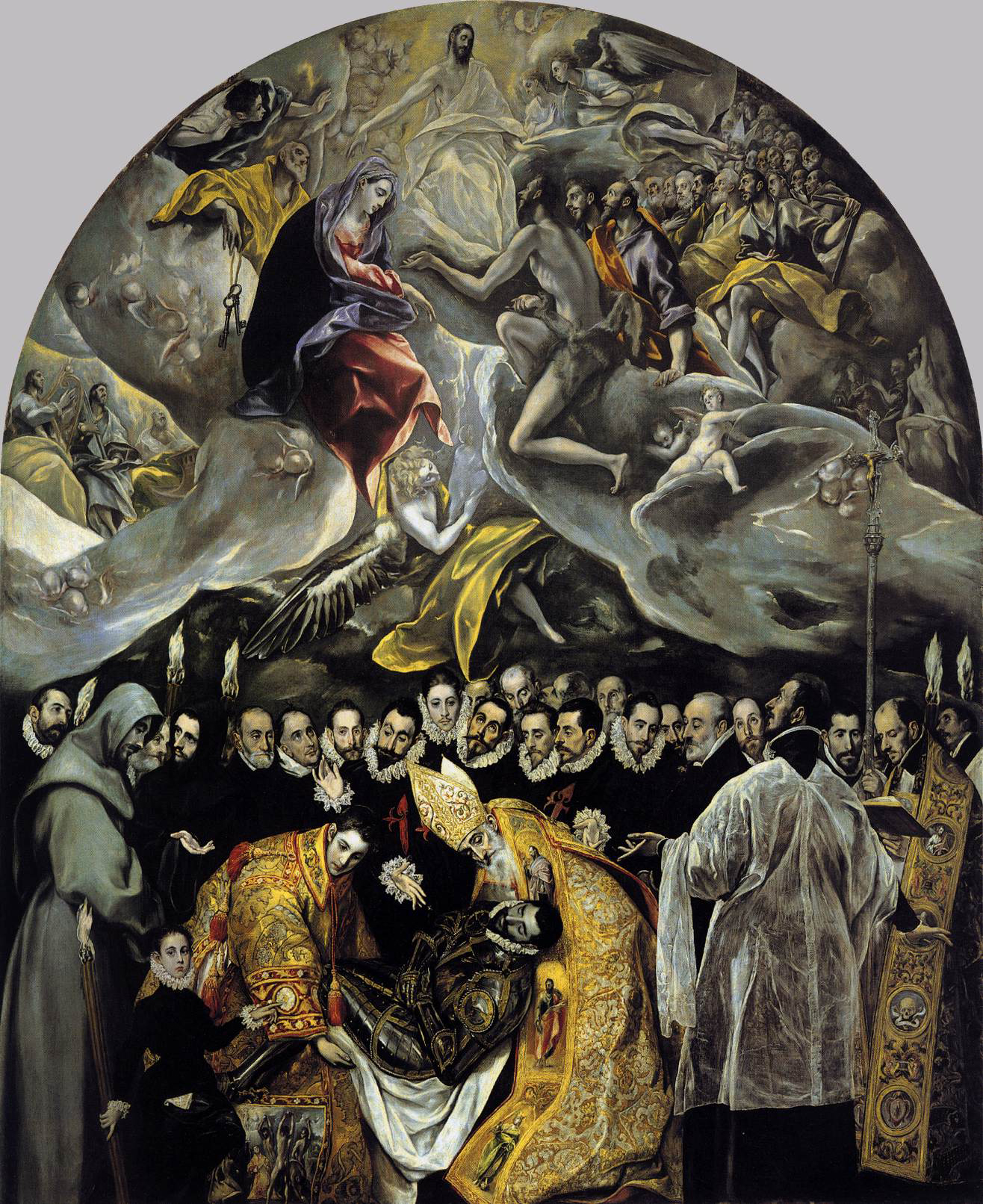
El Greco does not paint death as a sealed earthly event. In The Burial of the Count of Orgaz, a local funeral in Toledo opens upward, so that a nobleman's burial, the gathered faces of the city, and the machinery of salvation all occupy one vertical field at once. That structure is the whole point. The painting is not simply about a miracle. It is about how a parish, a city, and a doctrine of the afterlife can be held inside one image. That is why it stands so centrally in Mannerism: order is still present, but it has become tense, elongated, and spiritually charged.
A parish commission built on a local legend
The subject comes from a medieval Toledo story. Don Gonzalo Ruiz de Toledo, later remembered as the Count of Orgaz, had supported the Church of Santo Tome. According to tradition, when he died in 1323, Saint Stephen and Saint Augustine descended from heaven and laid his body in the grave themselves. El Greco paints that legend more than two centuries later, in the 1580s, after the parish priest Andres Nunez had successfully reasserted the payments owed to the church from the Orgaz foundation. So this is not a generic religious scene. It is a local image of memory, prestige, and institutional claim.
That context matters because it explains why the painting feels both mystical and documentary. The miracle belongs to sacred history, but the commission belongs to a very specific parish and a very specific city. El Greco has to satisfy both levels at once. He has to paint a legend the faithful can believe in and a public image the community can recognize as its own.
The lower half is a civic portrait before it is a heavenly vision
The lower register is astonishingly controlled. Saint Stephen and Saint Augustine lower the armored body into the grave, but around them stands a dense group of contemporary Toledo gentlemen, dressed in black, their faces individualized and sober. The miracle is happening, yet the witnesses do not dissolve into theatrical panic. They watch with the composure of men attending a funeral and participating in a public act of memory.
That choice gives the painting much of its force. El Greco does not isolate miracle from social life. He places the supernatural event inside a gathering that looks like a corporate portrait of Toledo's elite. Even the little boy at left, pointing toward the scene, is not an anonymous child: he is generally identified as El Greco's son, Jorge Manuel. The painting becomes at once miracle image, memorial portrait, and claim about the city's religious seriousness.
Above them, El Greco changes the rules
The upper half does not obey the same visual logic. Below, bodies feel weighty, fabrics dense, armor hard. Above, the forms lengthen and thin out. Angels, saints, and clouds are not built as stable masses but as rising currents. The soul of Orgaz, shown as a small translucent figure, is carried upward toward Christ, while the Virgin and John the Baptist flank the celestial court. The whole upper zone feels less like a room or landscape than like a pressure system of ascent.
This split style is exactly why the painting matters. El Greco had trained in the world after Titian and after Michelangelo, but he does not simply repeat Venetian color or Roman anatomy. He makes earthly portraiture and visionary distortion coexist in the same canvas. The lower zone says: these are real witnesses in Toledo. The upper zone says: heaven does not have to look natural in order to feel present.
Why this is Mannerism rather than early Baroque
Put the painting beside The Calling of Saint Matthew and the difference becomes clear. Caravaggio collapses revelation into one dark room, one beam of light, and one abrupt human decision. El Greco keeps the registers separate. The earthly world remains below, the heavenly world opens above, and the event feels liturgical and visionary rather than immediate in a Baroque sense.
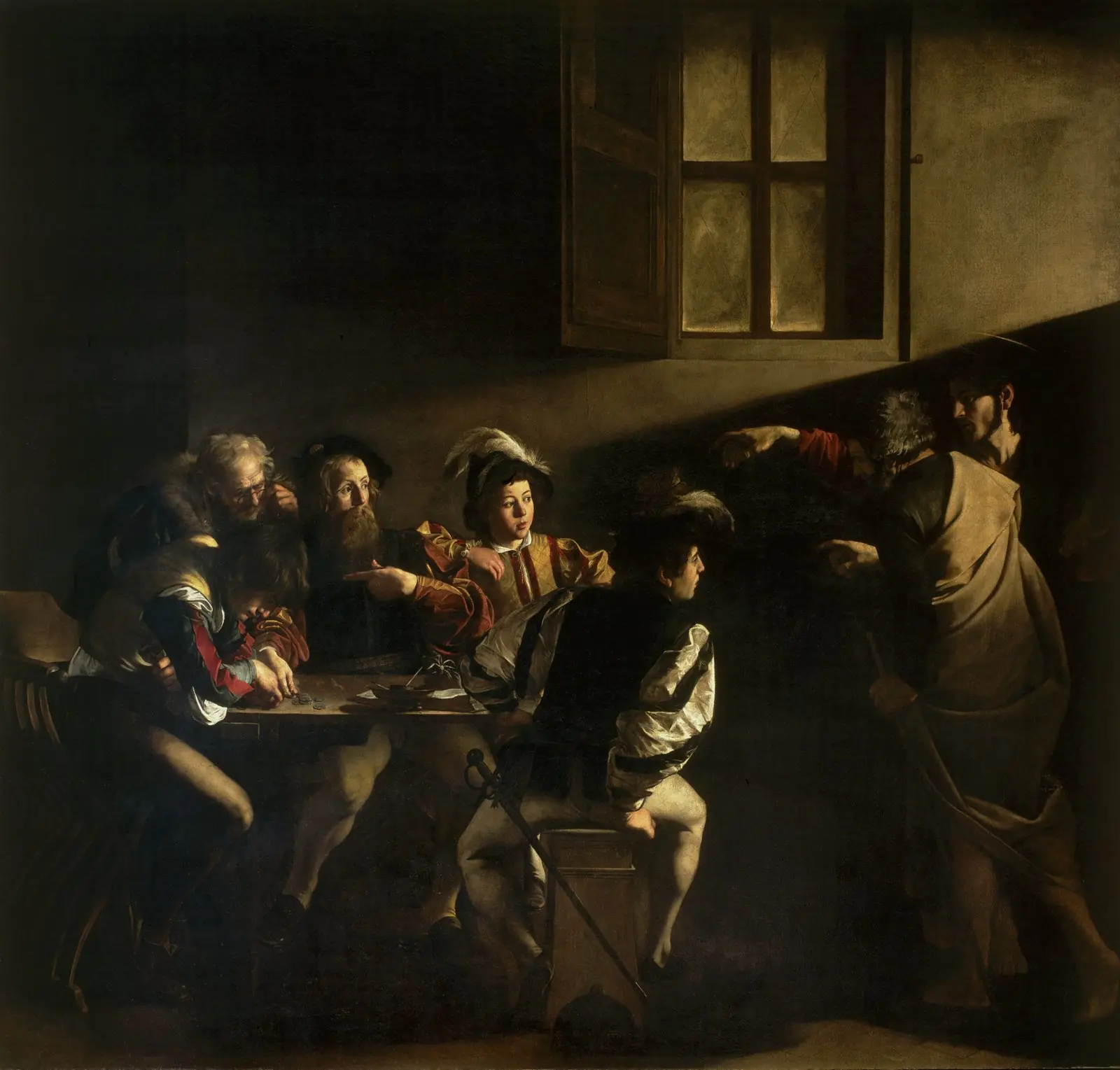
That does not make El Greco "less intense." It means the intensity works differently. Mannerism often heightens form by stretching it, complicating it, or making it hover between clarity and artificiality. In Orgaz, the miracle is not staged as sudden interruption. It is staged as a vertical ordering of worlds, with the city below and salvation above.
Why the painting mattered so much in Toledo
Seen in its original church setting, the canvas would have done several jobs at once. It honored a local benefactor. It affirmed the dignity of the parish. It materialized Catholic teaching about intercession, sainthood, and the soul. And it gave Toledo's elite a place inside a sacred image without turning the scene into mere flattery. That balance is one reason the work still feels so unusual. It is both deeply local and unmistakably art-historical.
This is also why The Burial of the Count of Orgaz is such an indispensable El Greco painting. It gathers everything that makes him singular: Byzantine memory, Venetian color, portrait precision, elongated form, and religious tension. Once you see how those elements fit here, the bridge from Renaissance balance to Baroque drama no longer looks like a clean break. It runs through El Greco's strange and exact middle ground.
Related works
Test yourself with the quiz
Then try the art quiz.
Primary sources
Frequently asked questions
According to local legend, the two saints descended at the funeral of Don Gonzalo Ruiz de Toledo and placed his body in the grave themselves. El Greco paints that miracle as if it were happening before the gathered citizens of Toledo.
El Greco separates the painting into two registers on purpose. Below, the gathered men behave like a civic portrait of Toledo. Above, bodies stretch, light thins out, and the heavenly realm becomes less solid and more visionary.