
Artist Guide
Wassily Kandinsky
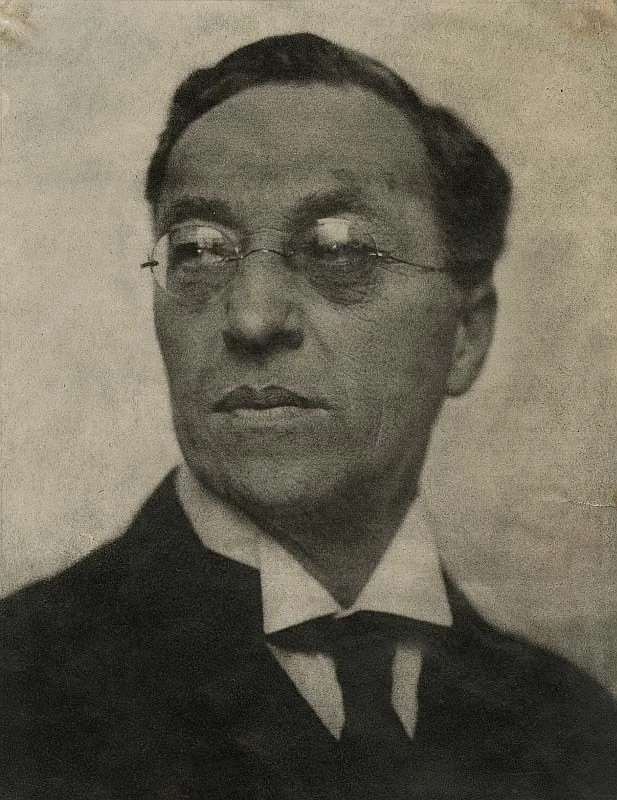
Wassily Kandinsky rebuilt painting around force, rhythm, and interval. He argued that painting could function like music: direct, non-descriptive, and emotionally structured. His abstract works transform color and line into active systems rather than representational signs.
From law to abstraction
After early studies in law, Kandinsky moved into art and became a key voice in modernist theory. Across Munich, Moscow, and Bauhaus contexts, he developed a language where composition meant energetic relation rather than scene-building.
In Composition VII, this approach reaches high density: the canvas becomes an orchestration of vectors, pressure, and timing.
Contribution
Kandinsky’s lasting contribution is pedagogical as well as artistic. He gave abstraction a conceptual framework that many later artists, designers, and educators could adapt. His writing and practice together made non-objective art legible as an intentional method.
The problem Kandinsky set for painting
Kandinsky's central wager was technical, not decorative: could painting organize meaning without relying on recognizable objects? Around 1910, that question cut against both academic realism and lighter forms of modern stylization. He did not abandon structure; he rebuilt it. Instead of perspective and narrative action, he worked with directional force, interval, chromatic pressure, and recurring compositional anchors that could stabilize a dense visual field.
That shift was historical as well as formal. Between Munich, Moscow, and later the Bauhaus, Kandinsky was moving through institutions where art, pedagogy, and theory overlapped. His writing gave audiences a vocabulary for what they were seeing, while his canvases tested the limits of that vocabulary. This dual role—maker and theorist—helped abstraction become readable to wider publics rather than remaining an isolated studio experiment.
Technique: density with control
In major works such as Composition VII, visual complexity is carefully staged. Broad color zones act like harmonic fields; diagonals introduce speed; curved elements redirect the eye and prevent collapse into noise. If you track the canvas in passes—first movement, then value, then edge behavior—you notice that the apparent chaos is actually a timed sequence of entries, frictions, and releases.
Kandinsky's pedagogy at the Bauhaus also mattered for technique transfer. He treated point, line, and plane as operational units that could be taught, tested, and adapted. That made abstraction portable across painting, graphics, and design education. In that sense, his contribution extends beyond individual masterpieces: he helped establish a method for building non-figurative clarity.
Debates and durable legacy
The old formula "father of abstraction" is too narrow, because parallel histories involve Hilma af Klint, Kazimir Malevich, and other paths to non-objective art. But Kandinsky remains pivotal because he linked studio practice to a repeatable explanatory framework. His influence survives wherever visual systems prioritize relation over representation.
In 2026, that legacy is easy to see: contemporary viewers already parse abstract interfaces daily. Kandinsky's paintings therefore feel less distant than they once did. They still demand attention, but they also teach a transferable skill—how to read structure, rhythm, and hierarchy when no narrative scene is provided.
Key works in Explainary
Associated movement
How to use this profile for deeper reading
Use this profile comparatively: start from Composition VII, then return and track what stays constant across Kandinsky's phases—directional force, chromatic pressure, and rhythmic layering.
Chronology is decisive here. Early experiments, mature orchestration, and Bauhaus pedagogy do not repeat the same formula, but they do share a stable problem: how to build meaning without literal depiction.
Read this page together with the Abstract Art movement page and the linked artwork analyses. That three-way reading makes Kandinsky's method far clearer than any isolated summary.
Kandinsky as a systems thinker
Kandinsky's importance is not limited to the claim that he "invented abstraction." He developed a transferable model linking color, rhythm, and compositional pressure, then tested it across essays and paintings such as Composition VII.
Seen with Improvisation 28, Suprematism, and the historical map in When Artists Started Abstract Art, his work reads as a laboratory where paint behaves like musical structure: motifs recur, accelerate, and resolve without narrative depiction.
Now test recall with the art quiz: can you recognize Wassily Kandinsky from visual cues in works like Featured work?