
Ukiyo-e
Fuji Seen from Kanaya on the Tokaido
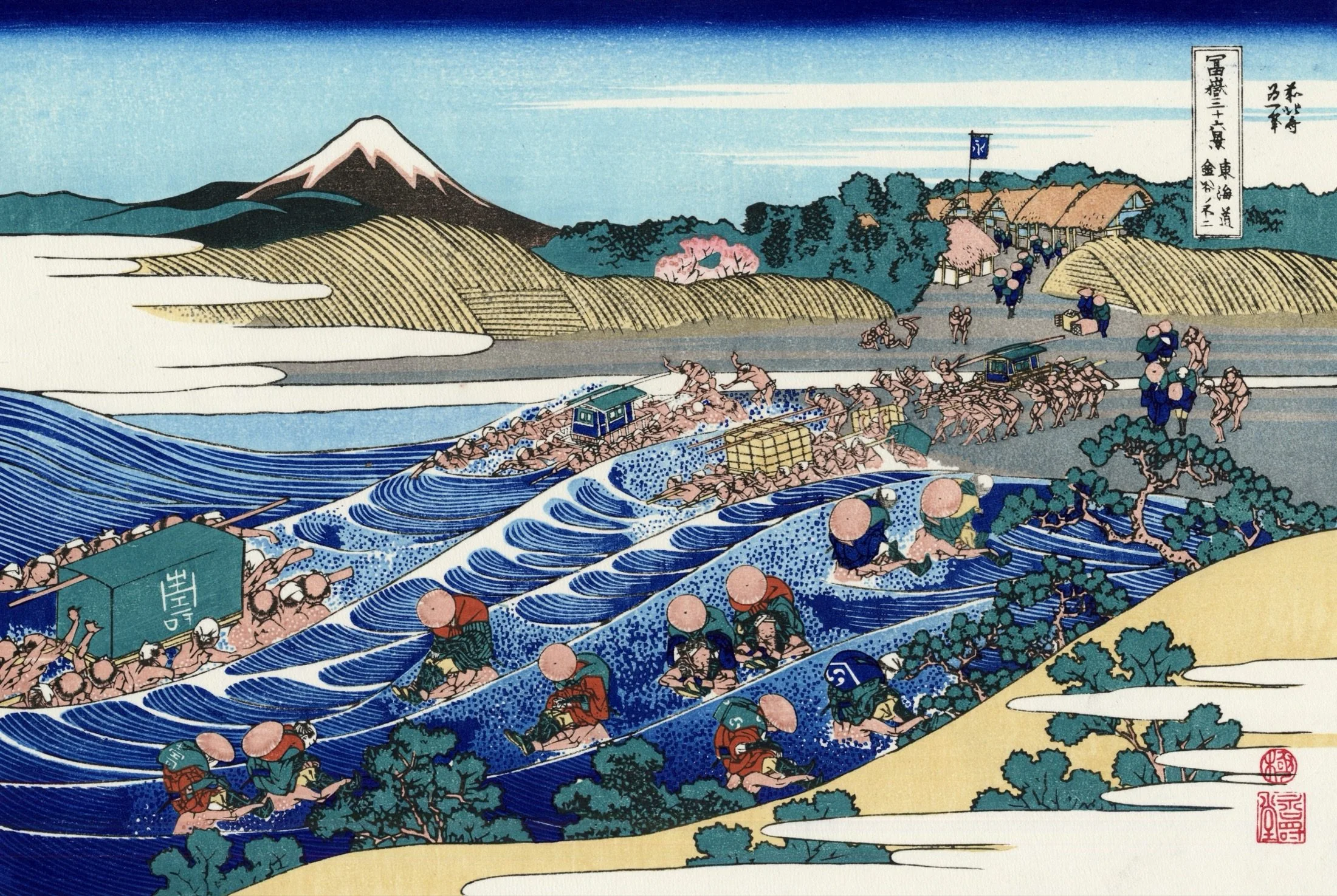
In Hokusai's Thirty-six Views of Mount Fuji, this sheet does not show the mountain from a calm lookout. It shows it above a difficult river crossing. Travelers, porters, palanquins, freight, and rafts all struggle through the Ōi River at Kanaya on the Tōkaidō road, while Fuji sits high and distant in perfect calm. That contrast is the whole intelligence of the print: human movement is crowded, wet, and provisional; the mountain remains clear enough to orient everything.
That is why the sheet matters in the series. The print does not ask us to admire Fuji in isolation. It asks what happens when an iconic mountain enters the thick of transport, labor, and everyday coordination in the world of ukiyo-e.
A river crossing, not a scenic stop
The Met identifies the scene clearly: travelers are crossing the Ōi River at Kanaya on the Tōkaidō highway. The British Museum adds the crucial practical detail. There was no bridge or regular ferry at this stretch between Kanaya and Shimada, so traffic on one of the busiest roads in Japan had to be carried across by teams of river-crossers or moved on rafts.
That detail changes how the picture reads. This is not a leisurely landscape view with a few picturesque staffage figures. It is a bottleneck in motion. Everything in the foreground is about passage: who is carried, what is rafted, what must wait, and how a route continues when the road itself disappears into water.
How Hokusai organizes the crossing
The print is dense, but not chaotic. Hokusai arranges bodies and loads in repeating bands that move across the river almost like a score. The Met is right to note the rhythmic arrangement of palanquins and figures in the waves. The eye travels laterally through carriers, passengers, and freight before lifting toward Fuji.
That motion matters because the crossing is the real subject of the foreground. The water is not a decorative surface. It is quick, unstable, and full of resistance. The repeated swell patterns make the current feel active, while the carried bodies, lifted legs, and rafted bundles show how much organization is needed just to keep movement going.
Fuji as distant counterweight
Fuji is small, but it is not secondary. Hokusai keeps the mountain almost monochrome and still, so it answers the river without competing with it. Below, everything is temporary: effort, traffic, negotiation, balance. Above, the mountain functions as a stable form that gathers the whole image into one larger order.
This is one of Hokusai's strongest serial strategies. The mountain does not need to dominate the page to dominate recognition. It can remain distant and still be unmistakable. That is part of what made Fuji such a durable visual symbol: Hokusai proved it could survive radical changes of scale, weather, and narrative setting.
The Tokaido as image corridor
The Tōkaidō was not just a road. It was one of Edo Japan's major arteries for officials, merchants, goods, news, and images. By setting Fuji above this crossing, Hokusai links the mountain to a corridor of actual circulation. The print is about geography, but also about traffic.
The British Museum notes another detail that pushes this even further: several bundles in the image carry the publisher Nishimuraya's emblem. That is a small but brilliant fold in the picture. The sheet shows transport, and inside that transport it quietly inserts the world of publishing that circulated the print itself. Commerce, movement, and visual memory are all inside the same design.
A useful comparison inside the Fuji series
Compare this sheet with The Great Wave off Kanagawa. In both prints, water presses hard against human life and Fuji remains small but stable. The difference is in the kind of pressure. The Great Wave is about sudden danger and violent compression. Fuji Seen from Kanaya on the Tokaido is about organized passage, repeated labor, and keeping a route functioning under difficult conditions.
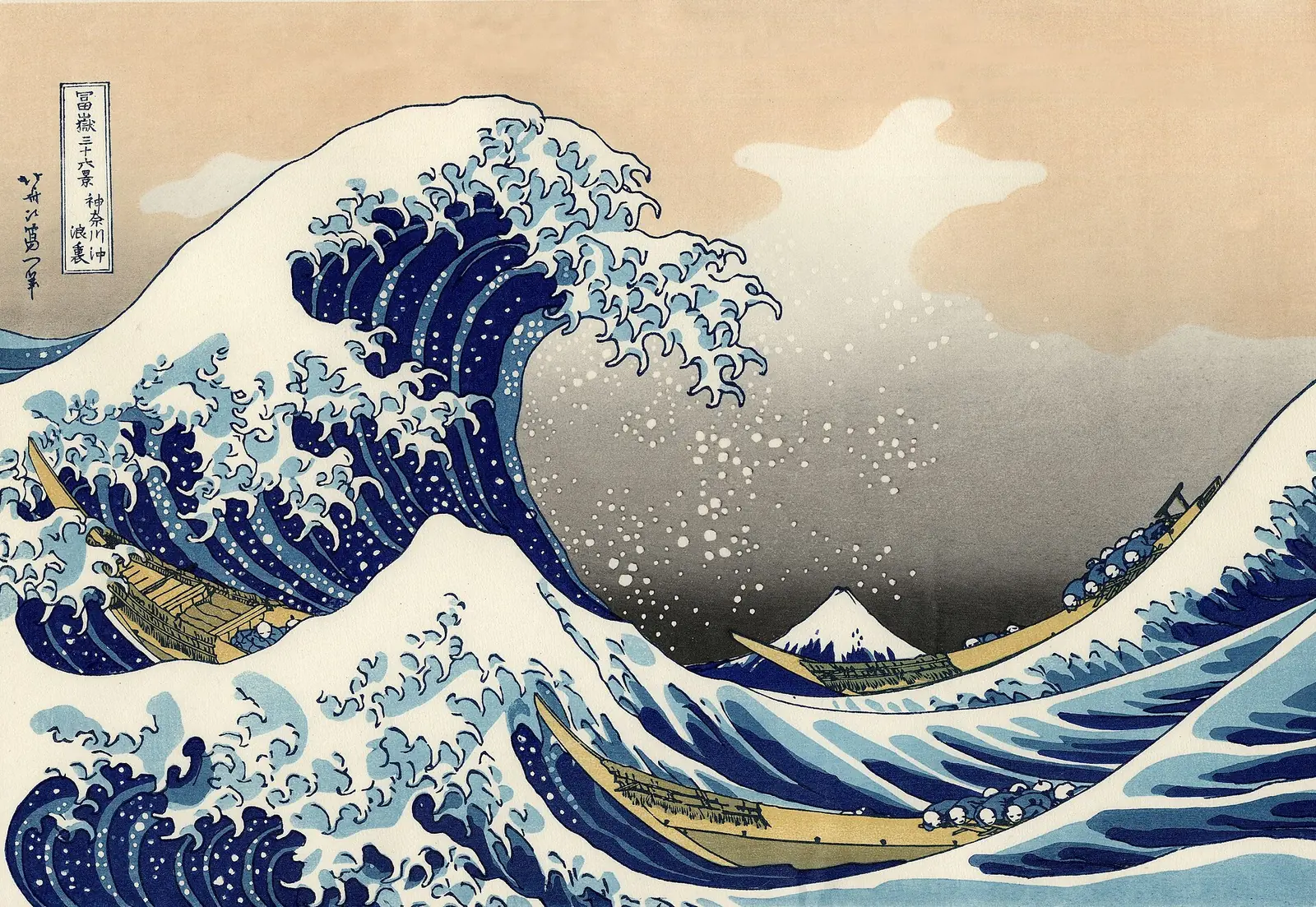
That difference helps explain the range of the series. Hokusai does not simply repeat the same mountain. He keeps testing what Fuji can do inside different systems: wave, weather, labor, framing, route, and distance. For another route-based variation, continue with Mishima Pass in Kai Province. For another labor-centered variation, see Kajikazawa in Kai Province.
Why this print matters for Fuji's iconicity
The sheet is important because it shows that Fuji became iconic not only through sublime isolation, but through repetition inside ordinary life. Here the mountain is not remote from the social world. It hovers above porters, passengers, freight, and route maintenance. It belongs to movement as much as to contemplation.
That is the deeper achievement of Hokusai's series. Fuji stays recognizable because it keeps reappearing in contexts that viewers could inhabit: dangerous water, work, roads, weather, and travel. The mountain is memorable not because it is frozen into one grand image, but because it can enter many kinds of image without losing itself.
In this print, Fuji is not the obstacle and not the action; it is the stable form that makes the action readable.
Reading paths from Fuji Seen from Kanaya on the Tokaido
The most useful route from here is to move back to Hokusai, then outward to ukiyo-e, then across to The Great Wave, Mishima Pass, and Kajikazawa. That sequence makes the serial method obvious: the same mountain becomes legible through different kinds of pressure. After that, try the art quiz.
Primary sources
The best way into the print is to begin with the river, not the mountain. Once the crossing reads clearly as work and coordination, Fuji stops looking like background and starts functioning as the still form that holds the whole design together.
Frequently asked questions
It shows travelers and goods crossing the Ōi River at Kanaya on the Tōkaidō highway, with Mount Fuji visible in the distance. Hokusai turns that practical crossing into a scene of rhythm, labor, and orientation.
At this stretch of the Ōi River there was no bridge or regular ferry. Travelers, palanquins, and freight had to be carried by river-crossers or moved on rafts.
Fuji is small because Hokusai wants the crossing itself to dominate the immediate experience. The mountain acts as a distant counterweight that stabilizes the whole scene.
The Great Wave turns water into a sudden crisis. Fuji Seen from Kanaya on the Tokaido is still dynamic, but it emphasizes organized passage, labor, and route management rather than catastrophe.
Yes. It belongs to Hokusai's Thirty-six Views of Mount Fuji, the series in which he kept testing how the same mountain could remain recognizable across different settings, scales, and kinds of human activity.