
Artist Guide
Katsushika Hokusai
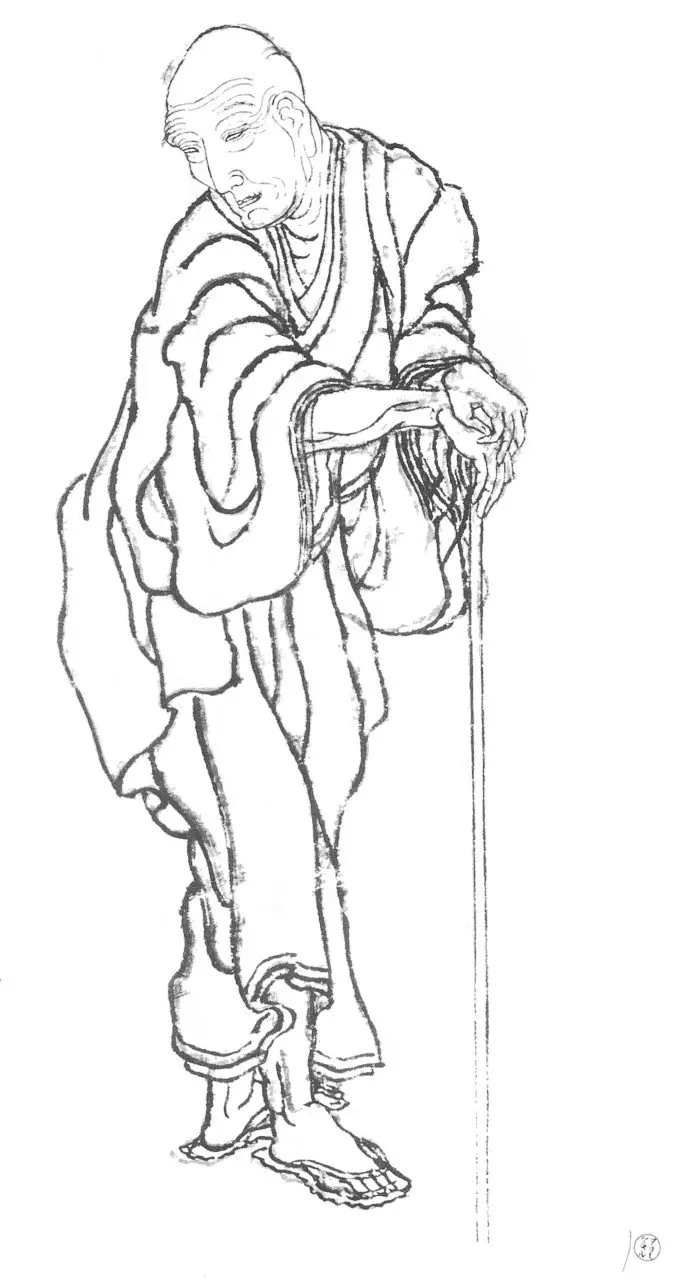
Hokusai turned reproducible prints into a long-form experiment in seeing. Katsushika Hokusai turned the printed image into a thinking machine. His best sheets look immediate, but they are built from hard compositional choices about scale, speed, and attention.
Edo's print economy and Hokusai's reinventions
Born in Edo in 1760, Hokusai built his career inside one of the busiest image markets in the world. Print publishers, booksellers, and lending libraries fed constant demand, and ukiyo-e was already a popular medium long before he became famous. What distinguishes Hokusai is not that he escaped this market, but that he used it strategically: he changed studios, signatures, and formats as he moved from actor prints toward landscapes, manuals, and serial projects with wider intellectual ambition.
That professional flexibility mattered when he launched Thirty-Six Views of Mount Fuji in the early 1830s. He was already in his seventies, working with publisher Nishimuraya Yohachi, and the series sold strongly enough that the initial thirty-six sheets were extended. The often repeated detail is practical and revealing: what began as a numbered set grew because demand confirmed that viewers wanted variation, not just one iconic image.
Composition as force: wave, mountain, and human scale
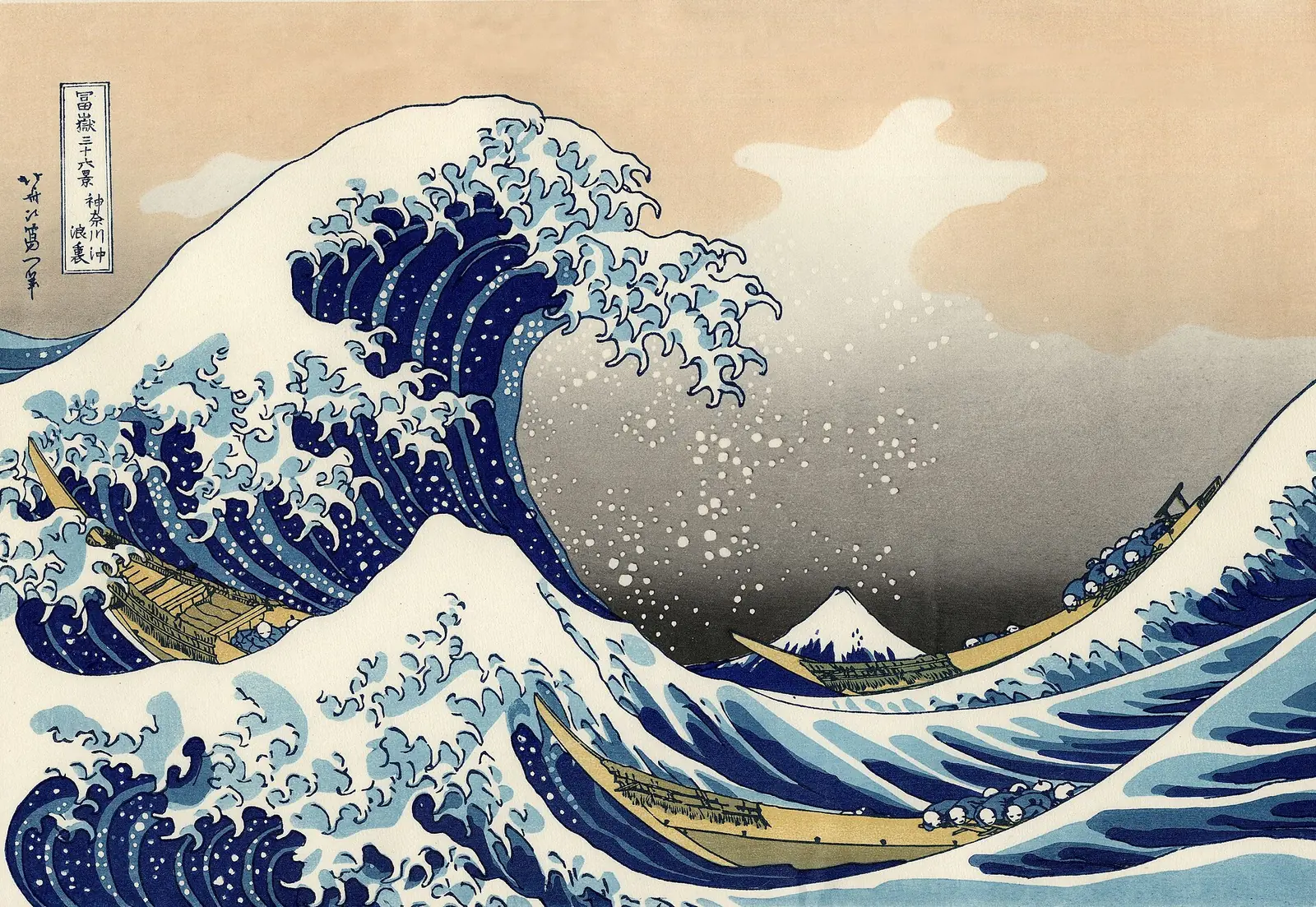
Hokusai's line is famous, but line alone does not explain the effect. In The Great Wave off Kanagawa, the arc of foam compresses boats and crews into a narrow band of survival while Mount Fuji stays small, distant, and stable. The image reads quickly because the structure is ruthless: one dominant curve, one counter-mass, and a precise human scale that turns weather into drama.
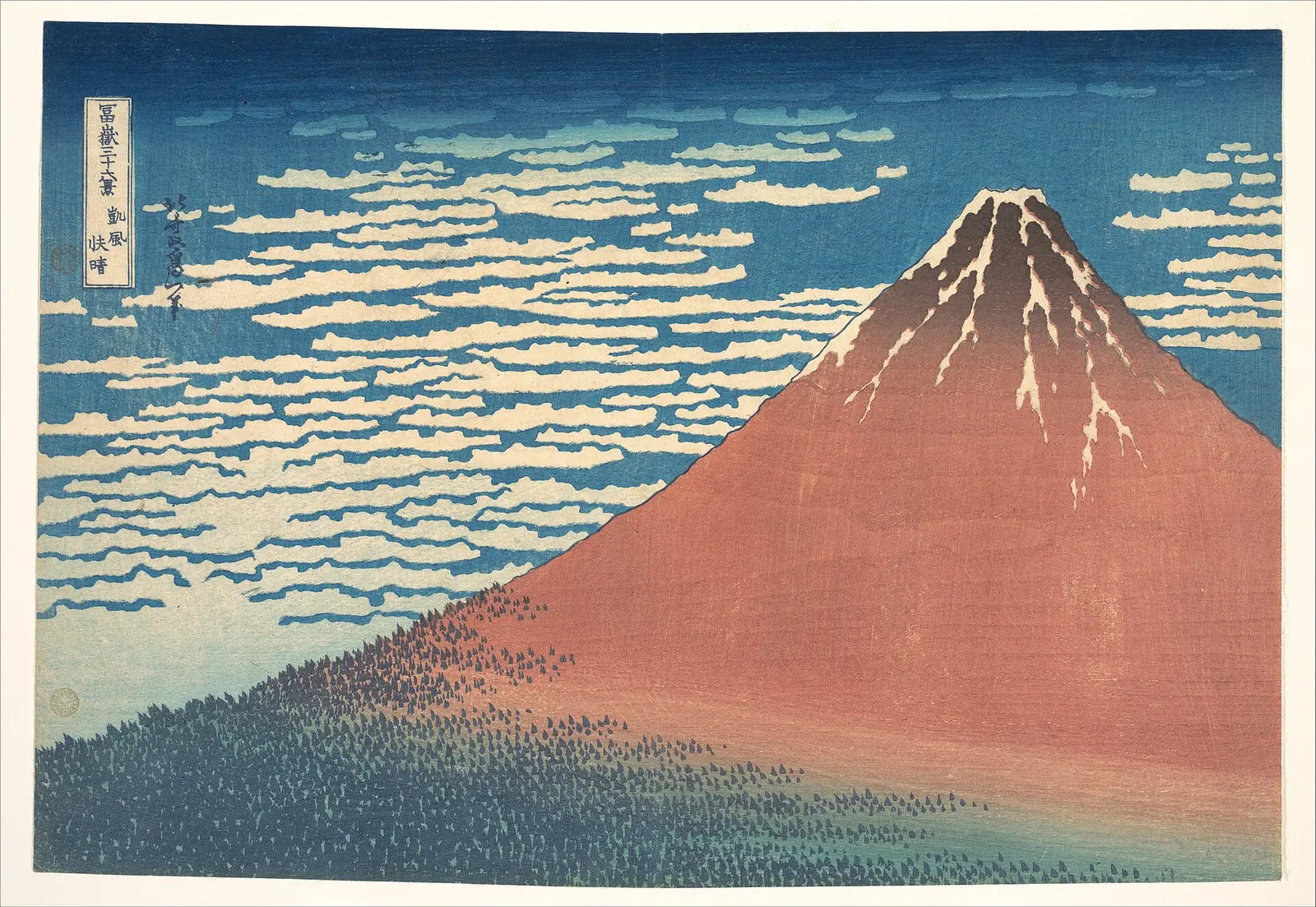
In Fine Wind, Clear Morning (Red Fuji), he solves the same motif differently: no crashing wave, no panic, only mountain mass, air pressure, and controlled color fields. The shift from sea violence to atmospheric stillness is exactly the point. Hokusai demonstrates that serial practice can change emotional logic while keeping a single subject constant.
Serial intelligence in the Fuji sheets
The Fuji series is a method more than a motif. Sheets like Kajikazawa in Kai Province, Mishima Pass in Kai Province, and The Fuji from Kanaya on the Tokaido test distance, labor, weather, and viewpoint as variables. Instead of narrating a single event, Hokusai maps perception across multiple conditions.
This ambition depended on collaborative craft: designer, block carvers, printers, pigments, and publisher. Hokusai's achievement was to compose images clear enough to survive that chain without losing formal precision. Prussian blue, increasingly used in Japan at the time, helped him push stronger sea-sky contrasts and made color an organizing structure rather than a decorative finish.
From Edo print shops to global modern visual culture
By the late nineteenth century, Hokusai's prints circulated in Europe and became central to Japonisme. Artists absorbed his cropped framing, asymmetric balance, and active empty space; the transfer was methodological, not folkloric. Read him alongside Utagawa Hiroshige and How Mount Fuji Became Iconic to see how visual invention and distribution networks reinforce each other.
That is why Hokusai still matters in 2026. He solved an enduring image problem early: how to make an artwork immediately legible without flattening its complexity.
Legacy and influence across visual media
Hokusai's legacy is visible far beyond nineteenth-century print history. Poster design, comics, photography, animation, and interface illustration still borrow his way of distributing force between contour and empty space. His influence is durable because it is structural: he provides a practical grammar for balancing instant readability with layered interpretation.
Key works in Explainary
Associated movements
Now test recall with the art quiz: can you recognize Katsushika Hokusai from visual cues in works like The Great Wave off Kanagawa?