
Ukiyo-e
Kajikazawa in Kai Province
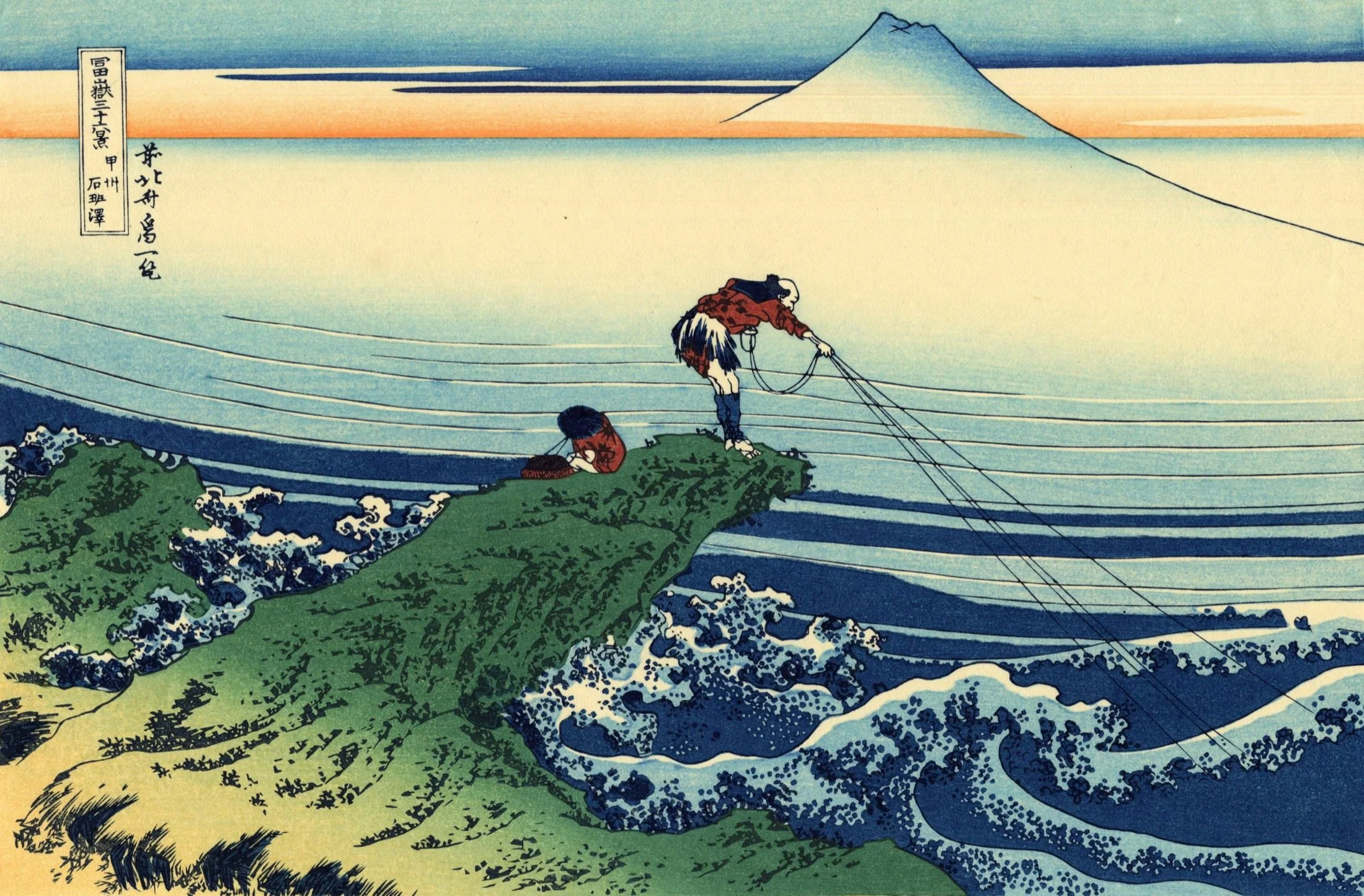
A man throws his lines into fast water, and the whole print snaps into order. In Katsushika Hokusai's Thirty-six Views of Mount Fuji, Kajikazawa in Kai Province is one of the clearest demonstrations that Mount Fuji does not need to dominate the page to dominate the image. The fisherman's back, the triangle of the lines, the point of rock, and the small cone of Fuji answer one another across the sheet.
That is why this print matters. It is not a generic scene of labor and it is not a picturesque Fuji view. It is a tightly built design in which local work and distant form are locked together.
One cast holds the whole image together
The Met is right to stress the repetition and rhyme of shapes here. Hokusai builds the print from a short list of forms: the fisherman's arched back, the triangular spread of the lines, the wedge of the promontory, and the triangle of Fuji on the horizon. The image feels immediate because the structure is so exact. You do not have to decode it; your eye recognizes the echoes almost at once.
Color makes the same point. The deep blue of the water is answered by the blue in the fisherman's jacket and by the summit of Fuji. That chromatic link keeps foreground and distance from drifting apart. What could have become a split image, work below and mountain above, instead reads as one continuous design.
A working scene, not a heroic landscape
The British Museum record describes a fisherman casting lines into the fast-flowing Fuji River, with a small boy and basket beside him. That second figure matters. It prevents the scene from turning into solitary heroics. Hokusai keeps the print grounded in routine work: timing, balance, repetition, and the practical knowledge needed to work beside fast water.
The tension comes from control, not panic. The ledge is steep, the water is active, and the fisherman's body is stretched to its limit, but the image never becomes theatrical. Hokusai is showing practiced risk. That difference is important. The print is about competence under pressure, not about a man being overwhelmed by nature.
A Fuji sheet built on scale contrast
Inside Thirty-six Views of Mount Fuji, this is one of the sheets that explains the series best. Fuji is small, but it is not background. Hokusai makes recognition do the work. The mountain is far away, reduced in size, almost quiet, yet it stabilizes everything. If Fuji were larger, the print would become monumental. By keeping it small, Hokusai preserves the force of the working action while still making the mountain the final point of orientation.
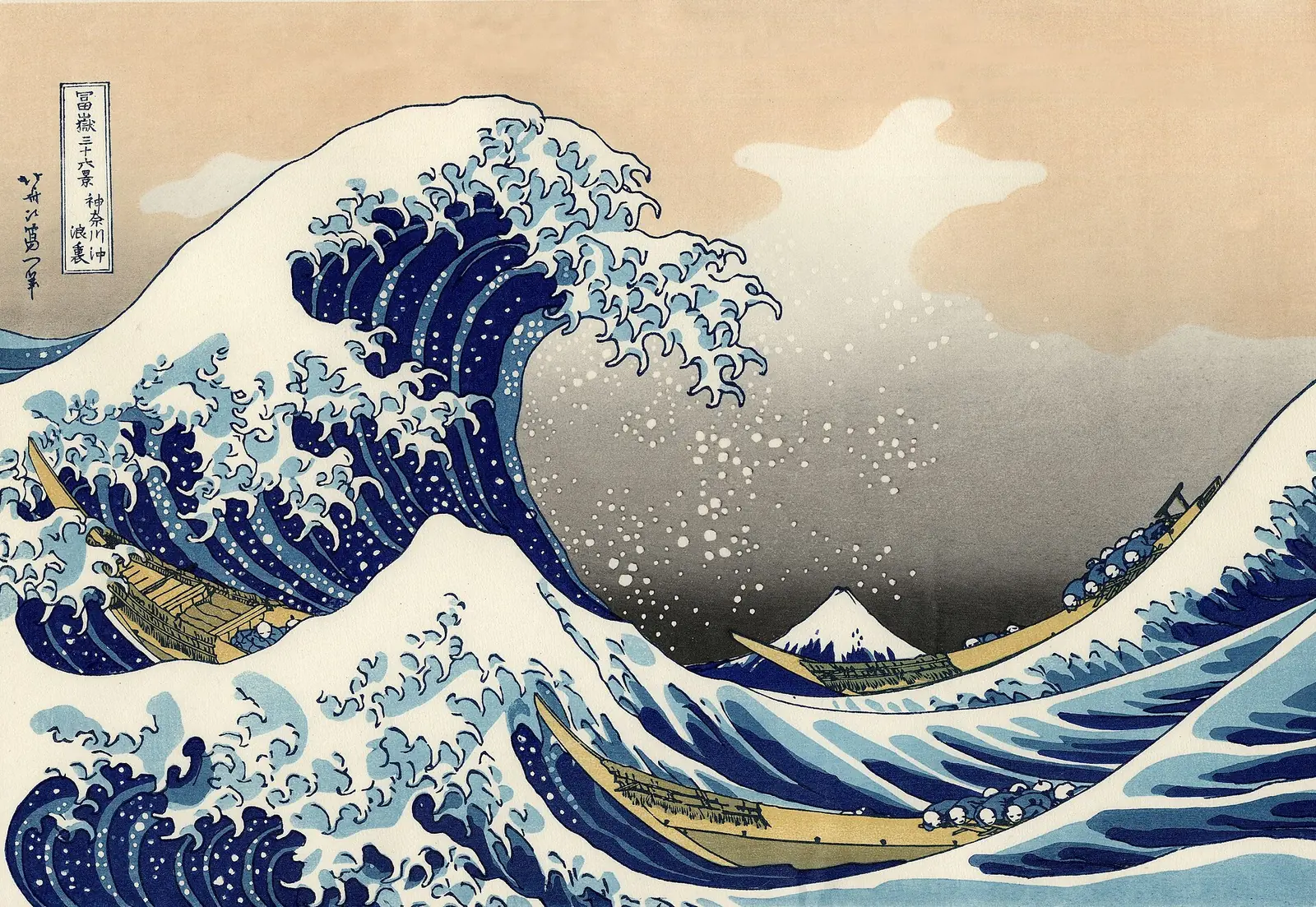
That is the link with The Great Wave off Kanagawa. In both prints, Fuji is a distant constant while water carries the main pressure. But the pressure is different. The Great Wave is about sudden compression and near-catastrophe. Kajikazawa is about a practiced gesture repeated beside a difficult river.
One design, several impressions
This sheet also clarifies something basic about ukiyo-e: a woodblock print is not a single, fixed object in the way an oil painting is. The Met notes that early impressions of Kajikazawa were printed in an indigo-heavy scheme, while later impressions introduced more colors. The British Museum uses the print as an example of how the same design can evolve over time.
That detail matters because it shows how robust Hokusai's construction is. The color scheme can shift, the land can turn greener, and the figures can become more vivid, but the design still holds. The fisherman, the water, and Fuji remain locked into the same visual logic. That is one reason the print stays memorable even when viewers know it through different impressions.
Kajikazawa stays in the mind because Fuji answers the fisherman's gesture instead of replacing it.
Reading paths from Kajikazawa
Read Kajikazawa next to The Great Wave, Fuji from Kanaya, and Mishima Pass in Kai Province and Hokusai's serial method becomes much easier to see. He keeps changing the kind of pressure in the image, while Fuji remains the stable term in the equation. After that, try the art quiz.
Primary sources
- The Metropolitan Museum of Art: Kajikazawa in Kai Province
- The Met Heilbrunn Timeline essay on Hokusai
- The British Museum: Kajikazawa in Kai Province
- The British Museum blog: print variation and the evolution of woodblock impressions
- The Art Institute of Chicago: Kajikazawa in Kai Province
- Harvard Art Museums: Kajikazawa in Kai Province
The print becomes clearer once you follow the cast first and Fuji second. Hokusai wants the image to move from bodily effort to distant orientation, not the other way around.
That is also why the sheet matters inside the series. It proves that Hokusai can keep Fuji memorable without making it the largest form in the composition.
The mountain stays distant, but the design is built around it all the same.
That combination of proximity and distance gives Kajikazawa its special place in the series. Very few Fuji sheets make manual work and long-range structure feel this inseparable.
Frequently asked questions
It shows a fisherman casting lines from a rocky ledge into the fast-flowing Fuji River at Kajikazawa, with a small boy and basket beside him and Mount Fuji above the clouds. Hokusai turns that working scene into one of the clearest designs in the Fuji series.
Yes. It belongs to Thirty-six Views of Mount Fuji, the series in which Hokusai kept changing weather, viewpoint, labor, and distance while preserving the mountain's identity.
Because Hokusai wants the fisherman's action to dominate the foreground. Fuji is small in scale, but it stabilizes the whole composition and gives the sheet its final orientation.
Because woodblock prints were printed in multiple impressions over time. Early impressions of Kajikazawa used a more indigo-based scheme, while later impressions introduced more colors.