
Ukiyo-e
Mishima Pass in Kai Province
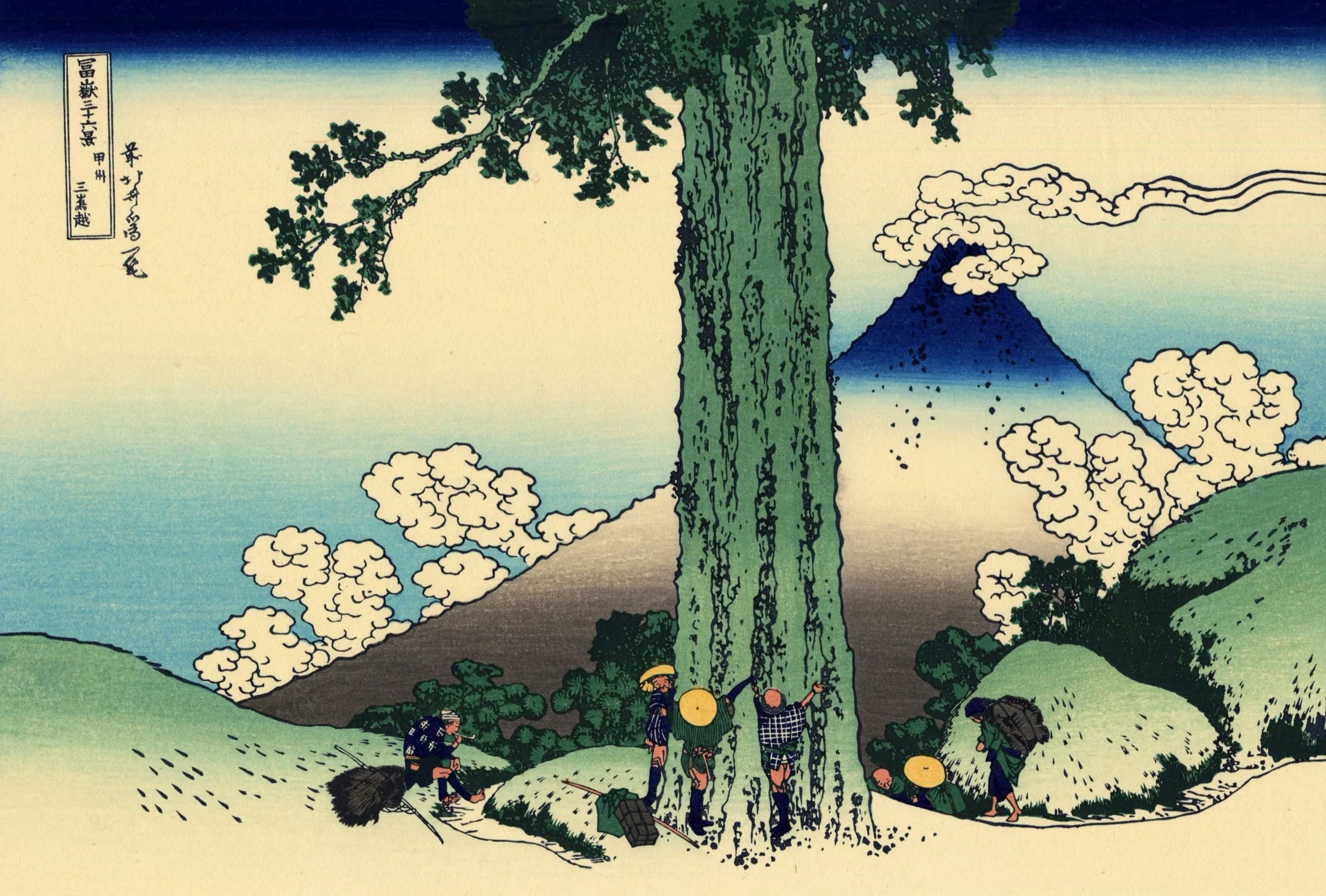
Hokusai does something sly here: in a series built to make Mount Fuji unforgettable, he lets a giant tree almost steal the picture. In Thirty-six Views of Mount Fuji, Mishima Pass in Kai Province shows three travelers stretching out their arms around an enormous ancient tree while Fuji sits small in the distance. The point is not to hide the mountain. It is to prove that the mountain can stay recognizable even when something else briefly outranks it.
The strength of the sheet lies there. It is one of Hokusai's sharpest experiments in scale. A huge trunk, tiny bodies, a small Fuji, and a sky alive with clouds are enough to build an image that reads instantly and stays in the mind.
A Fuji print that begins with a tree
The Met identifies the tree as an ancient cryptomeria, and the print treats it like a second monument. Three travelers reach around the trunk in a gesture of excitement, almost as if they are trying to measure it with their bodies. That detail matters. The image is not built around anonymous work or scenery. It is built around bodily comparison: how small are people, how large is the tree, and where does that leave Fuji?
The British Museum's description helps here too. Every mark in the bark has its own character, so the trunk feels rough, massive, and alive. Hokusai makes the tree more than a framing device. It becomes the main fact of the foreground, the thing that forces viewers to recalibrate scale before they even turn to the mountain.
Hokusai's intention is direct: he wants viewers to feel the tree's scale before they register Fuji's scale. His method is just as direct: a giant vertical trunk in front, tiny bodies wrapped around it, and a small but exact mountain held in reserve behind.
How Hokusai makes Fuji look smaller without losing it
Fuji is easy to miss for a split second, but never for long. Hokusai places it beyond the trunk and keeps its silhouette exact. The British Museum notes another useful detail: a branch dipping from the top of the composition echoes the mountain's left slope. The image quietly links tree and mountain so they do not compete as separate motifs. They belong to the same design.
The sky matters as much as the trunk. Around the mountain, museum records describe summer thunder clouds and a so-called hat cloud hovering above the summit. Those weather forms keep Fuji active even at a distance. The mountain may be small, but it is not inert. It has shape, atmosphere, and enough visual pressure to hold the background together.
A route title, not a survey map
The title sounds precise, but the British Museum notes that Mishima Pass may not refer to one exact lookout in the modern sense. It may describe a pass somewhere along the road running from Kofu toward Mishima, perhaps near Kagosaka Pass on the old border between Kai and Suruga. That uncertainty is useful, not annoying. It reminds us that Hokusai is not making a survey document. He is making a travel image for viewers used to route names, famous places, and serial variation.
In other words, the title works like a travel label inside Edo print culture. It locates the view broadly enough to be meaningful, while leaving Hokusai free to heighten the tree, the bodies, the clouds, and the scale drama that really drive the sheet.
One of the clearest tests in the Fuji series
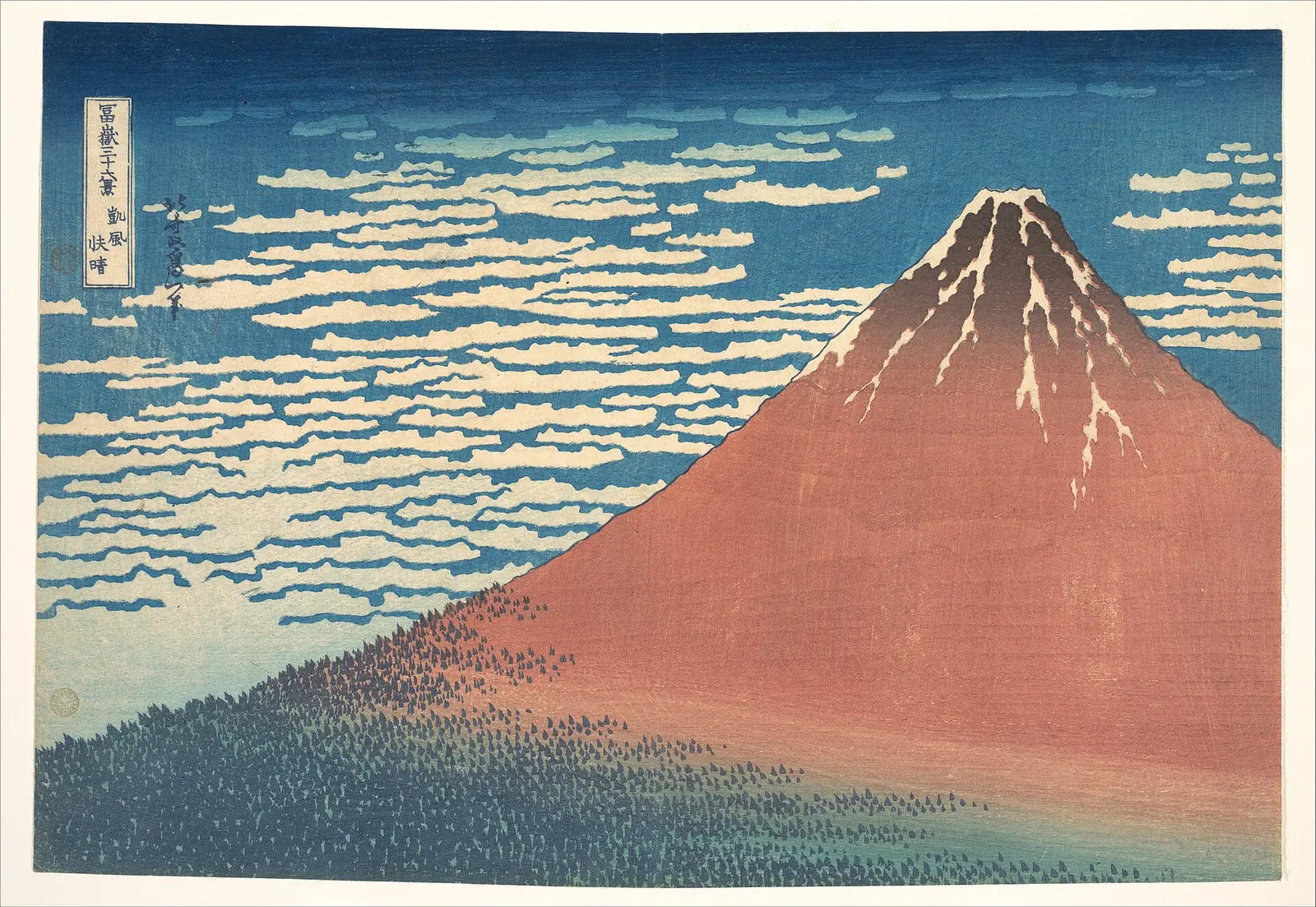
This print shows what the series can do when Fuji is not the largest form on the page. In Fine Wind, Clear Morning (Red Fuji), Hokusai gives the mountain almost the entire image. Here he does the opposite. Fuji is demoted in scale, but not in recognition. That reversal explains a lot about the series: Hokusai is not repeating a scenic formula. He is testing how far the mountain can shift in size, role, and context without losing its identity.
Read Mishima Pass next to Kajikazawa in Kai Province and Fuji Seen from Kanaya on the Tokaido, and the pattern becomes obvious. Hokusai keeps moving between different kinds of foreground pressure: a fisherman's cast, a difficult river crossing, an enormous tree. Fuji remains the stable term, even when it stops being the star of the foreground.
Fuji stays memorable here because Hokusai allows something else to outscale it for a moment.
Reading paths from Mishima Pass
Read Red Fuji, Kajikazawa, and Fuji from Kanaya after this. Each sheet changes the foreground pressure while keeping the same mountain legible. Then try the art quiz.