
Essay
Why Is Mount Fuji So Famous?
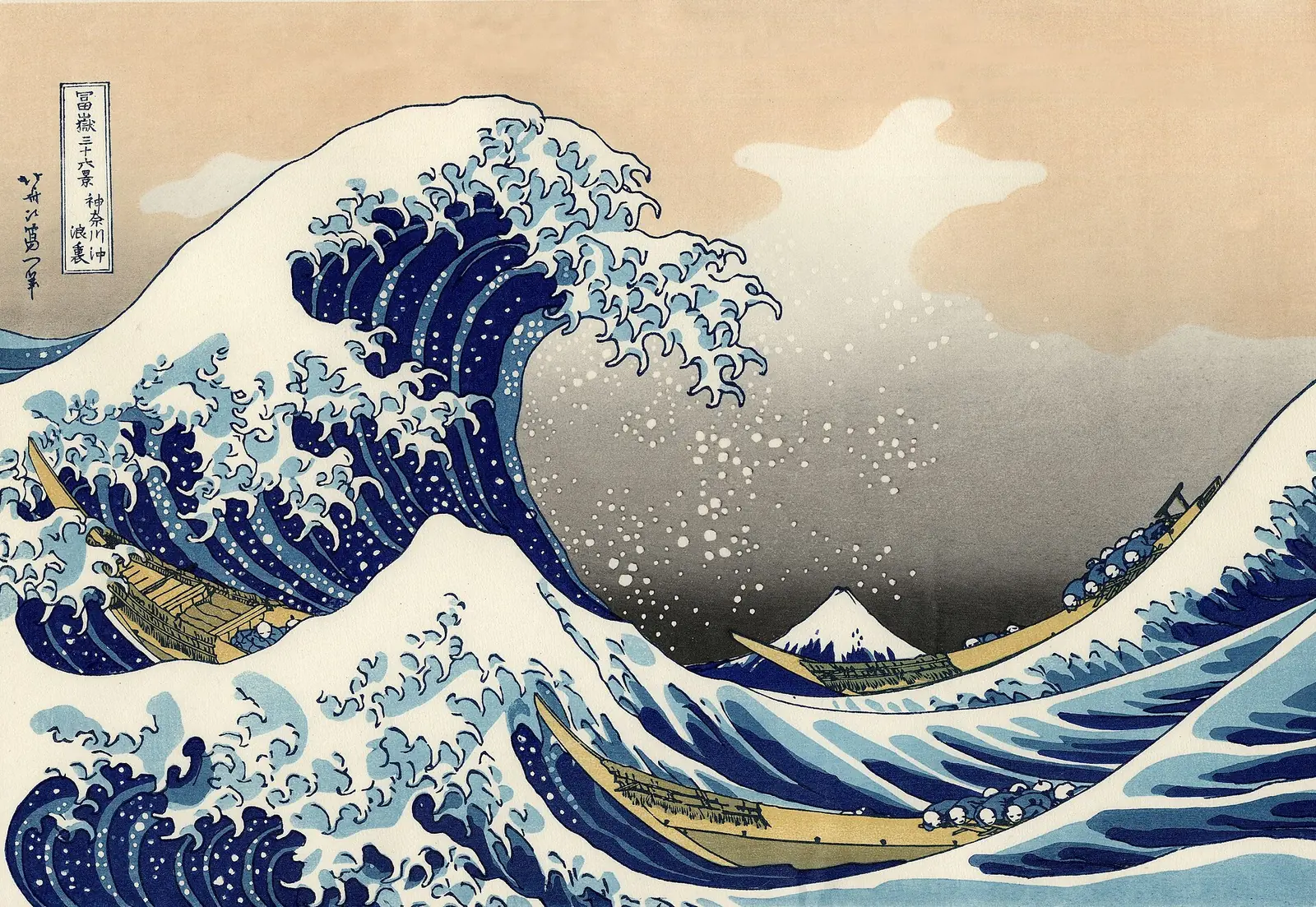
Most people can identify The Great Wave in a second. Fewer notice that the image is also a lesson in why Mount Fuji became so famous: even tiny and far away, the mountain is unmistakable. Fuji became iconic for three concrete reasons. It already carried sacred meaning and a culture of pilgrimage. Its shape is unusually simple and durable. And Edo print culture, above all Hokusai's Thirty-six Views of Mount Fuji, taught viewers to recognize it under radically different conditions.
That last point is the most important. Fuji did not become a global icon because one picture won. It became a global icon because a whole series trained the eye.
Fuji was famous before Hokusai
Hokusai did not invent Fuji's prestige. The mountain had long been a sacred site, a destination for pilgrimage, and a powerful landmark in eastern Japan. UNESCO's World Heritage description is useful here: it stresses both the religious history of Fujisan and its long afterlife as a source of artistic inspiration. Pilgrim routes, shrines, lodging houses, devotional practices, and Fuji-ko confraternities gave the mountain cultural density before modern image culture ever arrived.
Just as important, Fuji is visually suited to fame. The cone is simple, the summit is clear, and the silhouette survives distance, weather, and reduction better than most mountains do. That matters more than it sounds. An image enters collective memory more easily when it remains legible under variation.
Hokusai turned prestige into visual memory
The decisive shift comes with Hokusai's Thirty-six Views of Mount Fuji, issued in the early 1830s by the publisher Nishimuraya Yohachi. The mountain stops being only a revered place or literary symbol and becomes a repeatable image problem. How does Fuji look in storm, in calm, above work, behind a tree, above a road, beyond a river? Hokusai keeps asking the same question with a different answer each time.
That is why The Great Wave off Kanagawa is not the whole explanation. It is the most famous sheet, but it works so well because the series around it already establishes the rule. Fuji can be huge or tiny, central or distant, still or threatened, and remain immediately identifiable.
Five prints that taught the eye
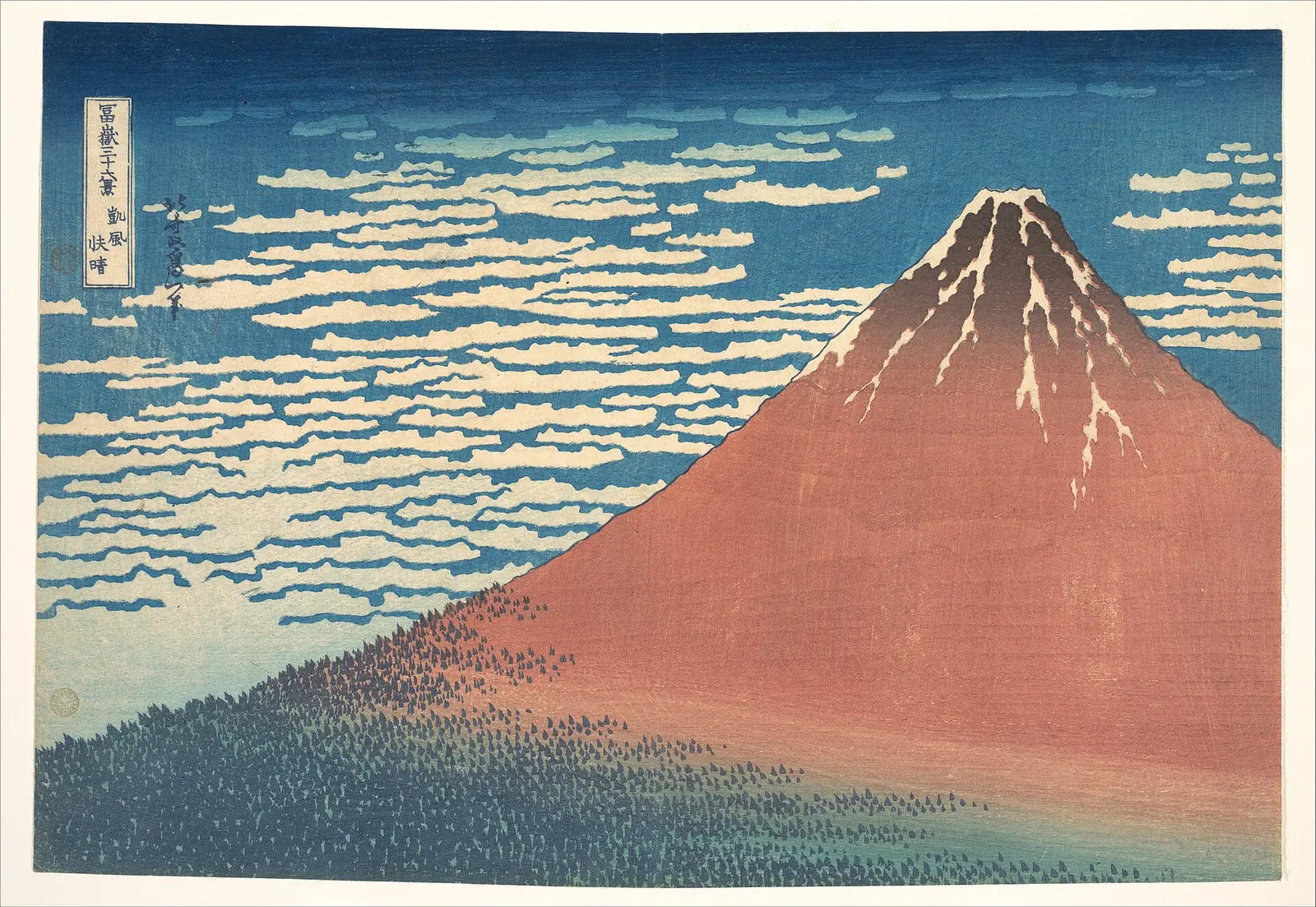
In Red Fuji, Hokusai gives the viewer the clearest possible version of the motif. The mountain is large, stable, and almost abstract in its clarity. This is the sheet that teaches recognition most directly.
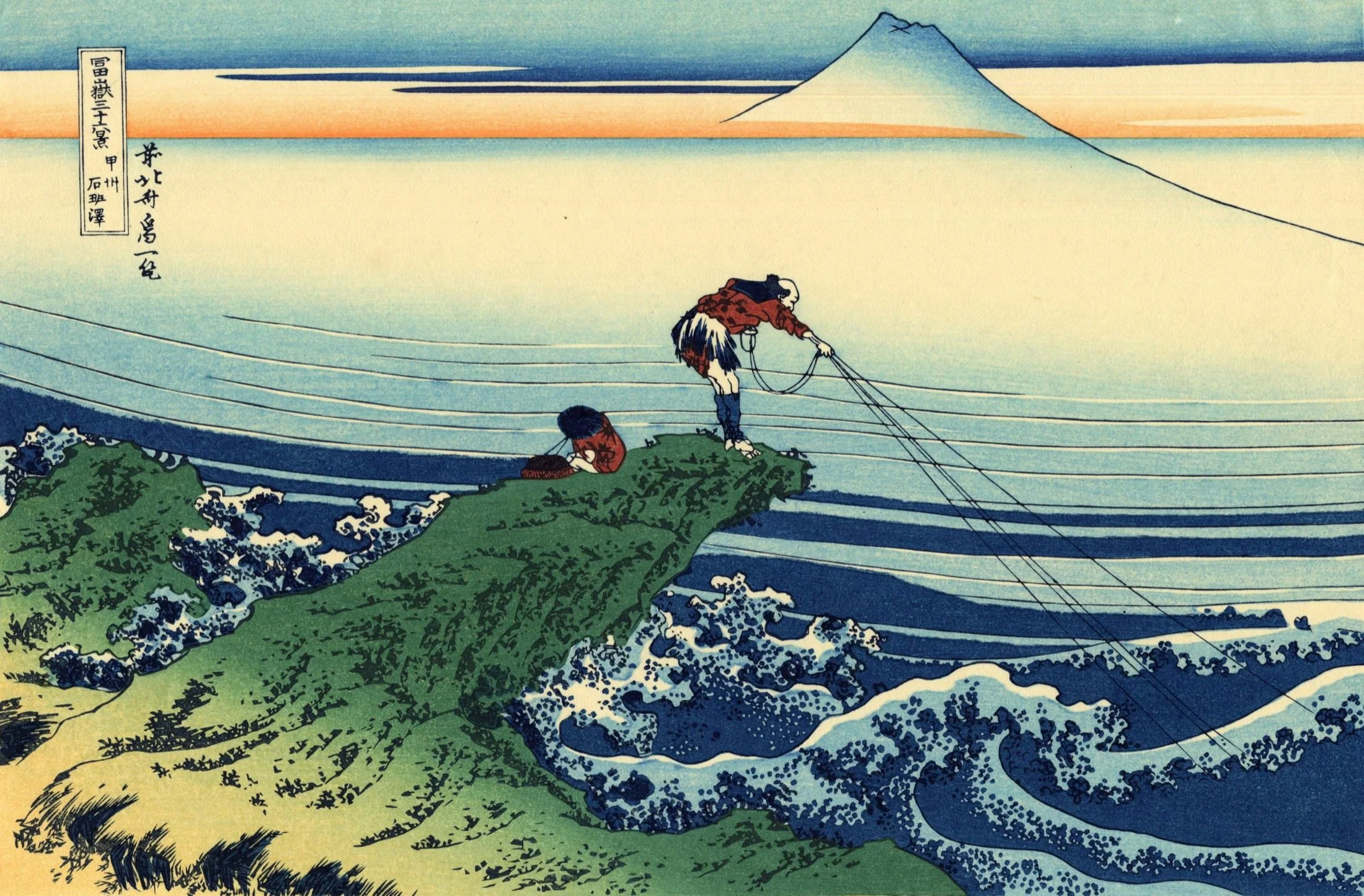
In Kajikazawa, Fuji is no longer the protagonist. A fisherman, a rocky ledge, and the pull of the river dominate the foreground. Yet the mountain still holds the whole image together. Here viewers learn that Fuji can stay memorable even when daily labor seems to take over.
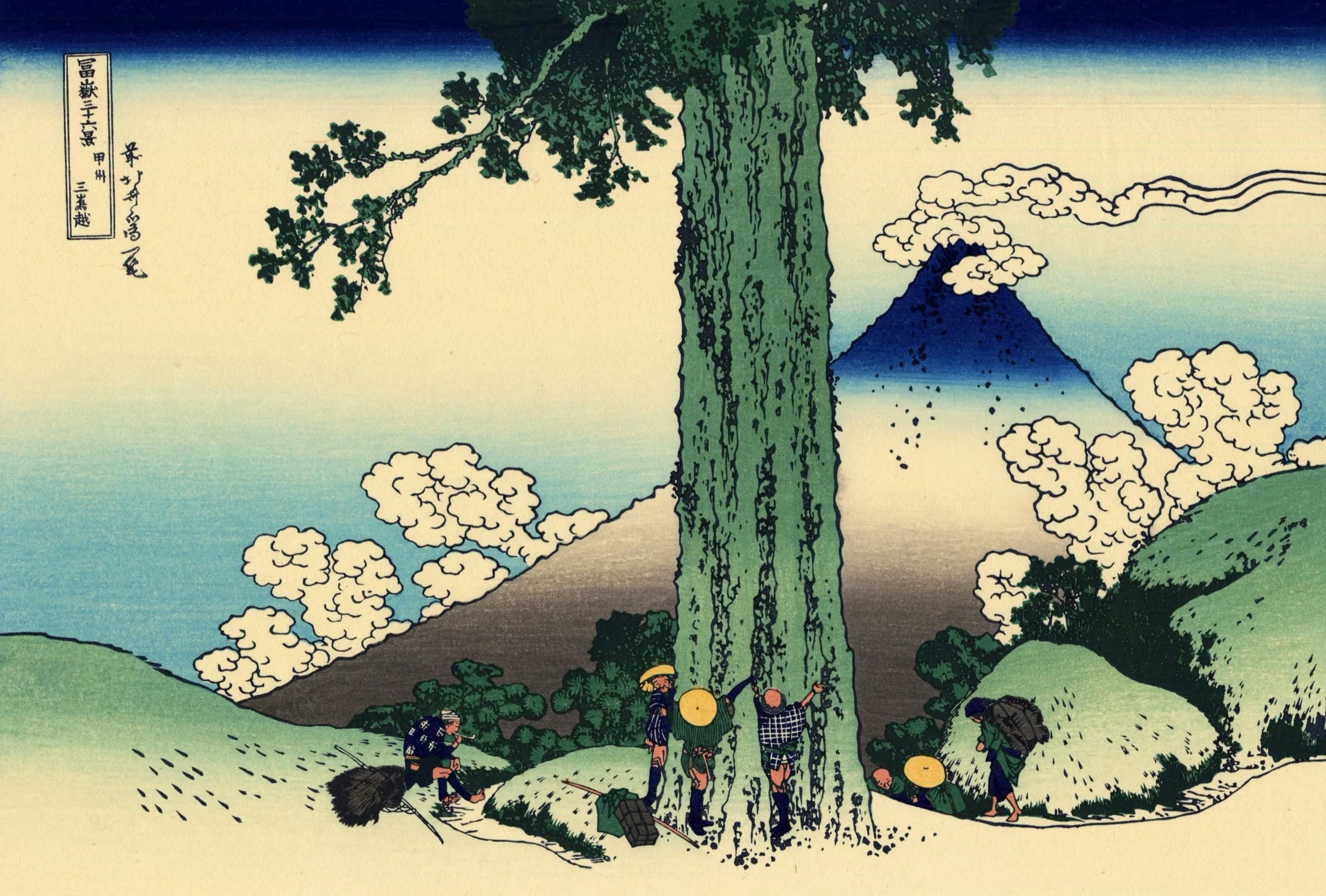
In Mishima Pass, Hokusai does something even bolder. He lets an enormous tree and three tiny travelers dominate the sheet. Fuji is reduced in scale, but not in recognition. The lesson is subtle and powerful: the mountain can afford to be small because the viewer already knows what to look for.
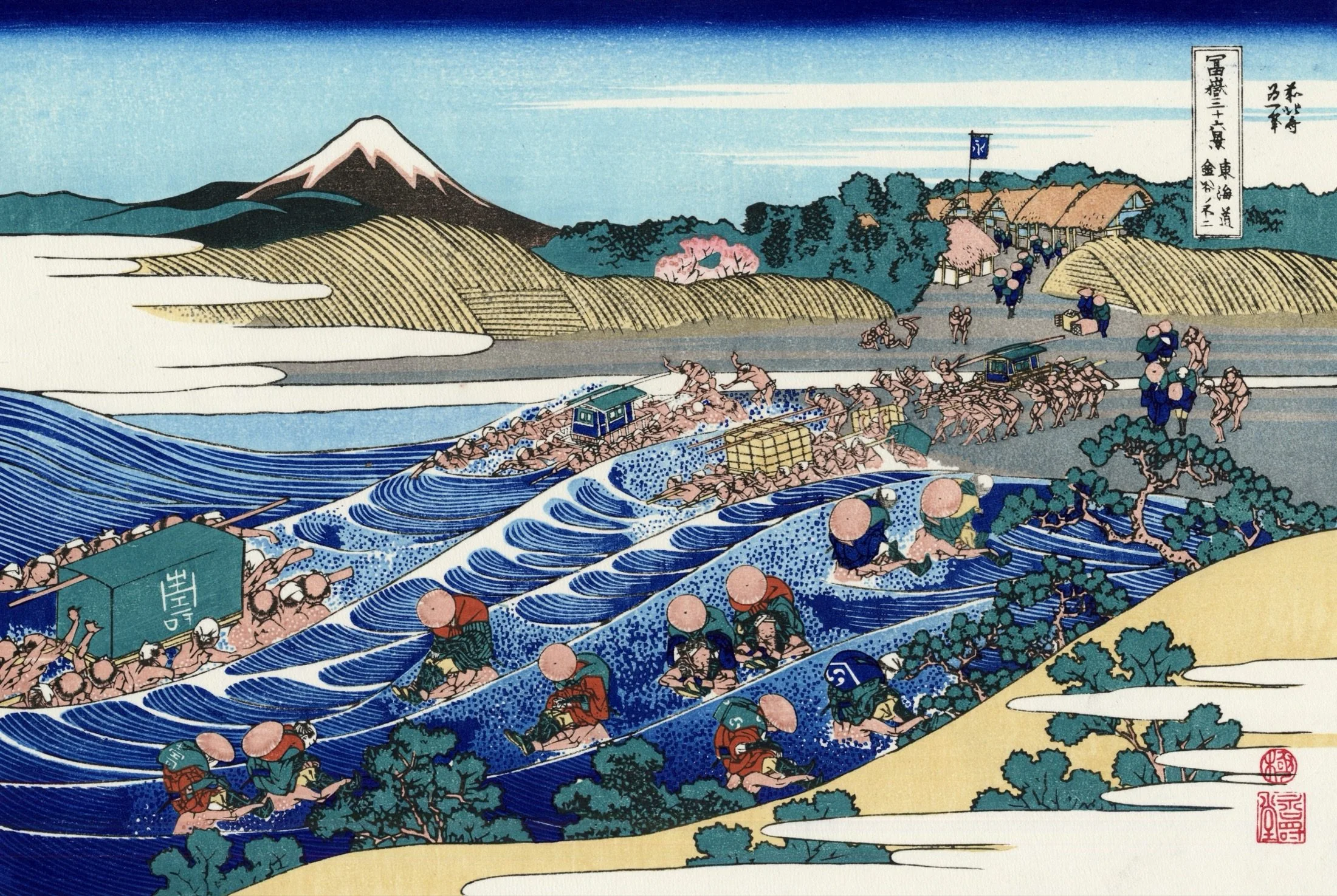
In Fuji from Kanaya, the mountain rises above carriers, goods, and the practical problem of crossing the Ōi River. Fuji becomes part of circulation. It is not only sacred and not only scenic. It belongs to roads, trade, and movement.
Taken together, these sheets do something stronger than repetition. They build a habit of recognition. Fuji becomes famous because viewers keep meeting the same mountain in changing visual situations and never lose it.
The workshop made repetition normal
The medium matters as much as the motif. A woodblock print was never the work of one hand alone. Designer, block carver, printer, and publisher all contributed to the final sheet. The ukiyo-e guide explains that process step by step; here it is enough to see that the medium was built for repetition. A successful image did not have to remain singular. It could be printed again, collected again, seen in another impression, and understood in relation to neighboring designs.
That is one reason Fuji scaled so effectively. The mountain was not trapped inside a unique object. It lived inside a commercial image system built for circulation. Early viewers did not just admire one masterpiece. They learned to recognize a mountain that kept returning through multiple sheets, multiple impressions, and multiple encounters. The icon was strengthened not in spite of reproduction, but through it.
Why the image traveled so well
The mountain's fame did not stay inside Edo print culture. In the nineteenth century, Japanese prints entered European and American collections, artists' studios, and museums. UNESCO's summary makes the point clearly: nineteenth-century woodblock prints helped make Fujisan an internationally recognized icon of Japan and influenced Western art deeply. By the later nineteenth century, the same sheets were also feeding what Europe called Japonisme. Once that happened, Fuji moved from local cultural memory into global image culture.
The image also traveled because the medium traveled well. Woodblock prints were affordable, reproducible, and easy to circulate. Later, museums, illustrated books, posters, classrooms, travel advertising, and heritage institutions kept selecting the same mountain. Each layer strengthened the previous one.
Why Fuji still works now
A strong icon survives reduction. Fuji does. It still reads at postcard size, on a museum wall, in a schoolbook, on a tourism poster, or in a phone-sized image. The reasons are the same as they were in Hokusai's time: clear outline, stable identity, and flexibility of use. The mountain can signify Japan, endurance, calm, weather, travel, danger, or spiritual ascent without losing its shape.
Modern tourism and the UNESCO designation of 2013 amplified that visibility, but they did not create it. They inherited an image that centuries of ritual, print circulation, collecting, and education had already made durable.
What the icon hides
The strength of the symbol creates its own distortion. Many viewers now collapse Fuji into one thumbnail, usually The Great Wave. That shortcut hides the labor scenes, route logic, weather changes, and serial thinking that actually made the mountain so memorable.
A second distortion is historical flattening. It is tempting to say that Fuji is "naturally universal." It is not. The mountain became universal through institutions: publishers, workshops, pilgrims, collectors, museums, guidebooks, schools, heritage bodies, and tourism networks. The icon is a historical construction, not a natural inevitability.
Mount Fuji became iconic because religion, form, and print circulation all pulled in the same direction.
Continue with linked works
Primary sources
- UNESCO World Heritage Centre: Fujisan, sacred place and source of artistic inspiration
- The Met Bulletin: Hokusai
- The Met: Under the Wave off Kanagawa (The Great Wave)
- The Met: South Wind, Clear Sky (Red Fuji)
- The Met: Kajikazawa in Kai Province
- The Met: Mishima Pass in Kai Province
- The Met: Fuji Seen from Kanaya on the Tōkaidō
- The British Museum: Mishima Pass in Kai Province
- The Art Institute of Chicago: Under the Wave off Kanagawa
- National Museum of Asian Art: Hokusai, a mad man before his time
Test your visual memory
If this essay made the mechanism clearer, open the art quiz next. The fastest test is simple: can you still recognize Fuji when Hokusai shrinks it, shifts it, or lets another form take over the foreground?
Frequently asked questions
Because it combines three rare advantages: long religious importance, an unusually clear silhouette, and a print tradition that repeated the same mountain across many different visual situations.
He did not invent Fuji's importance, but he did more than anyone to turn that importance into durable visual memory through Thirty-six Views of Mount Fuji.
No. The Great Wave is the most famous sheet, but Fuji's iconicity was built by the whole series around it: Red Fuji, Kajikazawa, Mishima Pass, and Fuji from Kanaya among others.
Tourism strengthened the icon, but the foundation was older: pilgrimage culture, Edo print circulation, museum collecting, schoolbook repetition, and modern heritage status.