
Ukiyo-e
Fine Wind, Clear Morning (Red Fuji)
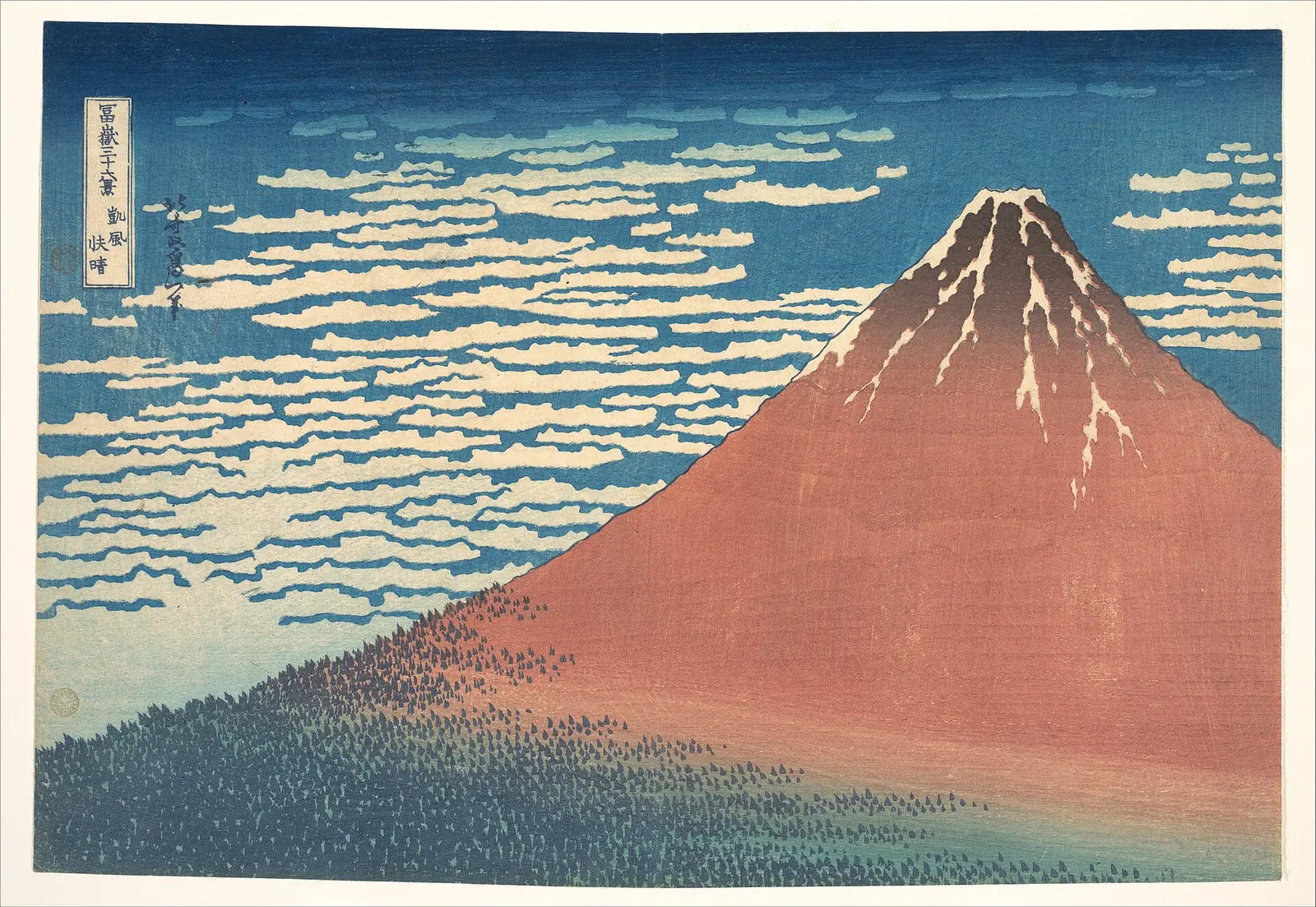
A mountain turns red for a short morning window, and an entire visual culture is born from that instant. In this print, Katsushika Hokusai shows how little is needed to make an image unforgettable: one slope, a few cloud bands, and color calibrated like weather.
A precise atmospheric moment, not a generic landscape
Fine Wind, Clear Morning (often called Red Fuji) captures a specific condition: low morning light warming the mountain's face while the sky remains cool. The red is therefore not a symbolic filter added on top of the motif; it is a temporal index, a sign that the scene belongs to a narrow climatic interval.
Fuji stays fixed, but the color makes time visible across it. The red face, cool sky, and thin blue cloud bands let a beginner read the print in seconds: first the mountain's geometry, then the weather passing over it.
What the print shows and what it omits
You see a dominant triangular mass, thin cloud strata, and an open sky with very few distractions. No crowd, no anecdotal foreground, no narrative detour. This omission is strategic: by removing local incident, Hokusai gives maximum interpretive pressure to color and contour.
The mountain's surface is not a flat red sticker. Subtle transitions from rust to darker bands create volume while preserving graphic simplicity. Because the forms stay large and legible, the image can travel across prints, posters, and screens without losing its structure.
Inside the logic of Thirty-Six Views of Mount Fuji
This sheet belongs to ukiyo-e serial culture and to Hokusai's broader project of making one landmark carry multiple temporal states. Read beside The Great Wave off Kanagawa or Sudden Shower over Shin-Ōhashi Bridge and Atake, the point becomes clear: Fuji is constant, atmosphere is variable, and meaning emerges from controlled variation.
Seriality here is not repetition for its own sake. It is a method. Each print tests a different relation between permanence (mountain) and contingency (light, weather, route, labor).
A comparison that clarifies Hokusai's method
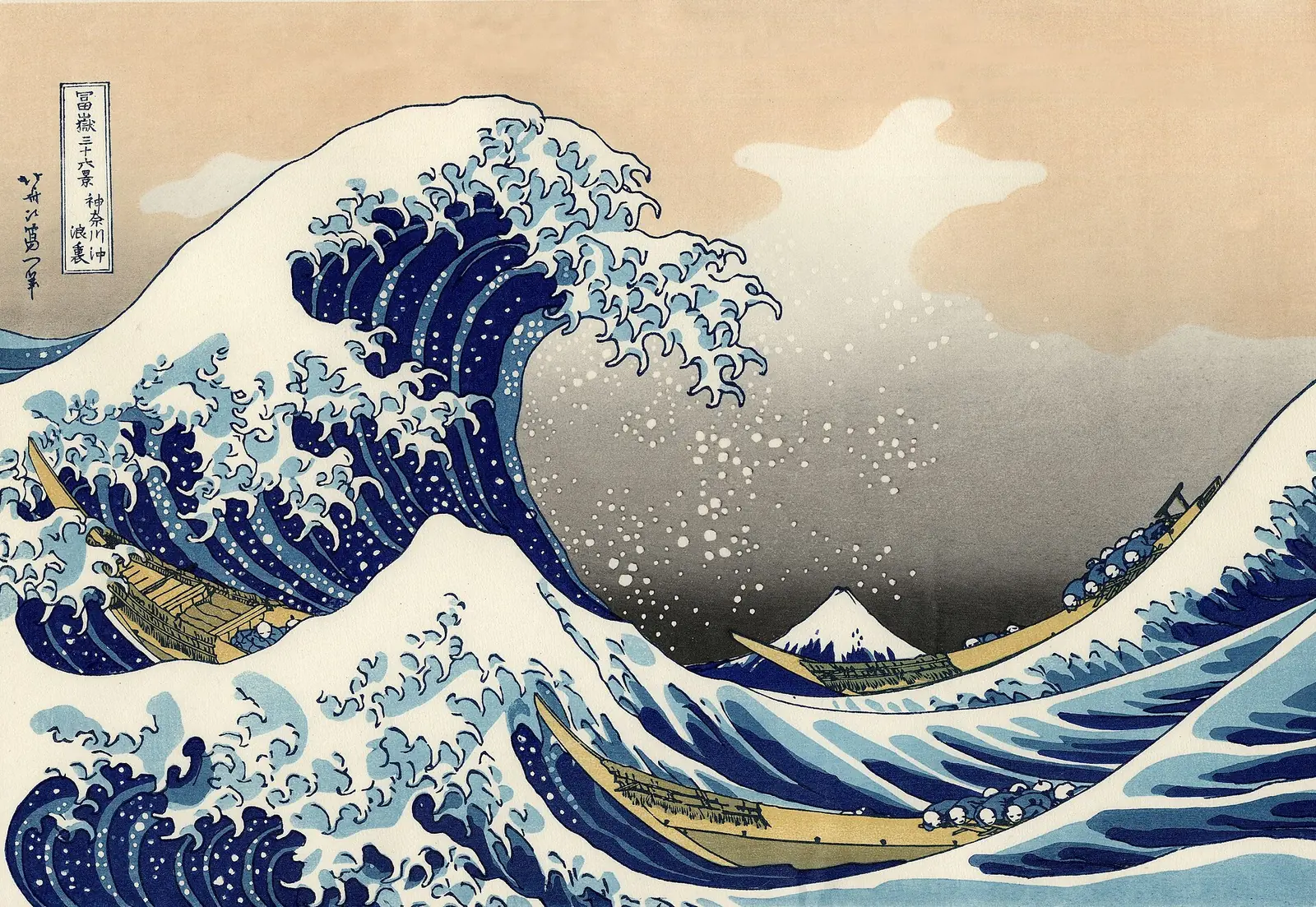
Compared with The Great Wave, this image is quieter but no less radical. The wave sheet dramatizes risk through violent curvature and crowding boats; Red Fuji dramatizes perception itself through stillness and chromatic shift. Same artist, opposite tempo.
Why Red Fuji still matters
The print's long afterlife comes from reproducible clarity. Its geometry survives scaling, cropping, and translation into modern formats, while its meteorological nuance rewards close looking. It works at two speeds: instant recognition from a distance, then a slower reading of weather, contour, and serial variation.
For deeper context, pair this page with the Hokusai page. Then test recognition in the art quiz and check whether you can distinguish Hokusai's compositional logic from nearby visual look-alikes.
The sheet's quiet force comes from a hard constraint: one mountain, one moment, no wasted form.
Explore more
Related works
Primary sources
Frequently asked questions
The strongest decision is reduction with precision: large color planes and restrained cloud bands make atmospheric change legible without narrative clutter.
It belongs to Hokusai's Thirty-Six Views of Mount Fuji, where one mountain is repeatedly re-read through different weather, routes, and visual tempos.
Compare with The Great Wave and Evening Shower at Atake to track different ways Japanese prints structure time and atmosphere.