
High Renaissance
The Virgin of the Rocks
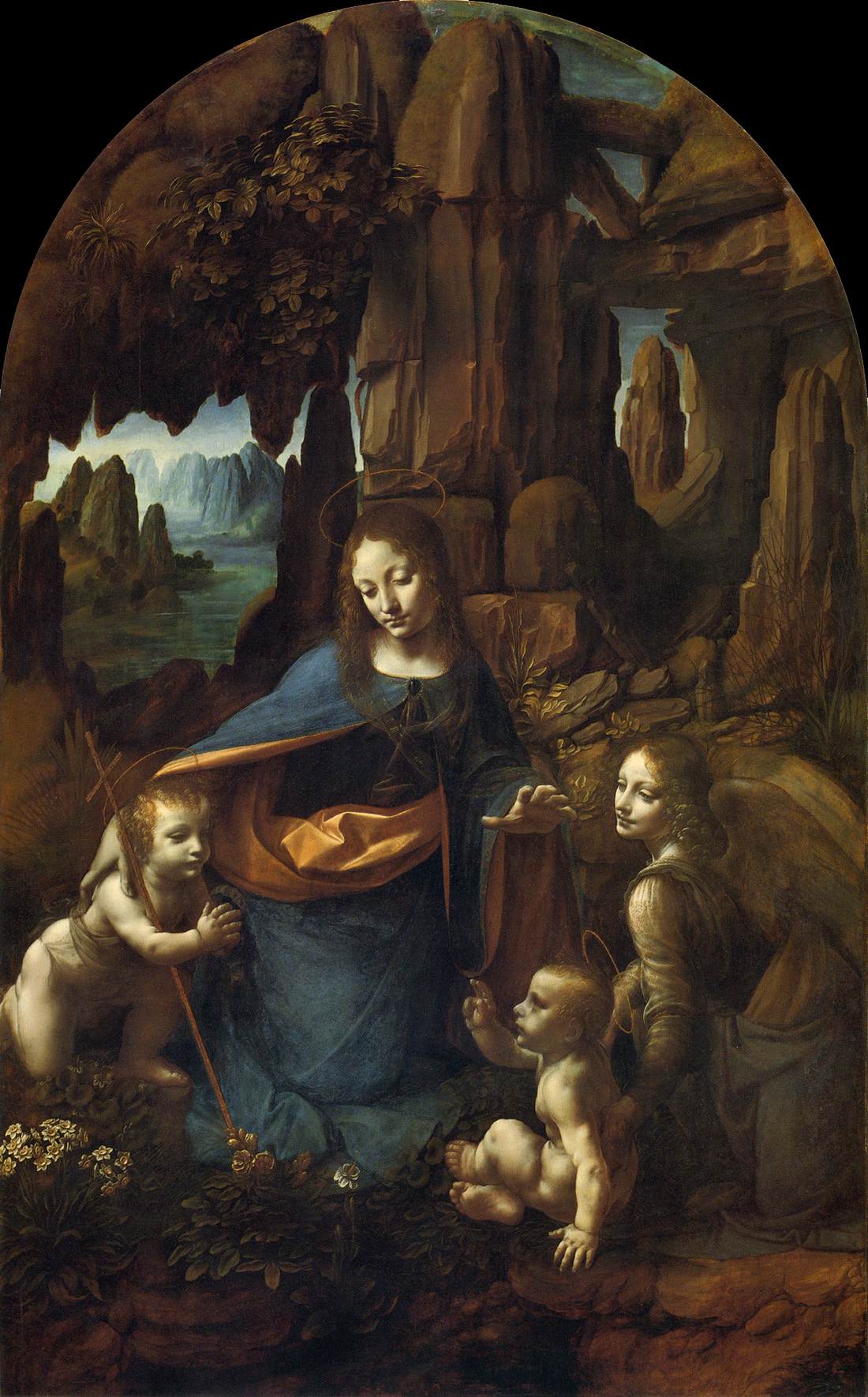
Four holy figures gather inside a cave, but Leonardo makes the rocks, water, plants, and haze feel as active as the people. The Virgin of the Rocks gives a very clear entry into Leonardo da Vinci's method: sacred painting becomes an experiment in atmosphere, nature, gesture, and visual uncertainty.
The version shown here is the National Gallery painting, made for an altarpiece connected with the Confraternity of the Immaculate Conception in Milan. A closely related earlier version is now in the Louvre. The two paintings show Leonardo working through a religious subject without turning it into a flat illustration. He builds a world where theology, geology, botany, optics, and human tenderness belong to one atmosphere.
What is shown
The Virgin Mary sits in a rocky grotto with the Christ Child, the infant Saint John the Baptist, and an angel. The figures are close together, but the space still breathes. Hands, glances, and kneeling bodies guide the eye around the group: Mary shelters, the angel indicates, John adores, Christ blesses. The scene seems silent, yet every gesture directs attention.
Leonardo places that sacred exchange inside a strange natural setting. The grotto is not a decorative backdrop. The rocks seem to rise like primitive earth still taking shape; water and bluish distance open behind the figures; plants grow close to the children. The setting makes the scene feel older than ordinary time, as if the holy family has been placed near the beginning of the world.
Why the grotto matters
The cave gives Leonardo an ideal space for experiment. It lets him paint indirect light, not a frontal beam but a softer brightness that slips across faces, hands, and mineral surfaces. The air feels damp, the reflections stay muted, and the darkness surrounds the figures without swallowing them. Instead of isolating the group against gold or architecture, Leonardo lets it appear inside a physically felt place.
The rocks, plants, water, and distant landscape do not merely decorate the scene: they help structure how it is read. The rocks are observed and invented at the same time. The plants look studied, though not all correspond neatly to real species. The distance depends on aerial perspective: far forms become bluer, softer, and less definite. Air, moisture, and depth change what the eye perceives.
The two versions
The existence of two versions gives the work an unusually rich history. The Louvre version is generally understood as the earlier painting. The National Gallery version is tied to a complex story of commission, payment, and replacement around the Milanese altarpiece. In the London painting, the angel no longer points outward in the same interruptive way, and the relations among the figures feel more enclosed.
Those differences redirect how the eye moves through the scene. The angel, Mary's gestures, Christ's blessing, and the relationship between the two children do not produce exactly the same rhythm from one version to the other. Leonardo is not copying a composition: he is changing how the figures communicate with one another.
What the painting reveals in the Leonardo-Michelangelo comparison
Compared with The Creation of Adam or David, this painting makes Leonardo's difference immediately visible. Michelangelo concentrates meaning into anatomy, scale, and bodily force. Leonardo spreads meaning through air, gesture, natural process, and tonal transition.
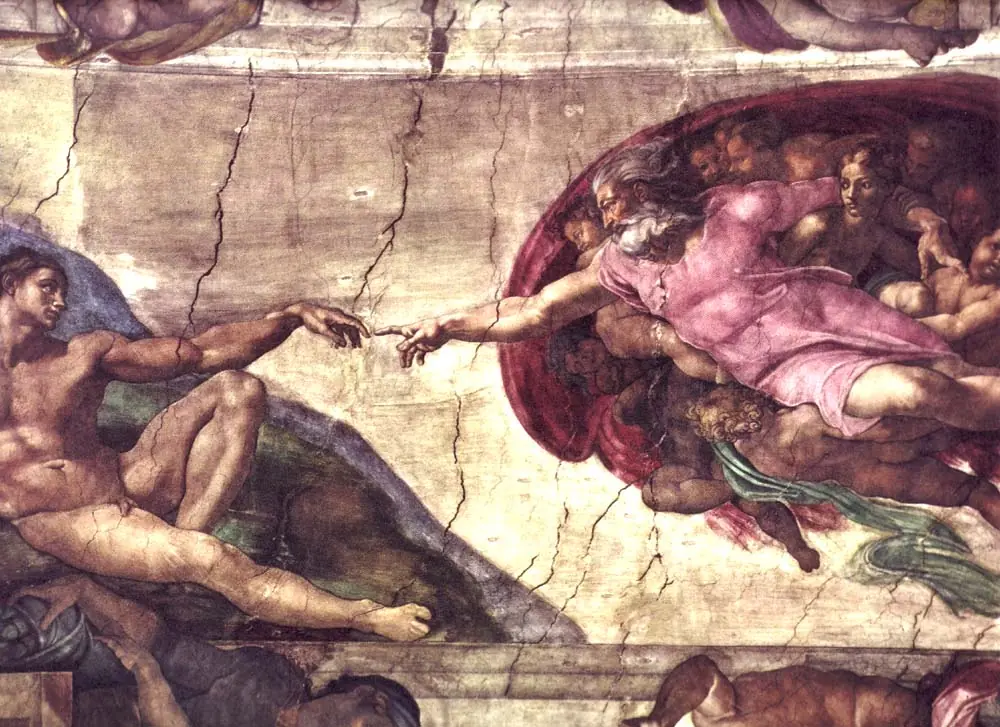
This contrast is central to Leonardo da Vinci vs Michelangelo. Leonardo asks the viewer to read relations slowly: a hand near a head, a child turned toward blessing, a landscape dissolving into blue. Michelangelo asks the viewer to feel form immediately: muscle, pose, extension, pressure. Both are monumental, but their routes to meaning differ sharply.
Where to look first
- Begin with Mary's hand over Saint John: it protects the child, but it also draws a direction.
- Then follow the glances and gestures between John, Jesus, and the angel. The group reads through relays, not as a frozen scene.
- Look at Christ's blessing: the small gesture answers John's adoration and tightens the spiritual center of the painting.
- Finally, enter the grotto: rock, water, darkness, and blue distance give the scene physical depth.
The painting rewards slow looking because no single element explains it alone. The more you follow the hands, glances, and passages of light, the more legible the scene becomes. Its mystery comes from relation: figures to setting, gesture to atmosphere, doctrine to natural observation. It is a religious image, but also a demonstration of how Leonardo turns seeing into inquiry.
Explore more
Related works
Primary sources
Frequently asked questions
The painting shows the Virgin Mary with the Christ Child, the infant Saint John the Baptist, and an angel in a rocky grotto. Leonardo connects the sacred figures with nature, water, rock, and creation.
Leonardo first painted a version now in the Louvre, and the National Gallery version is tied to a complex story of commission, payment, and replacement around the Milanese altarpiece.
It shows Leonardo turning religious painting into a study of atmosphere, nature, gesture, optics, and controlled mystery.