
Artist Guide
Cornelius Krieghoff
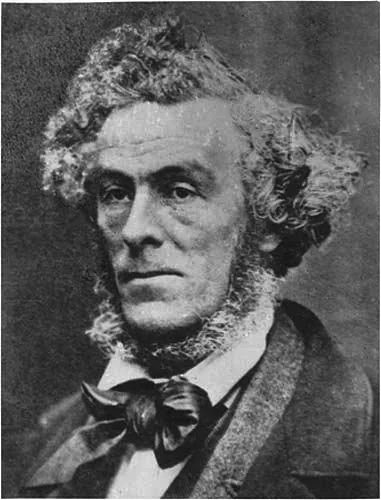
Cornelius Krieghoff turned winter Quebec into a visual system people could instantly read. He did not just paint snow scenes; he organized roads, tolls, crossings, and domestic routines into repeatable social narratives. His work sits at the intersection of observation, market demand, and identity construction.
From Amsterdam to the St. Lawrence corridor
Born in Amsterdam in 1815, Krieghoff trained in European contexts before building his career in British North America, especially in Quebec and Montreal. That trajectory gave him a dual position: close enough to local life to observe practical routines, but distant enough to package those routines for collectors seeking recognizable "Canadian" imagery. His work therefore belongs to both local history and transatlantic image circulation.
Instead of treating that distance as a flaw, it is more accurate to read it as his historical function. Krieghoff helped codify how Quebec winter life could be seen, remembered, and sold in the nineteenth-century art market.
A painter of social infrastructure, not just snow
Krieghoff's method is structurally clear. Roads, barriers, crossings, and doorways organize human relations before any symbolic interpretation starts. Snow is never decorative atmosphere; it is the condition that shapes movement, negotiation, and delay. That is why his scenes remain readable: they are built as social systems rather than loose anecdotes.
His realism is pragmatic. Clothing, architecture, and transport details create credibility, but the main goal is legibility of social interaction at first glance. This is what differentiates him from painters who prioritize painterly effect over narrative structure.
At the toll gate: movement, class, and small authority
The Toll Gate is a useful case study because it compresses governance into an everyday scene. A barrier, a route, and a transaction are enough to stage questions of class, compliance, and local authority. The same logic appears in Bilking the Toll, where social improvisation enters the frame more explicitly.
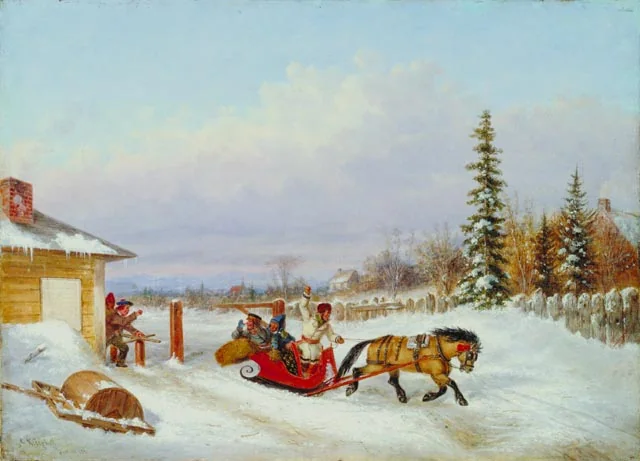
Read beside The Habitant Farm and The Ice Bridge at Longue-Pointe, these works map winter Quebec as a network of rules, shortcuts, and practical adaptation.
Serial motifs and market intelligence
A concrete anecdotal fact helps clarify his strategy: Krieghoff often produced multiple versions of successful motifs for different buyers. Repetition was not evidence of low ambition; it was how he tested compositional efficiency in a market that wanted recognizable scenes. This serial production made his imagery easier to circulate and helped stabilize a shared iconography of Quebec life.
That market intelligence partly explains his long visibility in museums, school culture, and popular memory. His pictures were not isolated masterpieces; they were nodes in a repeatable visual network.
What his paintings reveal and what they omit
Krieghoff is praised for documentary acuity and criticized for stereotype production, and both readings have merit. His paintings preserve concrete textures of nineteenth-century life, yet they also simplify social complexity into types that circulate efficiently. A critical reading must hold both facts together rather than choosing one camp.
Comparison helps. Set Krieghoff against Joseph Légaré in Cholera Plague, Quebec: Légaré foregrounds civic catastrophe, while Krieghoff privileges routine governance. The contrast clarifies his specific contribution to Canadian Realism.
Why Krieghoff still shapes Quebec visual memory
Krieghoff remains central because he built a durable grammar of winter social life. His images continue to return in moments when Quebec identity is publicly renegotiated, precisely because they combine clarity, recognizability, and interpretive flexibility. His legacy is this lasting framework of visual memory: not a final truth about Quebec, but a durable system that can still be read with both historical appreciation and critical distance.
Key works in Explainary
Associated movement
Now test recall with the art quiz: can you recognize Cornelius Krieghoff from visual cues in works like The Habitant Farm?