
Realism
The Ice Bridge at Longue-Pointe
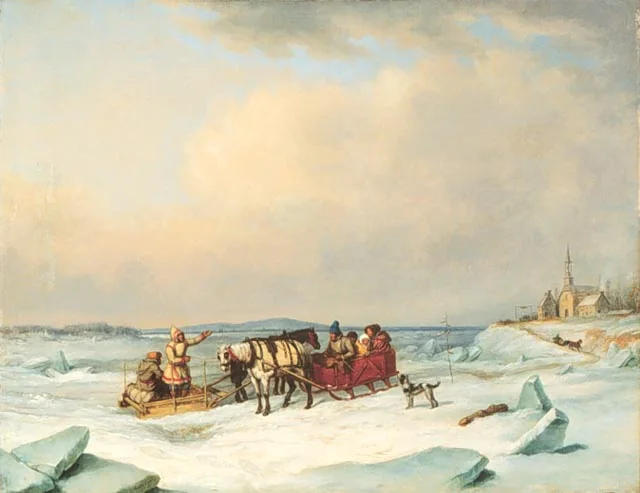
Few nineteenth-century images explain Quebec's winter reality as clearly as The Ice Bridge at Longue-Pointe. Krieghoff paints the frozen river not as scenic backdrop but as temporary infrastructure - a bridge made by climate, necessity, and collective risk management. This is crucial. The painting transforms winter from atmosphere into social engineering within a distinctly social branch of Realism.
A bridge without architecture
The phrase "ice bridge" can sound metaphorical, but here it is practical and literal. The St. Lawrence freezes enough to permit movement, and that movement reorganizes space, time, and economy. Krieghoff's composition stresses this by leading the eye across horizontal expanses where tracks, figures, and vehicles create improvised routes. Nothing is monumental, yet everything is high-stakes.
The absence of permanent construction is part of the meaning. Unlike stone bridges that symbolize durable state power, this bridge is seasonal and contingent. It must be read each day: thickness, cracks, weather shift, current. Mobility depends on local knowledge, not abstract planning alone.
Risk normalized as routine
Krieghoff avoids melodrama. There is no visible catastrophe. That restraint makes the image stronger. He shows danger normalized into daily practice - people crossing, working, negotiating distance in an environment where misjudgment can be fatal. The painting therefore offers a subtle anthropology of resilience: a community that survives through calibrated risk rather than heroic spectacle.
This differs sharply from the political-emotional intensity of works such as The Third of May 1808. Krieghoff's drama is logistical, not theatrical. Yet its social significance is equally deep, because repeated logistical decisions shape identity over generations.
The winter social contract
Who gets to cross, when, and with what load? Questions like these sit quietly inside the scene. The ice bridge functions as a shared resource, but also as a negotiated social space. Class, occupation, and local authority all condition movement. In this sense, the painting belongs with The Toll Gate and Bilking the Toll: all three examine governance at the scale of roads, barriers, and crossings.
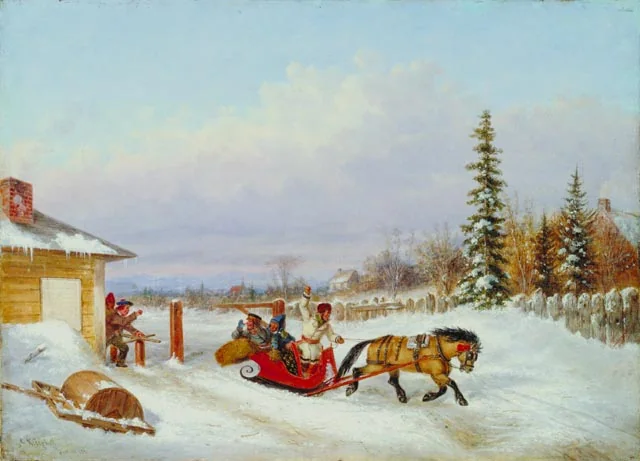
For Quebec history, that scale matters. Identity was not formed only in parliamentary rhetoric or nationalist manifestos. It was formed in repeated interactions with climate and infrastructure - where collective competence had to be demonstrated constantly.
Paint handling and perception
Krieghoff's palette and brushwork produce credible cold without flattening the image. Whites and grays are modulated to separate frozen planes, compacted paths, and atmospheric distance. Figures remain readable but not over-described, which keeps attention on system rather than individual heroism.
Spatially, the painting encourages lateral scanning. Your eye moves across the surface the way a traveler might scan ice conditions: where the path is compact, where traffic clusters, where route choice looks uncertain. This perceptual mimicry is one reason the work feels alive despite its modest scale.
Memory, myth, and selection
As with many Krieghoff works, the image can reinforce a selective memory of Quebec as predominantly rural, white, and homogeneous. Critical reading requires acknowledging that limit. But reduction does not erase value. The painting still records a historically specific mode of collective adaptation and helps explain why winter resilience became such a durable element in Quebec's self-image.
It also reminds us that identity myths rarely emerge from pure invention. They usually begin with repeated practical realities, then become stylized through cultural circulation. Krieghoff sits exactly at that junction between lived practice and representational codification.
Why this work speaks to present debates
In current conversations about autonomy, institutions, and social cohesion, climate infrastructure may seem peripheral. It is not. Societies often define themselves through the problems they repeatedly solve together. The Ice Bridge at Longue-Pointe visualizes one such problem and one such solution: collective mobility under severe environmental constraint.
For readers today, the painting offers a concrete analytic lesson. Identity is not only language and symbols; it is also shared competence in material conditions. Krieghoff turns that idea into an image that remains legible nearly two centuries later.
The point is not nostalgia. Krieghoff organizes visible evidence of collective decision-making: route choices, spacing, and pace encode local risk assessment. Unlike heroic history painting, the drama is procedural, and that procedural quality explains how everyday coordination becomes political memory.
Krieghoff paints winter as a system: route, risk, and shared adaptation.
Explore more
For broader context, continue with How to Understand a Painting and How Painting Shaped Quebec Identity.
Related works
Use the art quiz as a quick check: can you connect The Ice Bridge at Longue-Pointe to Cornelius Krieghoff when the options are mixed?
Primary sources
- Wikimedia Commons file metadata
- The Canadian Encyclopedia: Cornelius Krieghoff
- Britannica: Cornelius Krieghoff
- McCord Stewart Museum: Canadian winter and social history collections
- JSTOR: scholarship on Krieghoff and nineteenth-century Quebec winter imagery
- The Canadian Encyclopedia: St. Lawrence River
- The Canadian Encyclopedia: Canadian Art