
Insular Manuscript Maker
Eadfrith of Lindisfarne
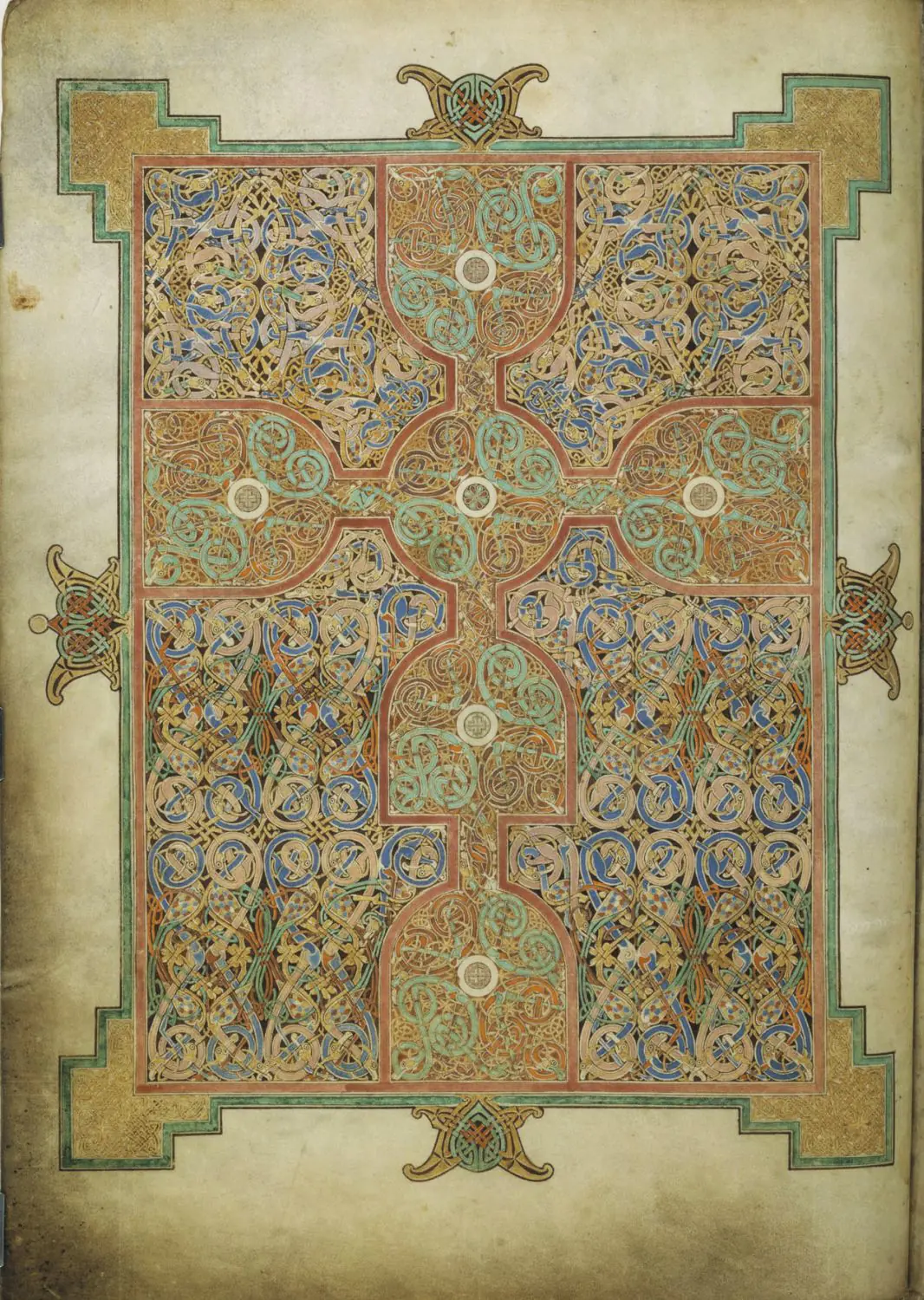
Eadfrith is one of the few early medieval makers whose name actually helps you read the work. He matters not because the Lindisfarne Gospels were made like a modern one-man masterpiece, but because his name lets us connect a real bishop, a monastic community, and an exceptionally controlled manuscript.
Bishop of Lindisfarne from 698 to 721, Eadfrith is the figure most closely linked to the book by a later written source. That makes him a rare bridge between anonymous workshop culture and identifiable design intelligence in early medieval Europe.
What we actually know about him
The secure facts are limited but important. Eadfrith was bishop of Lindisfarne, in the Northumbrian world of the early eighth century, and he died in 721. The key document is Aldred's colophon, added roughly two centuries later, which says that Eadfrith wrote the book for God and for St Cuthbert.
That is not the same thing as a signed modern document. It is later testimony, not contemporary self-advertisement. Still, in a field where named makers are rare, it remains strong evidence. Eadfrith is therefore not a legend attached to the manuscript after the fact. He is the best-supported personal attribution available for the Lindisfarne Gospels.
A bishop, a book, and the cult of St Cuthbert
Eadfrith also matters because Lindisfarne was not just a scriptorium. It was a cult center shaped by the memory of St Cuthbert. The year 698, when Eadfrith became bishop, is also the year Cuthbert's body was elevated by the community. Many historians therefore read the manuscript in relation to that renewed cult and to the need to give the house a book worthy of its saint.
That context changes how the manuscript feels. The pages are not decorative surplus added to a sacred text. They are part of a public devotional object, made for a community in which liturgy, prestige, and remembrance were tightly connected.
What kind of maker Eadfrith may have been
Calling Eadfrith an artist is useful, but only if the word stays flexible. He was not a modern studio painter. He may have been scribe, designer, illuminator, overseer, or some combination of all four. Aldred says he wrote the book. Modern readers use his name more broadly because the manuscript feels conceived as a coherent whole.
That is where the page itself becomes evidence. The Lindisfarne Gospels show ruled planning, compass work, highly stable patterning, and an unusual consistency between script and ornament. Whether every stage was executed by Eadfrith's hand or supervised by him inside a monastic team, the book still points to a governing intelligence rather than loose accumulation.
How Lindisfarne shows his method
The Lindisfarne pages do not feel improvised. On a carpet page, the cross remains legible from a distance, while the interlace holds together under close looking. The over-under pattern stays stable, the compartments do not drift, and color separates paths instead of creating classical depth. This is manuscript design under pressure, not spontaneous display.
Eadfrith sits productively between the Book of Durrow and the Book of Kells. Durrow makes the basic grammar of Insular ornament easy to see. Lindisfarne tightens that grammar into a more exact system. Kells then pushes similar forms toward denser, more elastic spectacle. Eadfrith matters in that middle position: he shows what happens when Insular ornament is subjected to almost total control.
He also helps mark a difference from emerging Carolingian art. Carolingian pages move more openly toward modeled bodies, revived Roman space, and a different kind of legibility. Lindisfarne remains committed to line, pattern, compartment, and sacred concentration.
Why his name still matters
Eadfrith's name is valuable because it gives this world a human scale without flattening it into biography. The manuscript still belongs to a monastic culture of shared making, and the larger production system matters enough to deserve its own page on Insular monastic workshops. But Eadfrith keeps us from talking about Lindisfarne as if it emerged from anonymous mist.
Eadfrith is not a medieval celebrity to admire from afar. He is the point where a name, a book, a saint's cult, and a method of page design become readable together.
Continue with related pages
Then use the art quiz and see whether Insular pages now stand out more clearly when medieval manuscripts are mixed together.
Sources
Frequently asked questions
Eadfrith was bishop of Lindisfarne from 698 to 721 and the named figure most closely associated with the Lindisfarne Gospels. He matters because early medieval manuscripts are rarely tied to a specific person with this degree of confidence.
Probably not in the modern sense of a solitary artist. Aldred's later colophon says Eadfrith wrote the book, but scholars still discuss how much was executed by one hand and how much involved monastic collaboration or supervision.
The key evidence is Aldred's colophon, added about two centuries later, which credits Eadfrith with writing the book for God and St Cuthbert. It is later testimony rather than a contemporary signature, but it remains the strongest named attribution attached to the manuscript.
His name helps readers connect the geometric discipline of Lindisfarne to a real historical figure without forgetting the monastic workshop behind the book. He is one of the clearest bridges between anonymous production and identifiable design intelligence in early medieval Europe.