
Abstract Art
Improvisation 28 (Second Version)
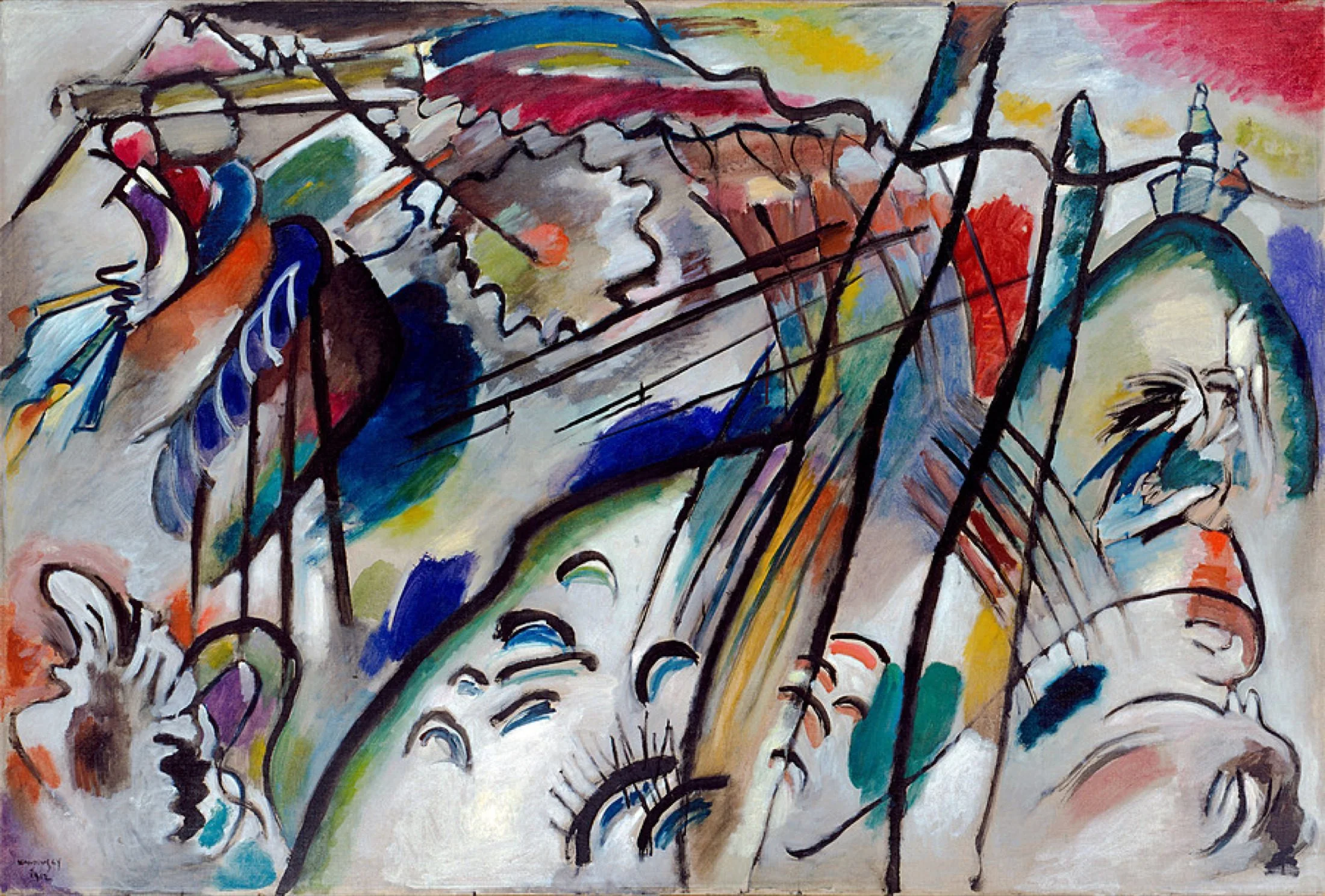
This painting feels like sound turning into movement. Kandinsky calls it an "improvisation," and the title works as method: read it as structured energy before you read it as object description.
1912: a risky transition, not a finished doctrine
When Kandinsky painted this work in 1912, abstraction still looked scandalous to many viewers. Improvisation 28 does not stage a clean break from figuration; it stages a threshold. Traces of riders, boats, and conflict motifs appear briefly, then dissolve into directional forces. That ambiguity is deliberate: Kandinsky is testing how far painting can move away from narrative while staying emotionally and structurally legible.
Diagonals, collisions, and moving color fields
The canvas is built from diagonals, arcs, crossings, and dense chromatic knots. Blue, red, yellow, black, and white behave as active pressures, not passive fills. Some zones accelerate the eye, others slow it, and coherence emerges through rhythmic relation rather than stable objects. The painting therefore asks to be read as an event in time, not a scene to decode once.
Inner necessity as a concrete method
Kandinsky's language of "inner necessity" is practical here. Directional lines establish momentum, chromatic contrasts redistribute weight, and partial recognitions keep the image open but not vague. This is why comparisons with music are useful: expectation, dissonance, and release are organized visually. In person, the brush pressure makes that rhythm clearer, because sharp cuts and feathered transitions produce tempo directly on the surface.
Why this canvas is a hinge in Kandinsky's trajectory
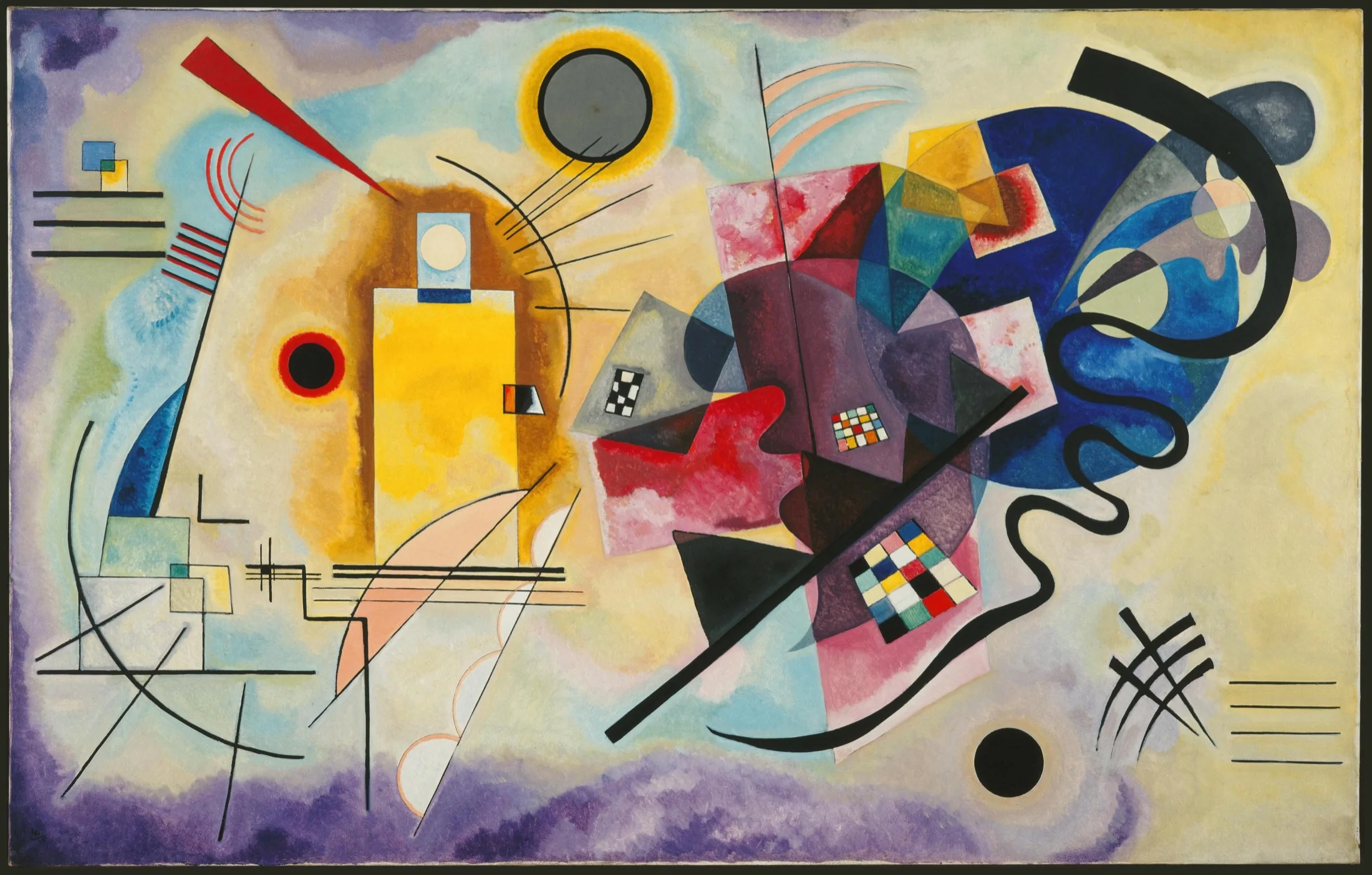
Read beside Composition VII and Yellow-Red-Blue, Improvisation 28 marks the turning point between eruptive experimentation and more engineered abstraction. It also clarifies the broader shift in modern painting: from "what is represented" to "how perception is organized."
Reception and longer historical impact
Early viewers often experienced this kind of painting as disorienting because it refused the normal hierarchy of subject, background, and narrative action. Over time, however, works like Improvisation 28 became crucial evidence that abstraction could build coherence through internal relations alone. That change in reception mirrors a broader shift in visual literacy: audiences learned to read pressure, rhythm, and interval as meaningful structures.
The impact extends beyond painting history. Kandinsky's model of layered signals, where dominant vectors coexist with secondary motifs, anticipates later visual systems that manage dense information without a single figurative anchor. This does not mean he "predicted interfaces" in a simplistic way; it means he developed a robust grammar for complex, non-narrative readability. The canvas remains a useful case study for how images can stay dynamic without becoming arbitrary.
A useful comparison chain inside abstraction
If you compare this work to Black Square, the contrast is instructive. Malevich seeks maximum intensity through near-zero vocabulary; Kandinsky seeks it through managed multiplicity. Add Mondrian to the sequence and a third logic appears: equilibrium through modular reduction. Together these pages show that abstraction is not one method but a field of competing solutions to the same problem of modern vision.
For that reason, Improvisation 28 is one of the best entry points to Kandinsky's broader project. It preserves the urgency of experiment while making the formal logic analyzable step by step, which is exactly what turns a difficult image into a durable teaching object.
Kandinsky's improvisation is not chaos. It is disciplined intensity that asks the eye to listen.
Related links
For a broader read, continue with Yellow-Red-Blue and Black Square, then the method essay How to Understand a Painting.
After this reading of Improvisation 28 (Second Version), open the art quiz to test if you can separate Wassily Kandinsky's work from close visual look-alikes.