
Essay
When Did Artists Start Painting Abstract Art? A Real Timeline
People ask this as if there were one founding moment: When did abstract art start? The stronger answer is more useful. Abstraction did not appear in a single studio, in one city, on one date. It emerged through overlapping experiments, competing theories, and different ambitions between roughly 1906 and 1930.
If you want a practical timeline in 2026, here is the short version: around 1906-1907 artists begin making fully non-objective works; in the 1910s abstraction becomes explicit, debated, and theorized; by the 1920s and early 1930s it becomes a transferable visual grammar used in painting, design, architecture, and education.
This still matters because we live inside abstraction every day: maps, interfaces, logos, dashboards, transit systems, and data visualization all rely on non-figurative clarity. Early abstract painters were not designing apps, but they invented crucial ways of thinking visually without direct depiction.
First, clarify what we mean by "abstract art"
A lot of confusion comes from mixing three different ideas under one label. Historians usually separate them:
- Abstraction from reality: artists simplify or distort visible subjects, but the motif remains recognizable.
- Non-objective painting: the work no longer represents a scene, body, or object at all.
- Systemic abstraction: abstraction becomes a method with rules, theory, teaching models, and cross-media influence.
When people ask, "Who invented abstract art?" they often mean the second or third category, not the first. That is why the answer depends on what threshold you are measuring.
Why the break became possible around 1900
Abstraction did not come from nowhere. Several forces converged. Photography had already taken over many documentary functions. Scientific culture made invisible forces newly imaginable (radiation, fields, wave models). Urban life accelerated visual perception. And artists circulated quickly through journals, salons, and transnational networks.
At the same time, many artists were trying to represent interior states rather than external appearances: attention, memory, anxiety, transcendence, rhythm. Once painting is asked to render those things, strict realism becomes only one option among many.
That context helps explain why different abstract solutions emerged almost simultaneously in different places. The problem was shared, even when answers diverged.
1906-1907: Hilma af Klint and the non-objective leap
A major early marker is The Ten Largest, No. 7 by Hilma af Klint. Her approach is not a hesitant transition. It is already structured through signs, circles, text fragments, chromatic fields, and serial logic that do not map to observed reality.
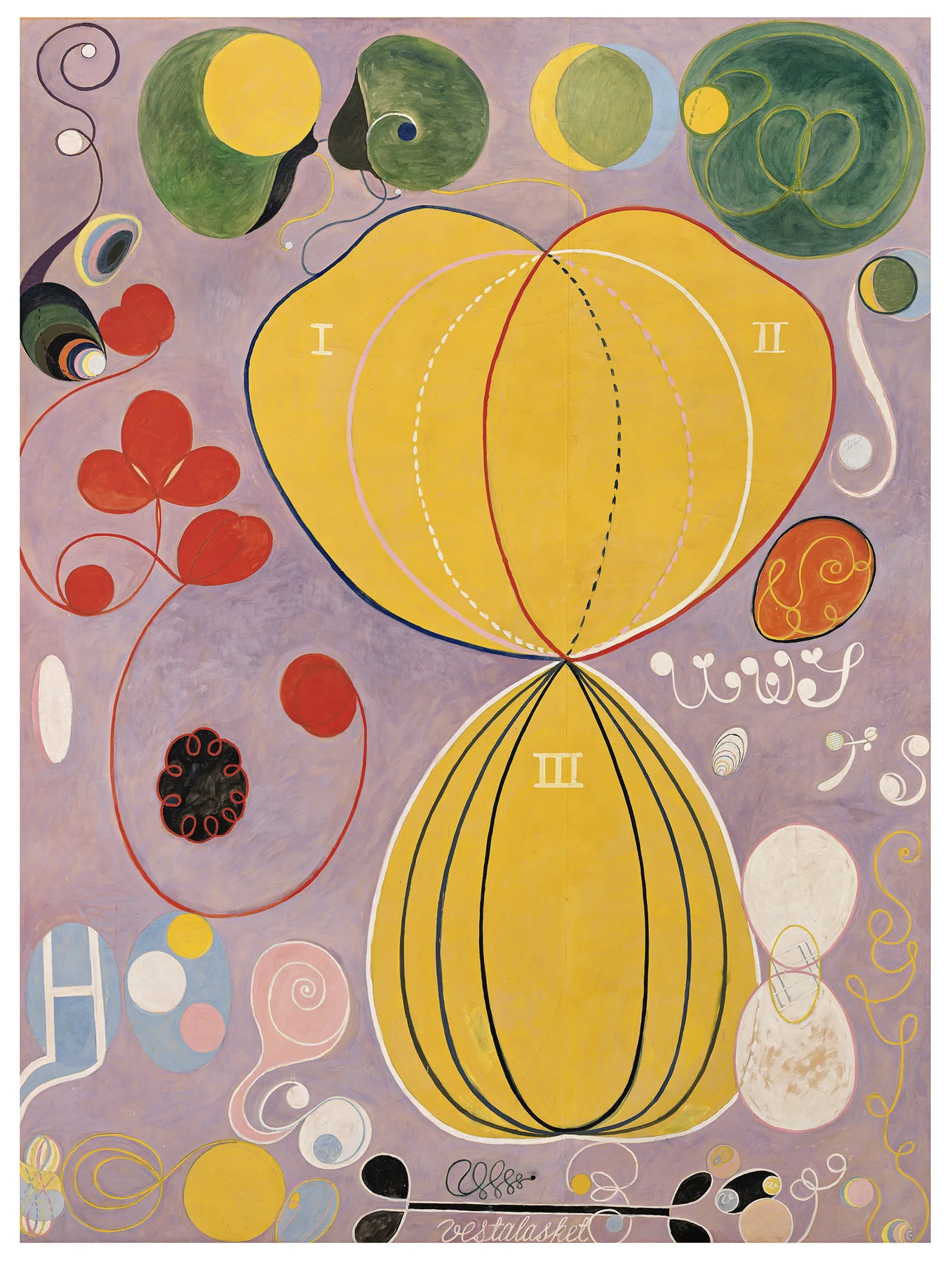
Af Klint's key contribution is methodological scale. She treats abstraction as a long-cycle program, not a one-off experiment. In other words, she does not merely paint a strange image; she builds a sustained abstract project with internal continuity.
Why was she long marginalized in canonical timelines? Partly because visibility lagged production. Works that are made early but shown late often enter history late. In 2026 scholarship, this lag is central to how abstraction's origin story is being revised.
1911-1913: Kandinsky and abstraction as visual music
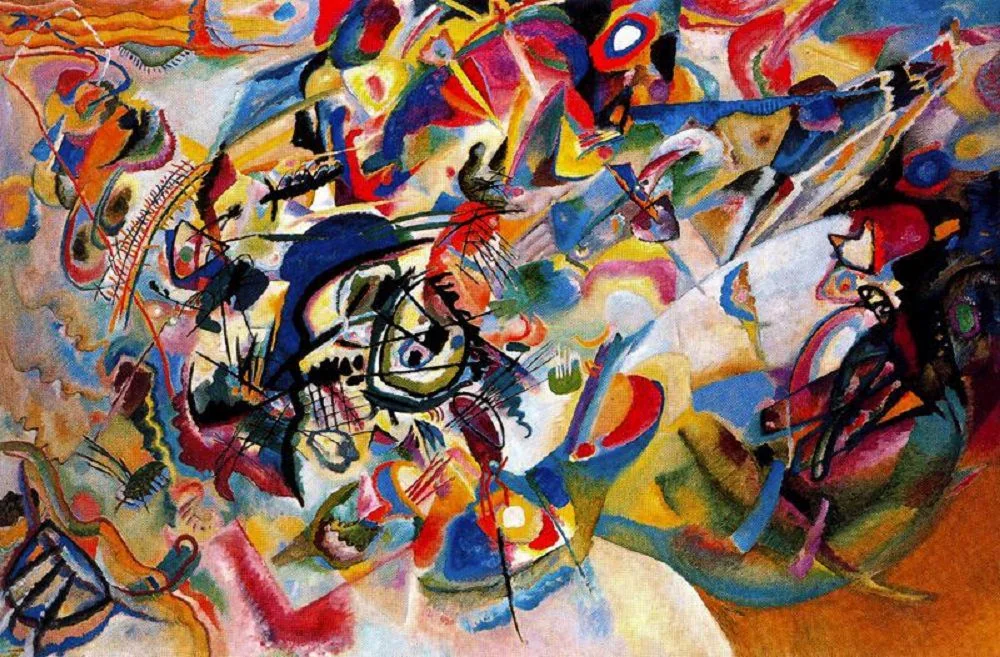
With Composition VII, Wassily Kandinsky demonstrates another path: abstraction as orchestration. Forms collide, rhythms overlap, directional forces pull against each other; the painting's meaning is produced by relation and intensity rather than object recognition.
Kandinsky also helped abstraction become discussable. Through writing and group activity, he provided terms for analyzing color, spiritual resonance, and compositional dynamics. Historically this is decisive: a movement stabilizes when it can be taught, argued, and transmitted.
Even famous dating debates (such as the so-called first abstract watercolor) are useful here. They remind us that "first" is rarely a clean category. What matters more is sustained production plus shared theoretical infrastructure.
1915-1918: Malevich and the zero degree of painting
If Kandinsky proves abstraction can be dense and expansive, Kazimir Malevich proves it can be severe. Black Square (1915) rejects scene, figure, and narrative at once. White on White (1918) pushes that logic to near immateriality.
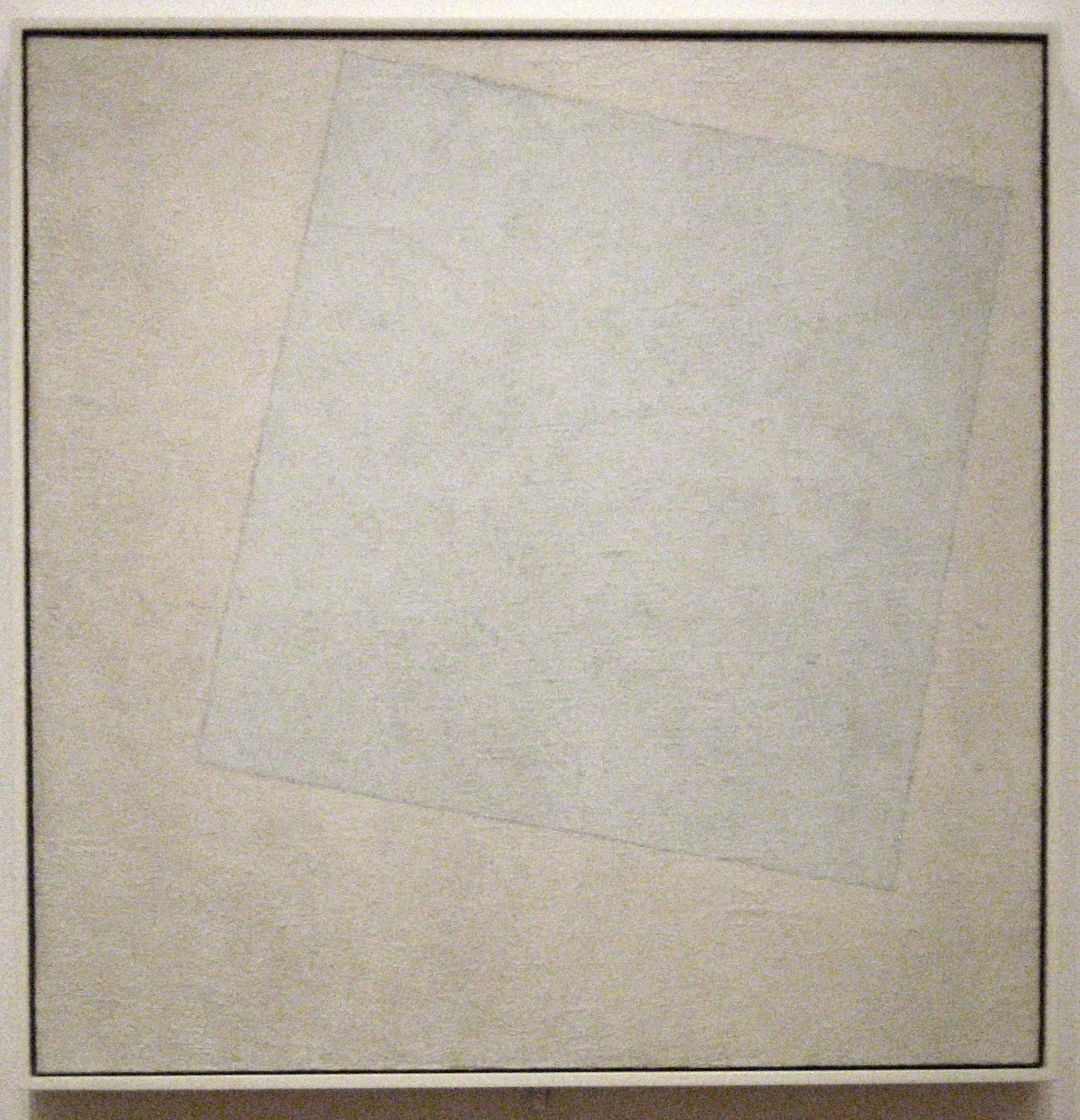
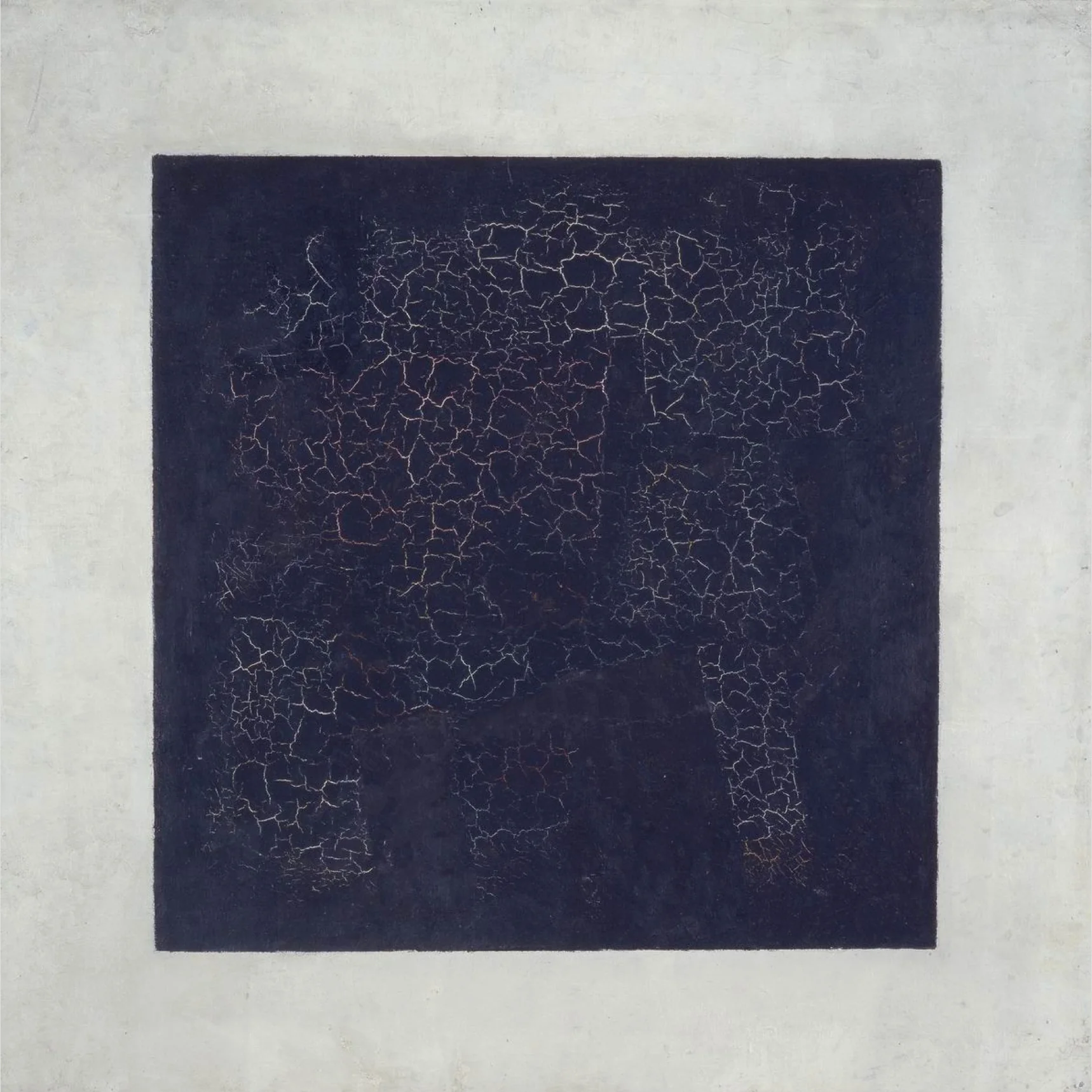
In the 1915 "0.10" exhibition, the placement of Black Square high in the room (where an icon might hang) made the claim explicit: this was not decoration, but a new hierarchy of vision. Malevich was redefining what painting is for.
Through Suprematism, painting becomes an investigation of edge, interval, orientation, and perceptual tension. That framework still underpins contemporary non-figurative design systems.
1917-1930: Mondrian, De Stijl, and abstraction as design grammar
By the time we reach Composition with Red, Blue and Yellow, Piet Mondrian has turned abstraction into an exact language: line, primary color, asymmetry, controlled spacing. The result looks simple, but the balance is tightly engineered.
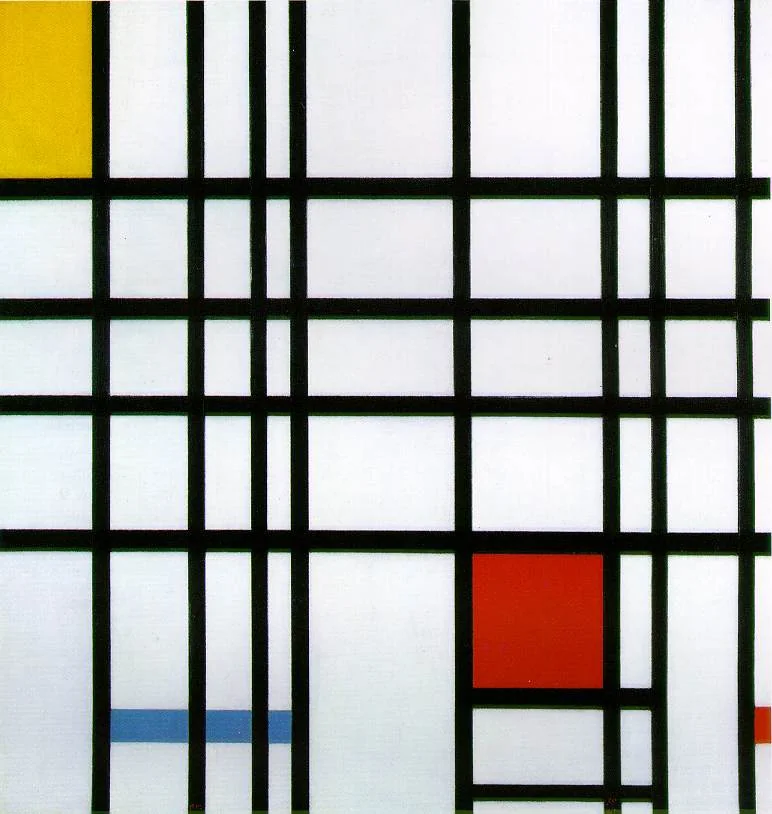
Within De Stijl, abstraction was no longer only about painting. It migrated into furniture, typography, architecture, publishing, and pedagogy. That transfer is historically crucial: abstraction becomes operational across disciplines.
At this stage, abstraction is no longer just avant-garde rupture. It is a system you can teach, repeat, critique, and adapt. That is one reason it scales so effectively into twentieth-century and twenty-first-century visual culture.
Parallel routes often left out of the "big four" story
A rigorous timeline should also acknowledge parallel contributors: Frantisek Kupka's experiments, Sonia and Robert Delaunay's chromatic structures, and constructivist approaches that integrated abstraction with material production and social design. The history is broader than any single lineage.
Including these routes does not weaken the narrative. It strengthens it. Abstraction becomes more coherent when we see it as a networked evolution rather than a relay race with one winner.
A practical timeline (1906-1930)
- 1906-1907: first sustained non-objective cycles appear in Hilma af Klint's studio practice.
- 1911-1913: Kandinsky's production and writing make non-figurative composition publicly legible.
- 1912-1914: broader European experiments test color/form autonomy across multiple groups.
- 1915: Black Square frames radical reduction as a historical break.
- 1918: White on White extends reduction toward near-dematerialized form.
- 1917-1925: De Stijl codifies geometric abstraction into a shared language.
- Late 1920s-1930: abstraction becomes embedded in design and architectural thought.
Three myths to avoid
Myth 1: "One artist invented abstraction."
History does not support this. Different artists solved different problems: serial symbolic structure, dynamic compositional force, radical reduction, geometric system building. The field is cumulative.
Myth 2: "Abstraction means random shapes."
Strong abstract works are highly controlled. Their legibility comes from proportion, interval, rhythm, contrast, edge behavior, and directional flow. The discipline is strict, even when the image looks spontaneous.
Myth 3: "Abstract painting has no relation to reality."
It relates to reality differently. Instead of depicting objects, it models forces: motion, tension, structure, scale, tempo, and perception. That is why abstraction remains so useful in contemporary visual systems.
How to read an abstract work without guessing
Use this quick sequence when you stand in front of an abstract painting:
- Track movement first: where does your eye accelerate, pause, or loop?
- Map hierarchy: what is dominant, secondary, and residual?
- Read interval and edge: how do distances and boundaries create tension?
- Test color function: is color describing, separating, weighting, or vibrating?
- Connect to context: what problem was this artist trying to solve in that year?
If you want a reusable method, continue with our How to Understand a Painting post, then return to abstract works with those questions in mind.
A 2026 lens: why this timeline still matters outside art history
The early abstraction timeline is not just a specialist debate. It explains why modern visual culture became comfortable with non-figurative systems: maps, interfaces, dashboards, logos, data graphics, and motion identities all depend on relations rather than depiction. When Kandinsky or Mondrian asked whether form could carry meaning directly, they were also opening a long technical future for communication design.
That is why the "when" question matters. If abstraction had remained marginal, it would not have moved into public institutions, publishing, education, and eventually digital product design. But because it became a shared grammar between the 1910s and 1930s, we now read complex abstract systems every day with minimal training. The history is old; the cognitive shift is still current.
A practical way to use this timeline is to compare two works with one fixed question: what formal problem is each artist trying to solve? Keep date and context in view, then test composition, color hierarchy, and edge behavior. The differences become concrete: af Klint builds serial symbolic systems, Kandinsky organizes force-fields, Malevich strips painting to structural minimum, and Mondrian stabilizes a transferable grammar. That side-by-side reading is far more reliable than searching for a single \"first\" abstraction.
Primary sources
- Moderna Museet — Hilma af Klint overview
- Guggenheim — Wassily Kandinsky
- Tate — Kazimir Malevich
- MoMA — Piet Mondrian
- The Met — De Stijl historical essay
So, when did abstract art begin?
Most defensible answer: it begins in sustained studio practice in the early twentieth century (around 1906-1907), becomes a self-conscious field in the 1910s, and turns into a transferable modern grammar in the 1920s and early 1930s.
Best answer: abstraction is not a single invention but a braided transformation. Once that becomes clear, the twentieth century reads differently—and so does visual culture in 2026.
Abstract art begins when relation, rather than representation, becomes the primary unit of meaning.
Where to continue
Next step: test your eye
Open the art quiz and test how quickly you can recognize these abstract works from visual cues alone.