Insular Art
The Ardagh Chalice
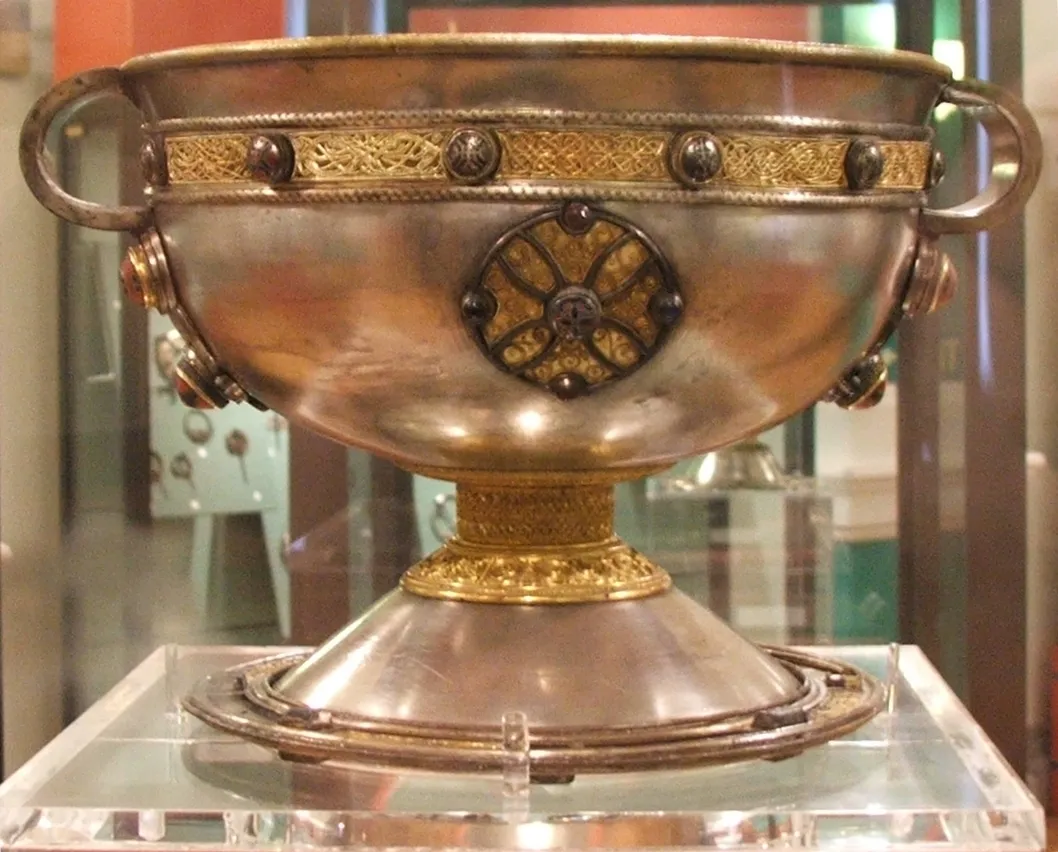
The Ardagh Chalice is the moment Insular art leaves the page without losing its discipline. You still get framed density, repeated ornament, and slow, controlled looking. But now the support is not vellum. It is a liturgical vessel in silver, gold, glass, and light.
Made in eighth-century Ireland, the chalice belongs to the same world as the Book of Durrow, the Lindisfarne Gospels, and the Book of Kells. It also belongs to the world of the Insular monastic workshops that shaped books, liturgical objects, and ritual attention across Ireland and the Irish Sea region. Inside the Insular sequence, it proves that the same visual intelligence can survive a complete change of medium.
What kind of object it is
The Ardagh Chalice is not a treasure cup made only to impress. It is a liturgical chalice used in the Eucharist. That function changes the way the object should be read. It had to work in the hand, in the rite, and in candlelight. Its precious materials mattered, but so did its ability to project sacred rank with calm authority.
Britannica describes it as a large two-handled silver cup, and that plain physical fact is already useful. The body of the vessel stays broad and stable while the ornament is concentrated into bands, studs, and engraved zones. The design does not cover every surface equally. It organizes attention by contrast: plain silver against dense filigree, smooth volume against worked edges, calm body against zones of intense detail.
How the ornament works
The chalice becomes much easier to read once you stop treating it as a pile of luxury details. The bands of decoration are doing structural work. They slow the eye, mark hierarchy, and keep the vessel from becoming visually flat. Filigree, studs, engraved inscriptions, and repeated abstract patterns all help divide the object into readable zones.
The makers are not trying to imitate natural appearances. Their intention is to build a vessel that concentrates sacred attention by balancing broad calm surfaces against intensely worked passages. Their method is cumulative and exact: assemble the form, fix the main bands, then use filigree, inscriptions, and colored accents to control where the eye lingers.
That logic is close to the manuscripts. In the Book of Durrow, framing and repetition keep the page legible. In Lindisfarne, compartments tighten and the system grows more exact. In Kells, density expands dramatically without losing control. The chalice belongs in that same family. It translates page discipline into metalwork. Even the engraved names of apostles around the bowl push the object toward the world of script and inscription, not away from it.
Made to move through ritual
The chalice is also an engineered object. It is assembled from many separate elements, not cast as one inert piece. That matters because Insular magnificence is rarely blunt. Precision is part of the effect. Gold filigree, glass studs, and worked metal details create a surface that changes as the object turns in the hand or catches shifting light.
This is where the page comparison becomes especially useful. A manuscript controls looking through line, color, and scale on a fixed surface. The Ardagh Chalice does something similar in ceremony, but with movement added. It is handled, raised, and seen from changing angles. Insular design does not disappear in that transition. It adapts.
Why it matters inside the Insular world
The Ardagh Chalice prevents a narrow version of Insular art in which everything important happens on parchment. Once it enters the sequence, the whole tradition widens. Insular art becomes easier to understand as a cross-media culture of framing, repetition, hierarchy, and sacred concentration.
Read the chalice beside the workshops page and the essay Book of Kells vs Lindisfarne. The workshops page explains the production system; the comparison essay clarifies visual differences between the major manuscripts; the chalice then shows that the same habits of control can move into liturgical metalwork without becoming decorative background.
Buried, lost, and found again
The survival of the chalice is contingent. It was found in 1868 near Ardagh, County Limerick, buried with other valuable objects. Like other early medieval treasures, it was probably hidden during a period of insecurity. Viking raids are often part of that story, though the exact circumstances of concealment cannot be reconstructed in full.
Its rediscovery restores a missing side of the Insular world. Without objects like this, the tradition can look too book-centered. The chalice reminds us that sacred attention in early medieval Ireland was shaped not only by pages to read, but by objects to hold, lift, and see in ritual space.
Key paths on Explainary
Read Durrow, then Lindisfarne, then Kells, and return here. The chalice stops looking like an isolated treasure and starts reading as a metal version of the same disciplined visual language. Then use the art quiz.
Sources
Frequently Asked Questions
It is one of the finest surviving examples of Insular metalwork and shows that the visual logic of Irish Gospel books also shaped liturgical objects made for ceremony and display.
It was a liturgical chalice used in the Eucharist, designed not only to function in ritual but also to project sacred dignity through precious materials and concentrated ornament.
It was assembled from many separate elements. A large silver body was enriched with gold filigree, gilt bronze, glass studs, engraved inscriptions, and intricate ornamental bands.
It was found in 1868 near Ardagh, County Limerick, buried with other precious objects, probably after being hidden during a period of insecurity in the early medieval period.