
Baroque / Dutch Golden Age
The Stoning of Saint Stephen
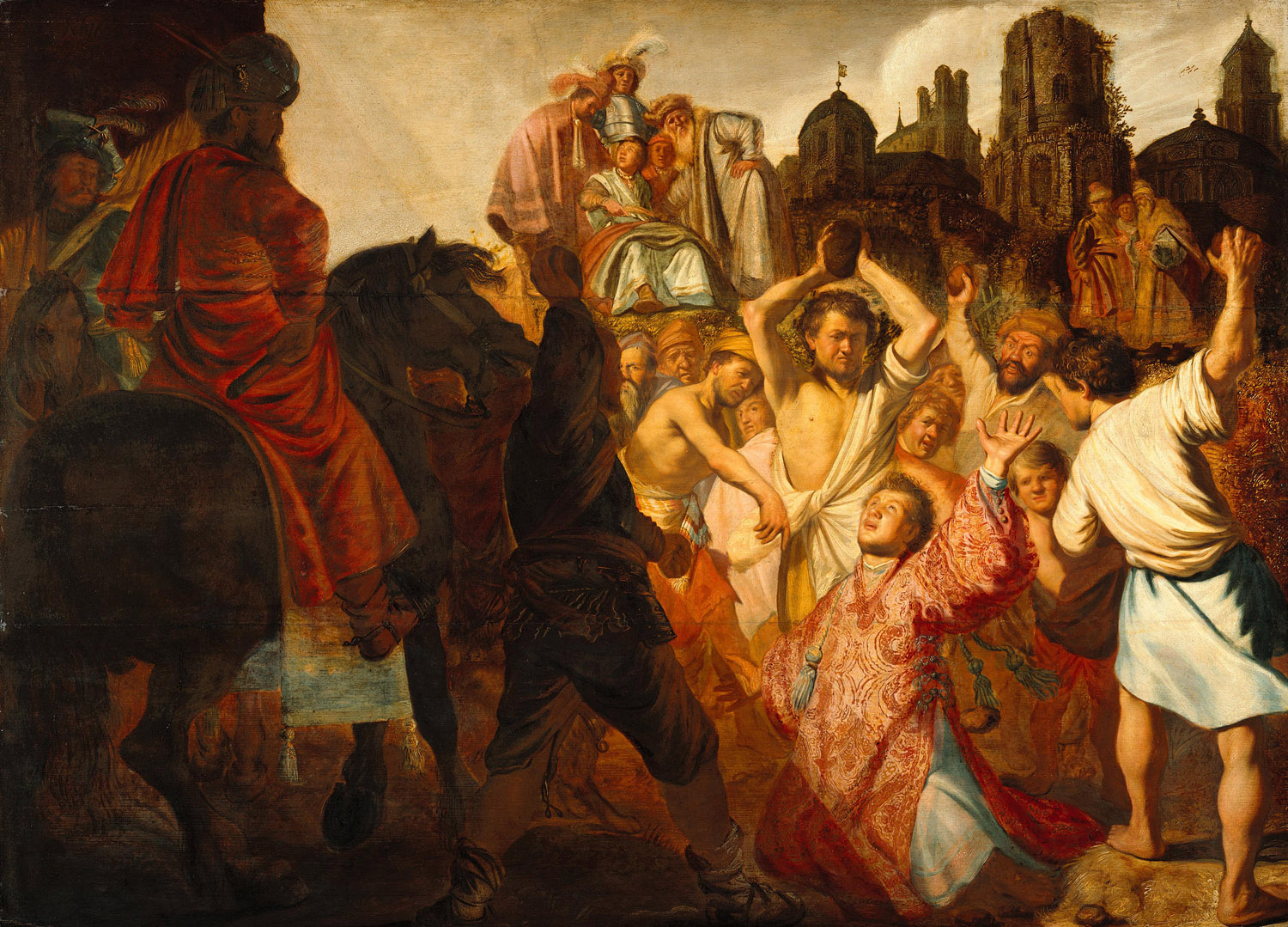
Around the age of nineteen, Rembrandt paints Stephen on his knees as the crowd around him raises its stones. Rembrandt van Rijn made The Stoning of Saint Stephen in 1625. The painting, now in the Musée des Beaux-Arts de Lyon, is usually treated as his earliest signed and dated painting. It is not yet mature Rembrandt, but the method is already visible: isolate the saint with light, press the crowd around him, and place the viewer before the violence.
The scene comes from the Acts of the Apostles. Stephen, a young deacon in the early Christian community, has been condemned after false testimony. Rembrandt does not choose an aftermath or a devotional stillness. He chooses the instant before the violence lands: Stephen is on his knees, the crowd closes in, and bodies around him are already lifting stones.
That choice makes the picture immediately readable. Light identifies Stephen before the full story is clear; raised arms set the rhythm of the attack; the crowd almost blocks the viewer's escape. Early Baroque drama appears here as a way of making the event felt, not as a decorative style.
A martyrdom split by light
The painting is built on a sharp division. In the foreground, several figures are caught in counter-light, packed into shadow and bodily effort. Above them, Stephen receives a much brighter light. The beam from above does not simply illuminate the saint; it visually separates the kneeling man from those about to strike him.
Stephen does not look weak. Around him, faces grimace, arms lock, stones rise, and bodies lean forward. He remains kneeling, turned toward a vision outside the visible frame. Rembrandt makes the contrast physical: the crowd pushes toward him, while his gaze has already left the earthly scene.
The reading needs no complicated symbol. The saint is visible, the crowd is compact, and the gestures are already underway. Rembrandt makes martyrdom legible through bodies before he makes it legible through biblical narrative.
What Rembrandt takes from Pieter Lastman
Rembrandt had recently left the studio of Pieter Lastman, a leading Amsterdam painter of history scenes. Lastman's influence helps explain the dense staging, biblical subject, theatrical costumes, and crowded surface. The Lyon painting is not yet the late Rembrandt of worn faces and thick paint; it belongs to a young painter proving that he can handle ambitious narrative.
The painting does not stay at the level of studio exercise. The bodies do not simply fill the space; they make pressure visible. Suspended hands, bent backs, twisted heads, and blocked sightlines keep the viewer inside the second before impact. The composition is crowded because the subject is crowd violence.
The painting shows what the young Rembrandt can already do. He turns a large biblical scene into a conflict of gazes: those who strike, those who watch, those who look away, and the saint who seems to see something beyond them.
The self-portrait places Rembrandt in the crowd
The Musée des Beaux-Arts de Lyon notes that Rembrandt inserted his own face just above Stephen's head, and perhaps the face of his friend Jan Lievens below the saint's hand. The detail is small, but concrete: Rembrandt does not illustrate martyrdom from outside. He slips himself among the witnesses, close to both the saint and the attackers.
The context gives that placement extra weight. The subject involves false testimony, public hostility, and religious persecution. The museum has connected the painting to the Remonstrant milieu around Petrus Scriverius, a Protestant current opposed to strict Calvinist predestination. Even if the precise commission remains uncertain, the image does not show only an ancient story. It shows a just man exposed to a crowd that has already chosen violence.
The self-portrait is not vanity. It turns Rembrandt into a witness inside the scene itself.
A Lyon painting with a complicated attribution story
The Musée des Beaux-Arts de Lyon acquired the painting in 1844 as a Rembrandt. The attribution was later doubted because the work did not match the Rembrandt many viewers expected: darker interiors, mature psychological depth, looser late surfaces. In 1962, the art historian Hans Gerson identified the signature and date, restoring the painting to Rembrandt's early corpus.
The attribution history helps explain why the painting can look surprising. It is not supposed to look like The Night Watch or the late self-portraits. It belongs to the Leiden beginning, when Rembrandt is still absorbing history painting from Lastman while making light, gesture, and witness more forceful.
Lyon therefore preserves an early Rembrandt: still young, still close to his models, but already able to turn a biblical scene into a tense visual confrontation.
From this early violence to mature Rembrandt
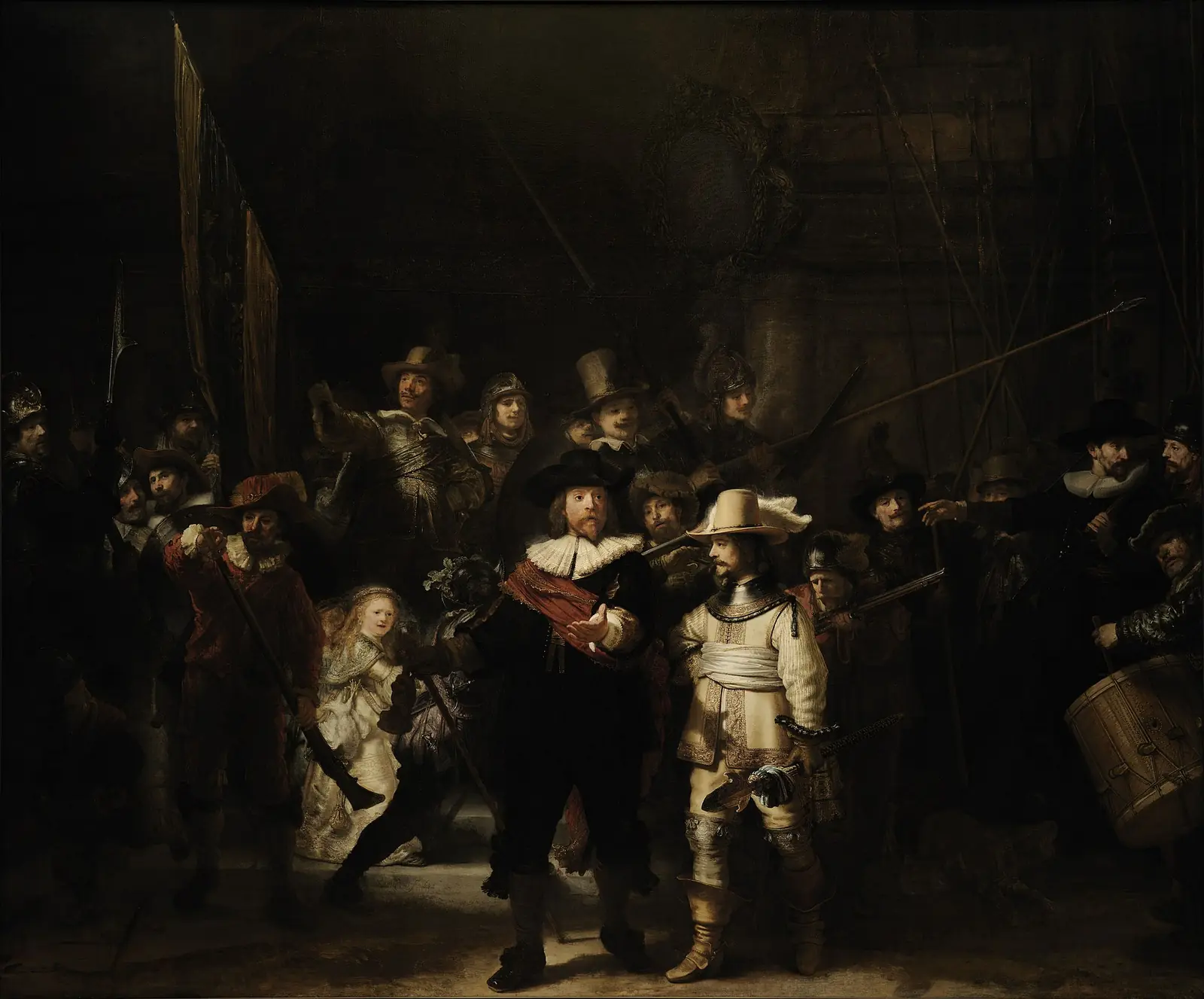
A direct comparison with The Night Watch shows the distance Rembrandt will travel. In the Lyon painting, light creates martyrdom by separating Stephen from the crowd. In the Amsterdam militia portrait, light distributes civic action across a public group. The device remains related, but the scale and social function change completely.
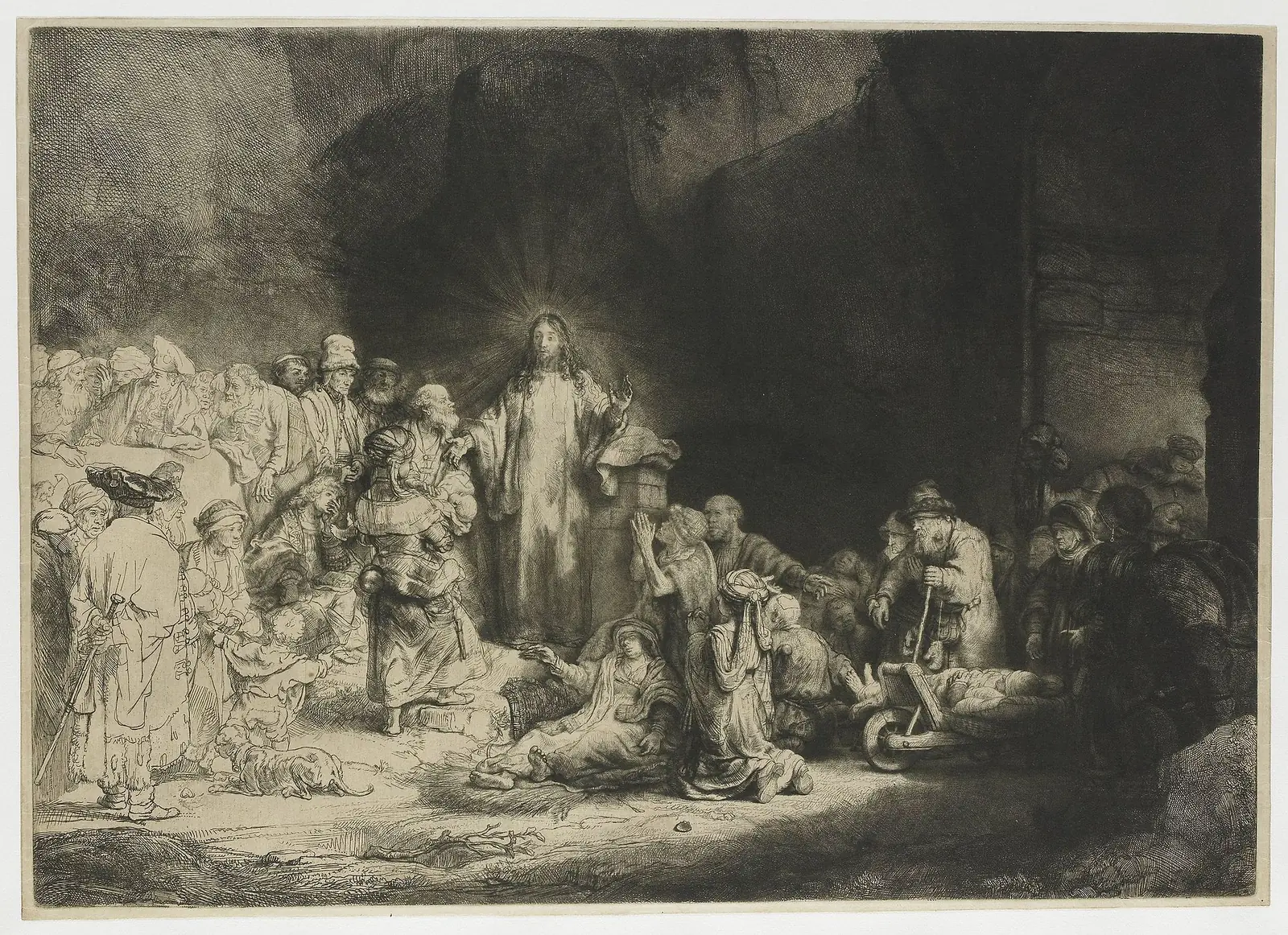
The same continuity appears in The Hundred Guilder Print. There, Rembrandt uses light and shadow to organize mercy, debate, illness, and attention around Christ. In the Lyon painting, light separates one saint from a hostile crowd; in the print, it organizes a whole group of poor people, sick people, children, and debaters.
How to read it at the museum
Start with the direction of the light. Then follow the stones: who holds one, who is about to throw, who is only watching? Next, compare Stephen's upward concentration with the crowd's compressed bodies. Finally, look for the small faces near the saint and ask why Rembrandt wanted witness, authorship, and conscience to occupy the same area of the picture.
The young Rembrandt makes martyrdom readable through three simple things: a kneeling body, an advancing crowd, and a light that isolates.
Continue with Rembrandt's profile, the wider Baroque guide, and the practical guide to chiaroscuro. Then test your visual memory in the art quiz.
Explore more
Related works
Primary sources
Frequently asked questions
The Stoning of Saint Stephen is a 1625 oil-on-panel painting by Rembrandt van Rijn. It depicts the martyrdom of Saint Stephen from the Acts of the Apostles and is now in the Musée des Beaux-Arts de Lyon.
It is usually treated as Rembrandt's earliest signed and dated painting. The young painter remains close to Pieter Lastman's history painting, but he already uses light, gesture, and crowd pressure to make the martyrdom immediately legible.
The painting is in the Musée des Beaux-Arts de Lyon, which acquired it in 1844. Its inventory number is A 2735.
The Musée des Beaux-Arts de Lyon identifies a self-portrait of Rembrandt just above Stephen's head. That detail makes the painting a scene of witness as well as a biblical martyrdom.
Yes. It belongs to early Rembrandt and to the wider Baroque world through its directed light, compressed action, diagonals, and forceful placement of the viewer before a dramatic event.