
Essential guide
Chiaroscuro in Art: Definition, Technique, and Examples
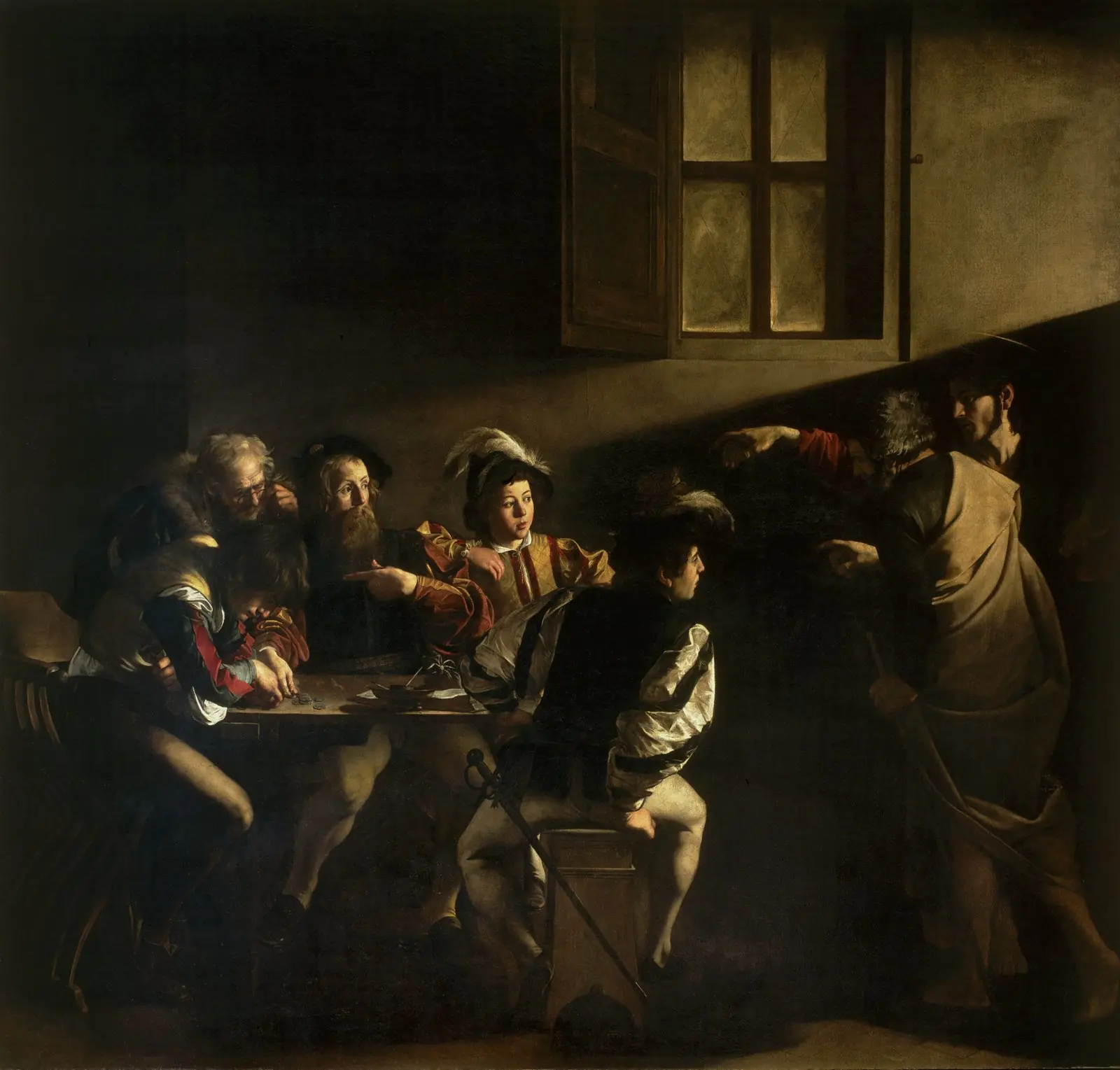
What is chiaroscuro? In painting, it is the use of light and dark to decide what matters. That is the fastest way into chiaroscuro. In Caravaggio's The Calling of Saint Matthew, the beam cutting across the room is not background atmosphere. It gives the scene structure, timing, and moral force. It tells you where to look, who is being claimed, and what remains uncertain.
This is why the term matters far beyond vocabulary. If you understand chiaroscuro, you start reading paintings differently. You see how volume is built, how attention is distributed, how drama is staged, and why darkness is rarely just emptiness. You also stop flattening several distinct techniques into one blur. Chiaroscuro, sfumato, and tenebrism overlap historically, but they are not interchangeable.
Chiaroscuro in one sentence
Chiaroscuro is the organization of light and dark so a painting can model form, direct attention, and stage drama. It is broader than sfumato, which softens local edges, and less extreme than tenebrism when the whole scene is not compressed into a harsh beam of light surrounded by darkness.
This page is built as a practical guide to chiaroscuro itself. It defines the technique clearly, shows how to spot it quickly, separates it from nearby terms such as sfumato, and trains the eye through five paintings already central to Explainary, by Caravaggio, Artemisia Gentileschi, Rembrandt, Vermeer, and Goya.
What chiaroscuro actually means
Chiaroscuro comes from the Italian words for light and dark. In painting, it refers to the use of tonal contrast to model form, separate planes, and organize emphasis. The term is broad. It does not belong only to the Baroque, and it does not automatically mean black backgrounds or theatrical shock. Renaissance painters use chiaroscuro to give bodies and drapery sculptural roundness. Baroque painters intensify it into pressure, stagecraft, and revelation.
That breadth matters. If you reduce chiaroscuro to one Caravaggio-style spotlight, you miss most of its usefulness. The core idea is simpler: a painting creates meaning by deciding how light and shadow distribute information. Which form advances? Which face remains half hidden? Which object receives the brightest accent? Which zone stays uncertain? Chiaroscuro answers those questions before iconography does.
This is why the technique belongs as much to method as to style. It is not a decorative add-on. It is one of the main ways painting turns a flat surface into something spatial, tactile, and emotionally charged. For a wider reading method, the next page after this one is How to Understand a Painting; chiaroscuro is one of the strongest tools inside that larger framework.
How to spot chiaroscuro quickly
If you want a fast museum test, do not start with labels or artist names. Start by asking what the light is doing to the image. Four cues usually make the answer clear:
- A dominant light direction. The picture does not feel evenly lit. One side, beam, lantern, or window does most of the work.
- Forms built by tone, not outline alone. Cheeks, sleeves, armor, and hands turn in space through gradations of light and dark.
- A hierarchy of attention. Some figures are pulled forward while others are delayed, softened, or partially hidden.
- Darkness that behaves actively. Shadow is not blank background. It withholds information, thickens mood, or pushes the bright zone into greater relief.
If all parts of a painting are lit with roughly the same clarity, you may still have realism, harmony, or color contrast, but you do not have strong chiaroscuro. The technique becomes most legible when the picture makes light unequal on purpose.
What chiaroscuro does to an image
First, it creates volume. Without tonal modulation, a face risks looking like a colored sign. Chiaroscuro gives it mass. A brow projects, a cheek recedes, a hand turns, a fold thickens. This is why the technique is so often discussed alongside sculpture: it helps paint feel bodily.
Second, it creates hierarchy. Not every part of a painting is equally important, and light is one of the fastest ways to make that clear. In The Third of May 1808, the lantern-lit white shirt is an ethical alarm. In The Night Watch, brightness moves across a crowd rather than staying in one place, which changes the whole social rhythm of the picture.
Third, it creates theater. Chiaroscuro turns rooms into stages. A table becomes a site of decision; a curtain of shadow becomes suspense; a body entering the light becomes an event. This is one reason the technique becomes so potent in religious and political painting. It can make revelation, violence, or witness feel timed rather than merely shown.
Finally, it creates tension. The eye never receives all information at once. It must move between exposed and withheld zones. That movement is not neutral. It is how the painting paces thought. Strong chiaroscuro often makes viewers feel that something is at stake before they can explain the story fully.
Chiaroscuro vs. sfumato
These terms are often confused because both involve light and shadow, but they operate at different scales. Chiaroscuro is the larger organization of tonal contrast across a picture. Sfumato is the soft local handling of transitions and edges.
A useful shorthand is this: chiaroscuro builds the light-dark structure; sfumato softens the joins inside that structure. Leonardo is the classic case because he uses both. His faces often sit inside a readable chiaroscuro pattern, but the eyes, mouth, and cheeks are joined by smoke-like transitions that avoid hard contour. Caravaggio, by contrast, depends far less on dissolved edges and far more on decisive zones of exposure and darkness.
If you want the full breakdown, open What Is Sfumato? next. The distinction matters because many viewers call any shadow-heavy old master painting "sfumato" when the real visual logic is plainly chiaroscuro.
Where tenebrism fits
Tenebrism is not a synonym for chiaroscuro. It is a more extreme branch of it, associated especially with seventeenth-century painting and with artists influenced by Caravaggio. Tenebrism pushes large parts of the scene into darkness and isolates the bright zone with greater violence. The effect is narrower, more abrupt, and usually more theatrical.
Put differently: all tenebrism relies on light-dark contrast, but not all chiaroscuro becomes tenebrist. Rembrandt often builds complex chiaroscuro without annihilating the surrounding world. Vermeer uses strong directional light against dark ground, but the darkness remains calm and breathable rather than engulfing. Goya inherits Baroque contrast for modern political ends, yet the lantern in The Third of May 1808 works less like a devotional spotlight than like an ethical exposure device.
| Question | Chiaroscuro | Tenebrism |
|---|---|---|
| Main job | Model form and guide attention through tonal contrast. | Intensify drama by isolating figures against deep darkness. |
| Darkness level | Can be moderate, distributed, or gradual. | Usually stronger, more engulfing, and more abrupt. |
| Typical effect | Volume, hierarchy, structure, pressure. | Spotlight revelation, shock, compression, theater. |
| Good mental image | A painting sculpted by light. | A painting staged by darkness. |
Among the five paintings discussed on this page, The Calling of Saint Matthew and Judith Beheading Holofernes are the closest to tenebrism: both compress the action into a sharply lit zone surrounded by large areas of darkness. The Night Watch works through broader, more distributed chiaroscuro rather than full tenebrist isolation. Girl with a Pearl Earring clearly uses chiaroscuro, but not tenebrism. The Third of May 1808 inherits some of tenebrism's pressure, yet uses it inside a wider modern political image rather than as a strict tenebrist scheme.
Caravaggio sits close to this boundary. He is a master case for learning chiaroscuro and an important route toward tenebrism. For the short side-by-side answer, open Chiaroscuro vs Tenebrism. The broader question on this page remains: how does light-dark contrast make the painting work?
Five paintings that train your eye
1. Caravaggio, The Calling of Saint Matthew
Caravaggio is the clearest case because he makes the logic brutally legible. In The Calling of Saint Matthew, the diagonal beam and Christ's pointing hand work together. The brightest zone is not just where the eye lands. It is where vocation becomes visible. The light does narrative work.
This is also the point where chiaroscuro begins shading toward tenebrism. Much of the room is withheld. Figures emerge out of dark rather than simply existing within a fully legible environment. If you want one picture that teaches why the distinction matters, start here and hold it in mind while you move to the next four.
2. Artemisia Gentileschi, Judith Beheading Holofernes
In Judith Beheading Holofernes, Artemisia Gentileschi inherits Caravaggio's proximity and contrast but pushes them toward bodily cooperation and violent contact. The light catches arms, sheet, blade, blood, and face in a compressed field where nothing can relax. Darkness does not simply create atmosphere. It forces the action into a tight, almost unbearable present tense.
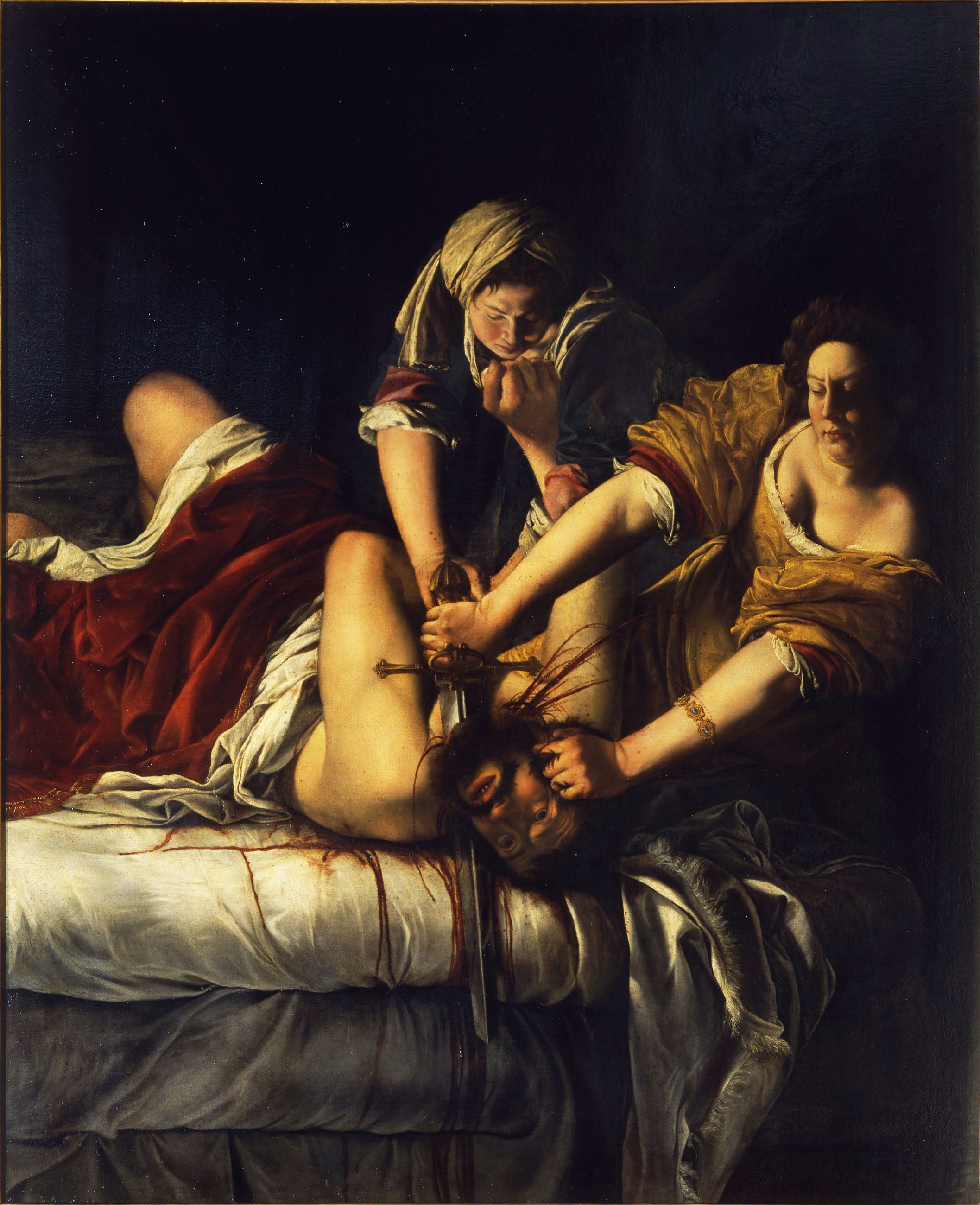
This is an excellent case for understanding that chiaroscuro can shape physical effort, not only spiritual revelation. The light organizes labor: Judith cuts, Abra restrains, Holofernes twists. Because the scene is so compressed, the contrast feels almost surgical. It belongs fully to the Baroque world of pressure and persuasion.
3. Rembrandt, The Night Watch
Rembrandt is indispensable because he proves that chiaroscuro can be distributed rather than single-beam. In The Night Watch, the picture is not staged as one flash of revelation in a void. Instead, light moves across a civic crowd, picking out Captain Cocq, the lieutenant, the enigmatic girl, the drummer, and fragments of weaponry or fabric at different moments.
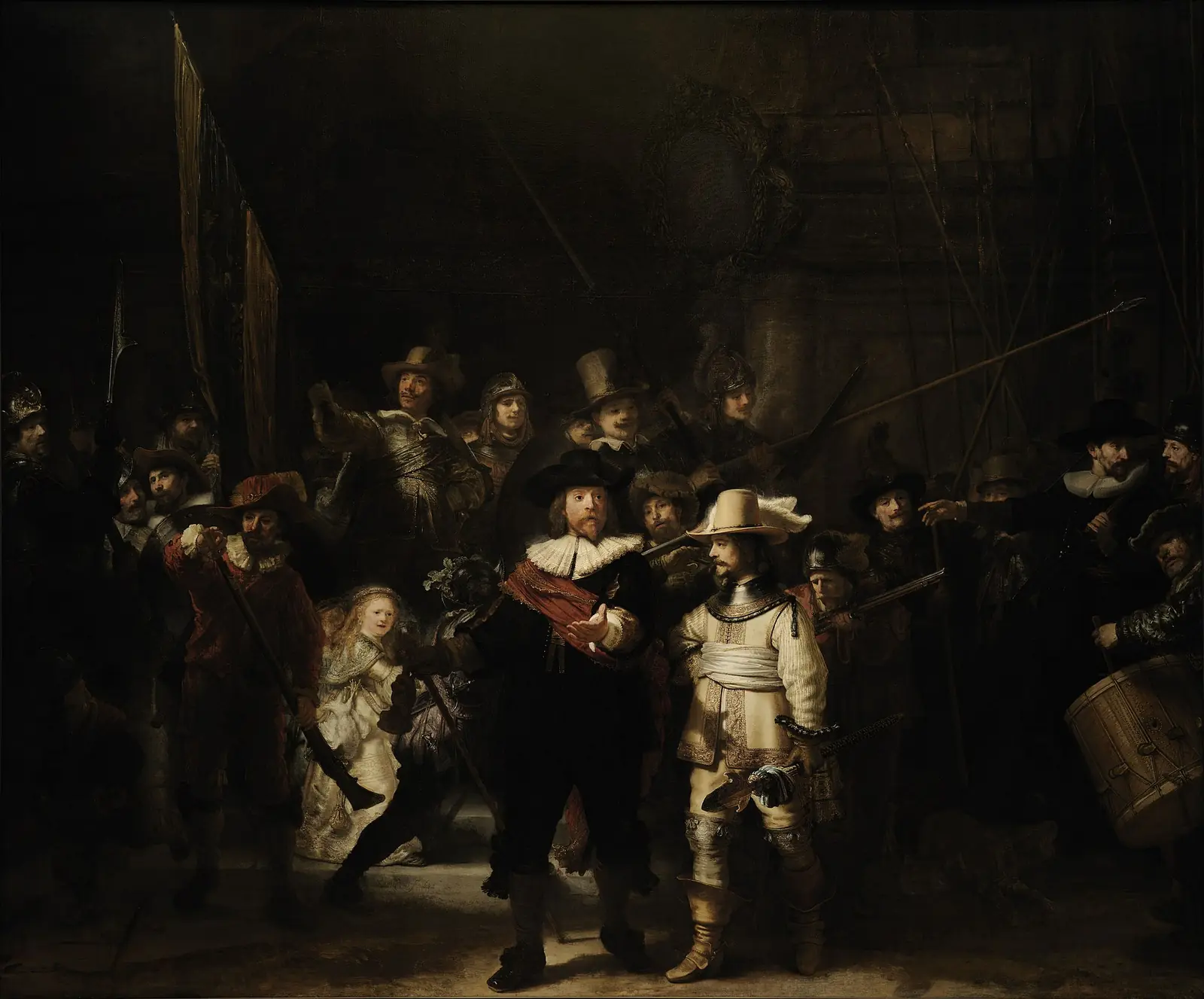
That difference is crucial. If Caravaggio teaches conversion by spotlight, Rembrandt teaches collective staging by unequal visibility. Some figures are fully assertive, others peripheral, others emblematic. Darkness remains active, but it does not erase the world. It thickens the social field. This is why Rembrandt is often better for learning chiaroscuro in the broad sense than for learning tenebrism in the narrow one.
4. Vermeer, Girl with a Pearl Earring
Vermeer is the essential counterexample. Girl with a Pearl Earring places a turning head against a dark ground and depends heavily on the relation between illuminated skin and surrounding shadow. So yes, it uses chiaroscuro. But it does so quietly. The effect is concentration, not shock.
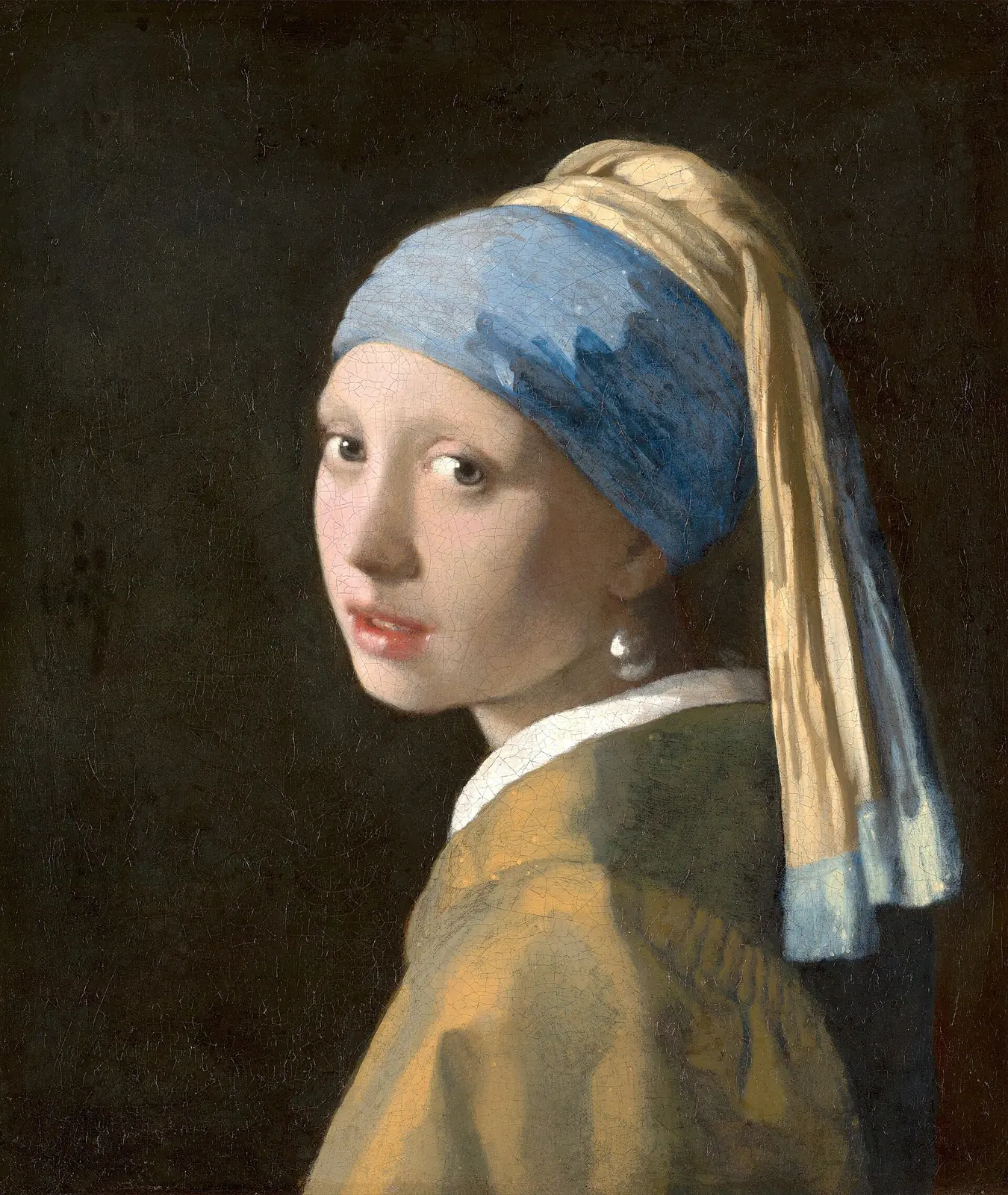
That is why the painting matters here. Many viewers see a dark background and assume tenebrism. But Vermeer's darkness is breathable. It does not feel like an engulfing void swallowing the world around the face. The head remains lucid, the pearl flashes, and the turning glance stays suspended rather than theatrically seized. The painting teaches that directional light and dark ground are not enough, by themselves, to produce tenebrism.
5. Goya, The Third of May 1808
With Francisco Goya, chiaroscuro becomes modern political argument. In The Third of May 1808, a lantern illuminates the victims and leaves the soldiers as a darker machine. The effect is not simply Baroque drama carried forward. It is a moral sorting of the image. Light separates civilian vulnerability from organized violence.
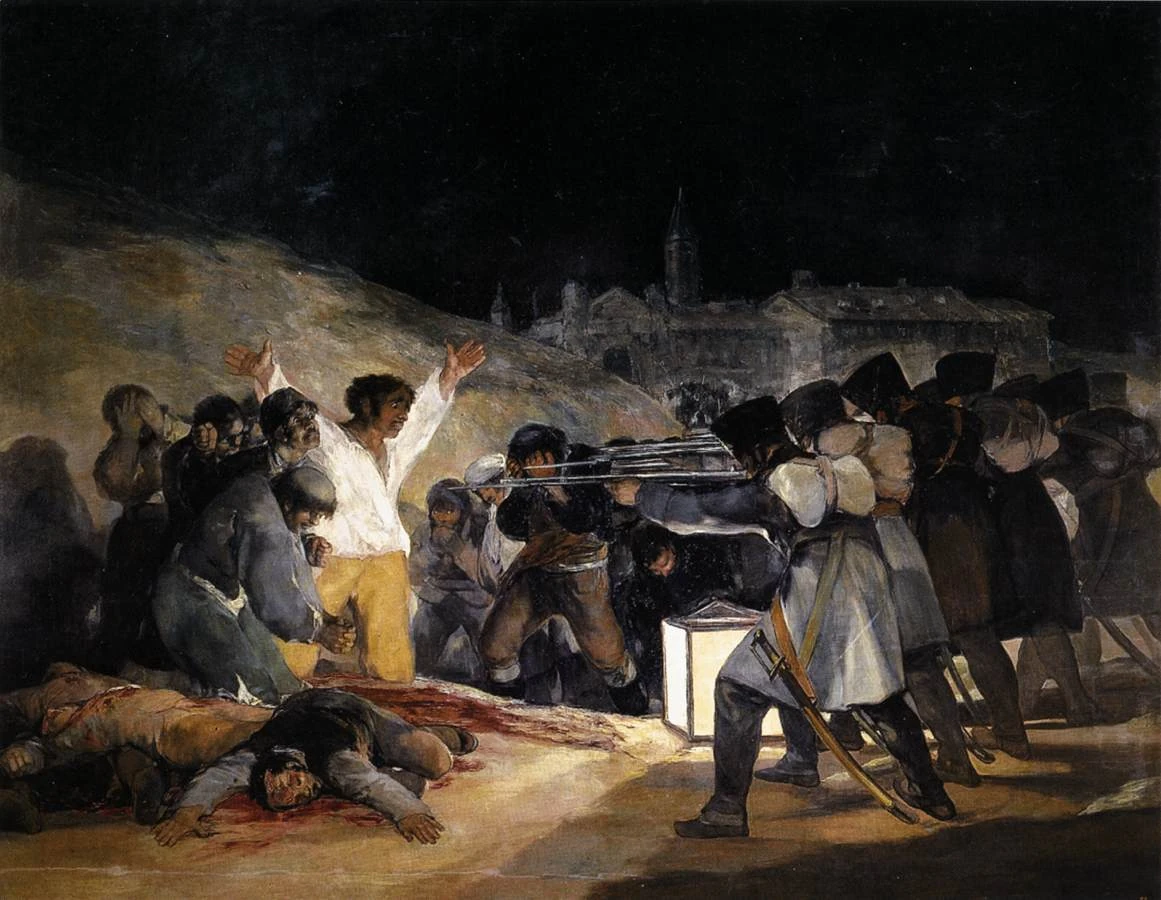
This is the moment when the technique stops belonging only to religious revelation or courtly theater and becomes an instrument of accusation. The white shirt is memorable not because it is merely bright, but because the entire tonal system is bent toward exposing the crime and assigning responsibility. If Caravaggio teaches revelation and Artemisia teaches pressure, Goya teaches indictment.
How to reuse this in a museum
The practical payoff is simple. When you meet a new painting, do not begin by asking what story it tells. Begin by asking how the light distributes permission to see. That one decision quickly clarifies whether the painting wants volume, intimacy, hierarchy, suspense, devotion, or public shock.
- Locate the dominant light source. Beam, window, lantern, or open sky: something usually governs the image.
- Ask what darkness withholds. Does it soften, delay, compress, or erase?
- Compare the brightest zone to the second-brightest. That is often where hierarchy becomes legible.
- Decide whether you are looking at broad chiaroscuro or near-tenebrist compression. The answer changes the whole reading.
If you want the larger method, continue with How to Understand a Painting. If you want the movement context that makes Caravaggio, Artemisia, and Rembrandt sit together more clearly, open Baroque. And if the question is really about soft edge transition rather than dramatic contrast, return to sfumato.
Primary sources
- National Gallery - glossary entry on chiaroscuro
- Britannica - tenebrism
- The Metropolitan Museum of Art - Caravaggio and his followers
- Khan Academy - Caravaggio, The Calling of Saint Matthew
- Uffizi - Judith Beheading Holofernes
- Rijksmuseum - The Night Watch collection record
- Mauritshuis - Girl with a Pearl Earring
- Museo del Prado - The Third of May 1808
- National Gallery - Artemisia Gentileschi
Related reading
Next step: quiz
Then try the art quiz. Once you start sorting paintings by their handling of light, recognition gets much faster.
Frequently asked questions
It literally means light-dark. In practice, it describes the use of tonal contrast to model form, direct the eye, and stage the picture's emotional pressure.
Tenebrism is an intensified branch of chiaroscuro: darkness takes over much more of the surface and isolates a sharply lit zone. For the focused comparison, read Chiaroscuro vs Tenebrism.
No. Chiaroscuro organizes large tonal contrasts, while sfumato softens local transitions and edges so forms dissolve more gently.
Strong examples include The Calling of Saint Matthew, Judith Beheading Holofernes, The Night Watch, Girl with a Pearl Earring, and The Third of May 1808.