
Essay
Hearing Colors: How Synesthesia Shaped Abstract Art
“Hearing colors” can sound like a romantic slogan, but for some people it describes a stable perceptual reality. In synesthesia, a stimulus in one sensory channel can trigger an additional experience in another channel: sounds may evoke color, letters may carry specific hues, days of the week may appear in spatial layouts. This matters for art history because it opens a practical question: what happens when painters stop treating color as a skin applied to objects and start treating it as an event in time, closer to rhythm than description?
The claim of this article is precise: synesthesia did not single-handedly “invent” abstract art, but synesthetic thinking gave artists a robust working model at a crucial moment. It legitimized the idea that a painting could be meaningful without representing a recognizable scene, because relation itself—interval, contrast, recurrence, tension—could carry structure and emotion.
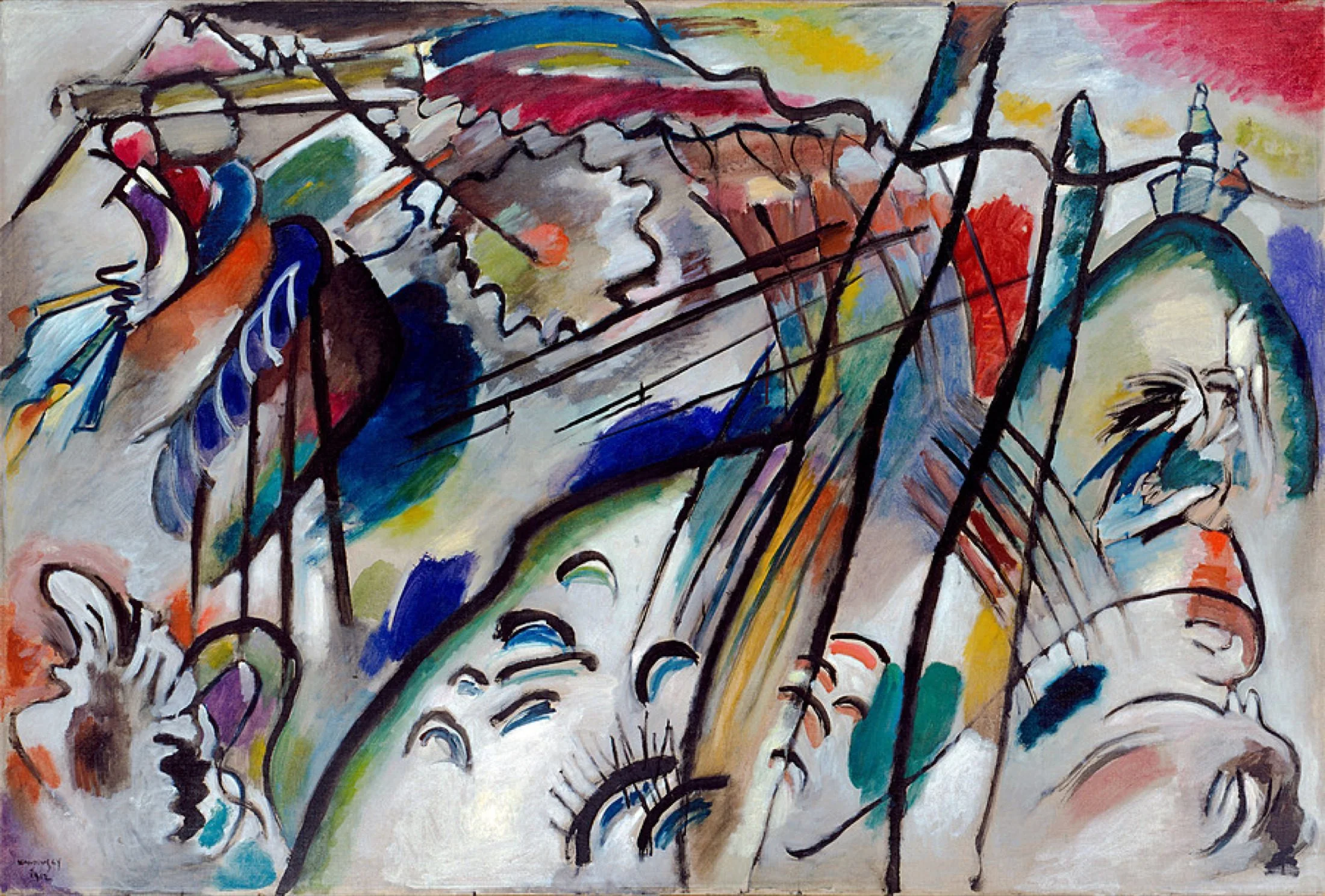
If you read abstraction through that lens, several works become much clearer: Improvisation 28 (Second Version), Yellow-Red-Blue, Composition VII, Simultaneous Contrasts: Sun and Moon, and Sonata of the Sea. Allegro. These are not just “strange images.” They are highly engineered perceptual systems.
1) What synesthesia is (and what it is not)
A useful distinction first: synesthesia is not simply “strong imagination” and not the same thing as metaphor. Saying “this trumpet line feels yellow” can be poetic language. In clinical and cognitive research, synesthetic responses are usually described as involuntary, repeatable, and consistent over time. The same trigger tends to produce the same concurrent experience months or years later.
That consistency matters for art interpretation. It reminds us that cross-sensory correspondences can be systematic, not decorative. Even when an artist is not medically diagnosed, they may still build a composition with synesthetic logic: a mapping between visual and musical parameters, where shape plays the role of phrasing, color behaves like timbre, and spacing functions like silence.
There is another caution: not every artist who talks about music and color is a synesthete. Some borrow musical vocabulary as a conceptual tool, not as a neurological report. But this does not weaken the argument. Historically, abstraction advanced through both pathways: lived cross-sensory perception and deliberate translation strategies.
2) Before abstraction had a name: the 19th-century background
By the late 19th century, Europe already had a broad “correspondence culture.” Symbolist poetry, theories of sensation, stage lighting experiments, and debates around Wagnerian total art encouraged artists to think across sensory boundaries. Color organs and music-to-light devices tried—sometimes awkwardly, sometimes brilliantly—to convert sound into visual sequence.
So when early abstract painters began speaking about rhythm, vibration, and orchestration, they were not inventing these analogies from zero. They were entering an existing laboratory of ideas and making it materially rigorous on canvas. The novelty was not the dream of sensory unity; the novelty was turning that dream into compositional method.
That shift from metaphor to method is exactly where modern abstraction becomes historically concrete.
3) Čiurlionis: painting in movements, not in scenes
M.K. Čiurlionis is one of the clearest bridge figures because he was seriously active as both composer and painter. In his cycles, titles like “sonata” are not decorative labels. They indicate real structural intention: motif, recurrence, variation, dynamic contrast.
In Sonata of the Sea. Allegro, wave forms behave like thematic returns. The painting is read over duration, not consumed in one static glance. You do not merely identify objects; you track how visual units enter, retreat, and reappear. In other words, the painting is composed like time.
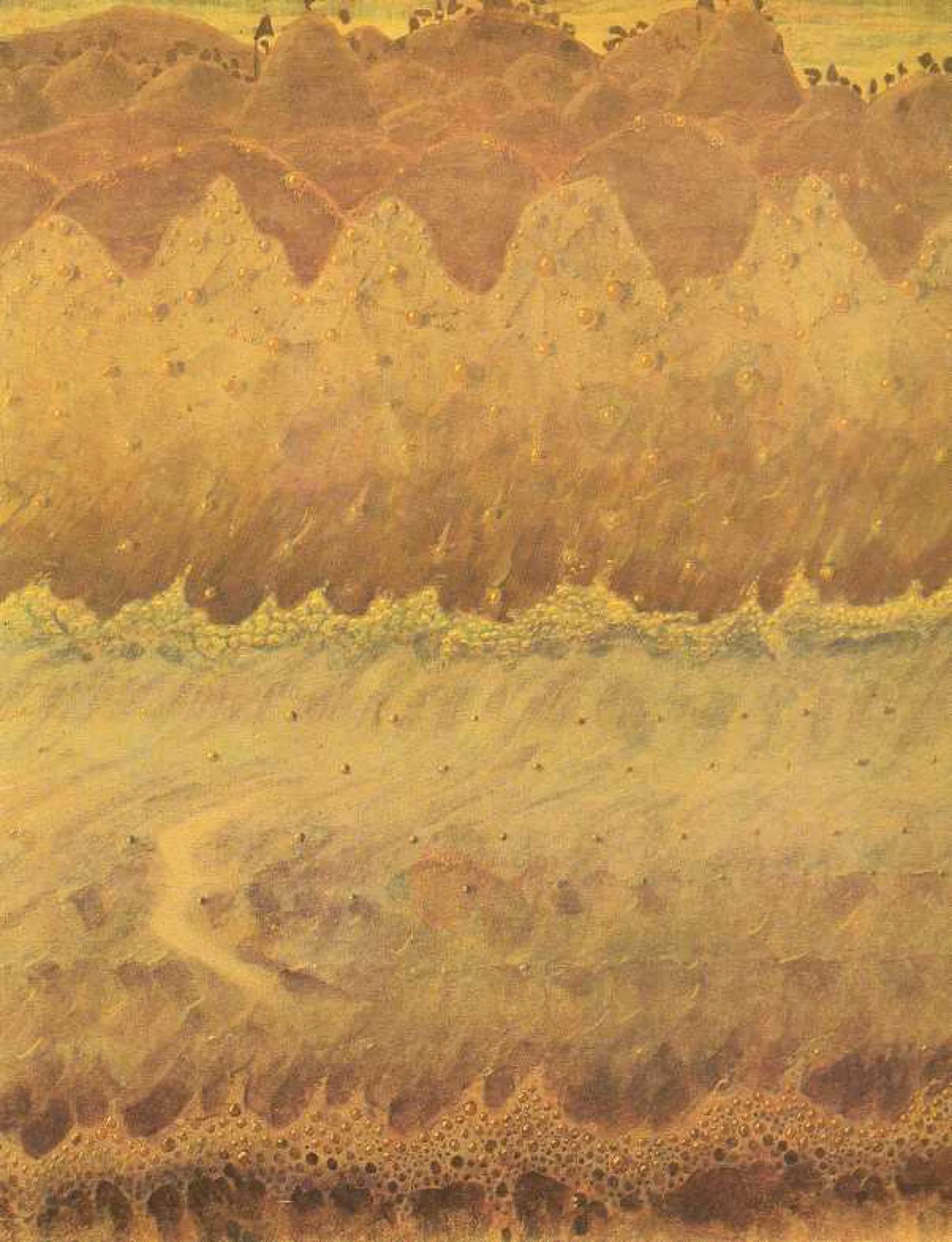
Čiurlionis helps correct a common oversimplification: abstraction was not only an anti-realist rupture. It was also a temporal re-organization of seeing, often borrowed from music.
4) Kandinsky: from eruption to architecture
With Kandinsky, cross-sensory thinking becomes both theoretical and practical. He writes extensively about inner necessity, affective force, and relationships among line, color, and direction. Whether every statement reflects personal synesthesia or broader symbolic theory, his project is unmistakable: painting should act, not just depict.
In Improvisation 28 (Second Version), the visual field behaves like live performance. Diagonals push, clusters collide, and chromatic zones form pulses. The first question is not “what object is this?” but “what energy is this passage producing?” The work is constructed as an unfolding dynamic, comparable to musical phrasing.
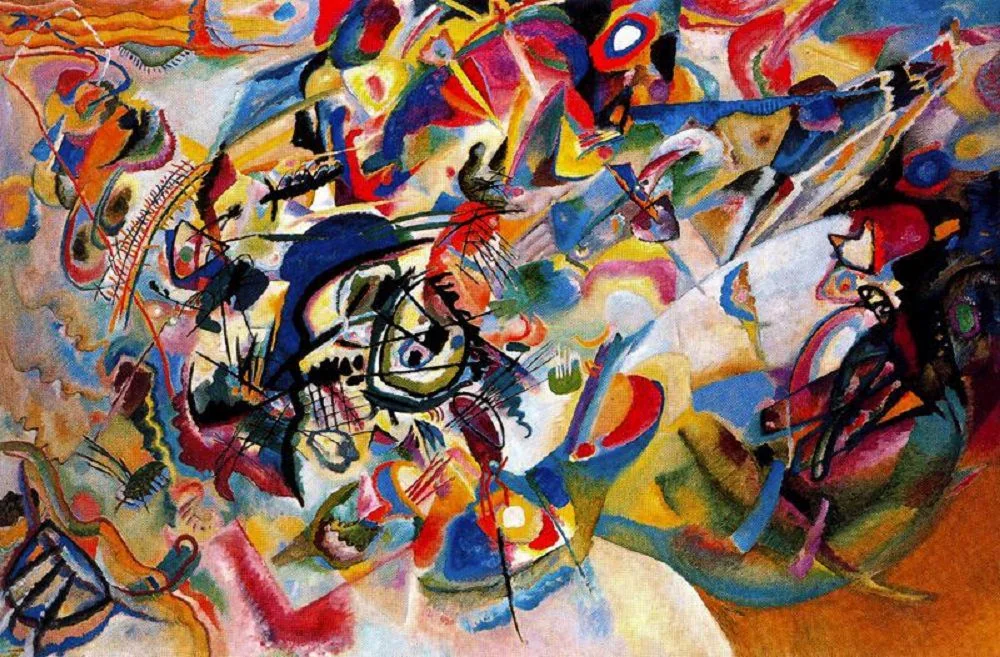
In Composition VII, that logic becomes denser and more stratified. Instead of one dominant line of reading, multiple vectors compete and interlock. The painting demands sequential attention: each pass reveals a different layer of structure, like hearing inner voices after first hearing only melody.
By the time of Yellow-Red-Blue, the field is more architectural. Gestural turbulence gives way to calibrated equilibrium between geometry and chromatic pressure. Yet the musical analogy remains: the work feels like counterpoint, not like static diagram.
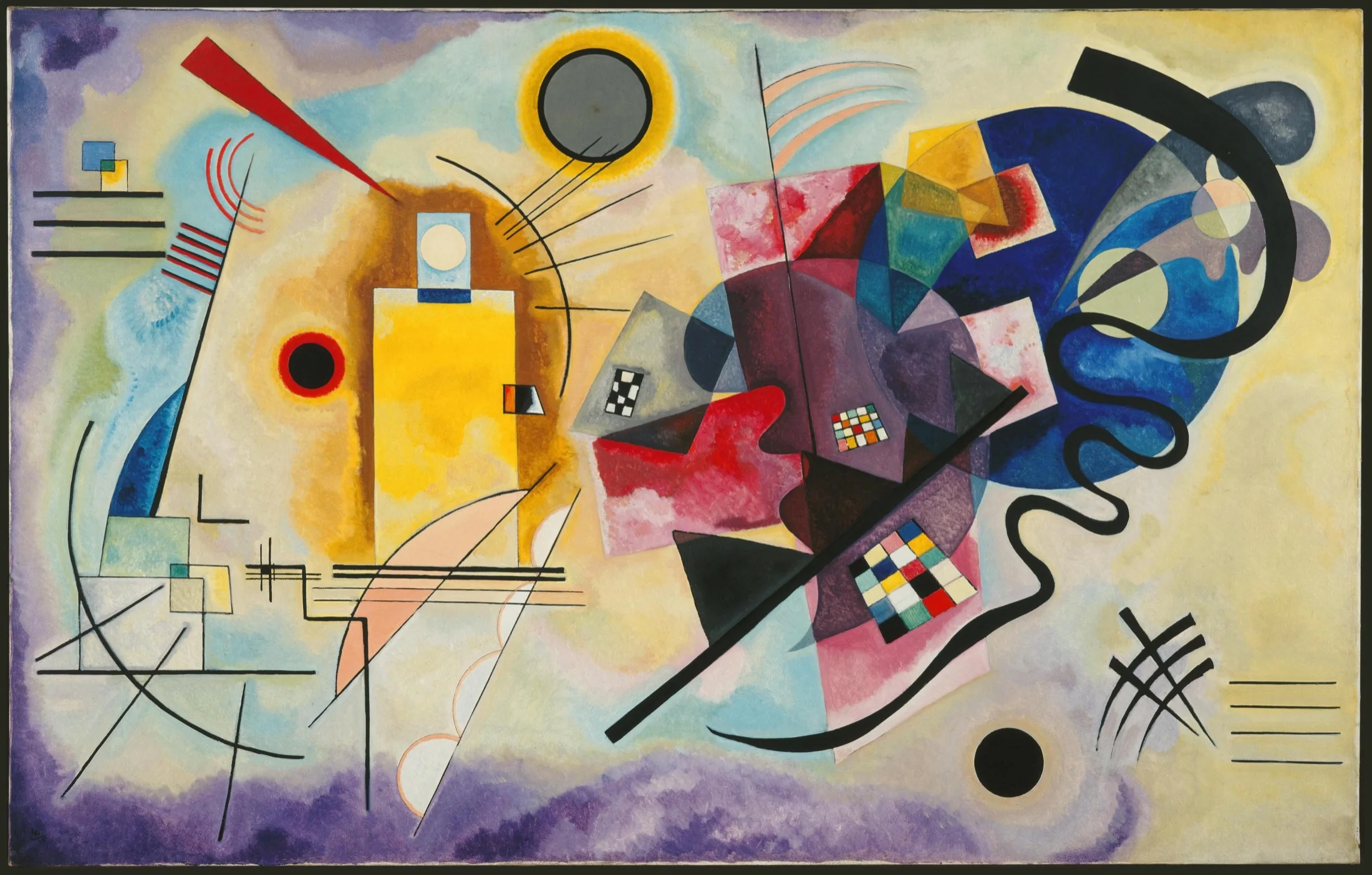
Kandinsky is therefore crucial not because he “proved” synesthesia medically, but because he provided a grammar for translating cross-sensory thought into durable pictorial form.
Abstraction did not remove meaning from painting; it relocated meaning from objects to relations.
5) Delaunay and Orphism: optical tempo
If Kandinsky often works through expressive force, Robert Delaunay develops another route: optical rhythm. In Simultaneous Contrasts: Sun and Moon, neighboring colors activate each other so strongly that the surface seems to rotate or pulse.
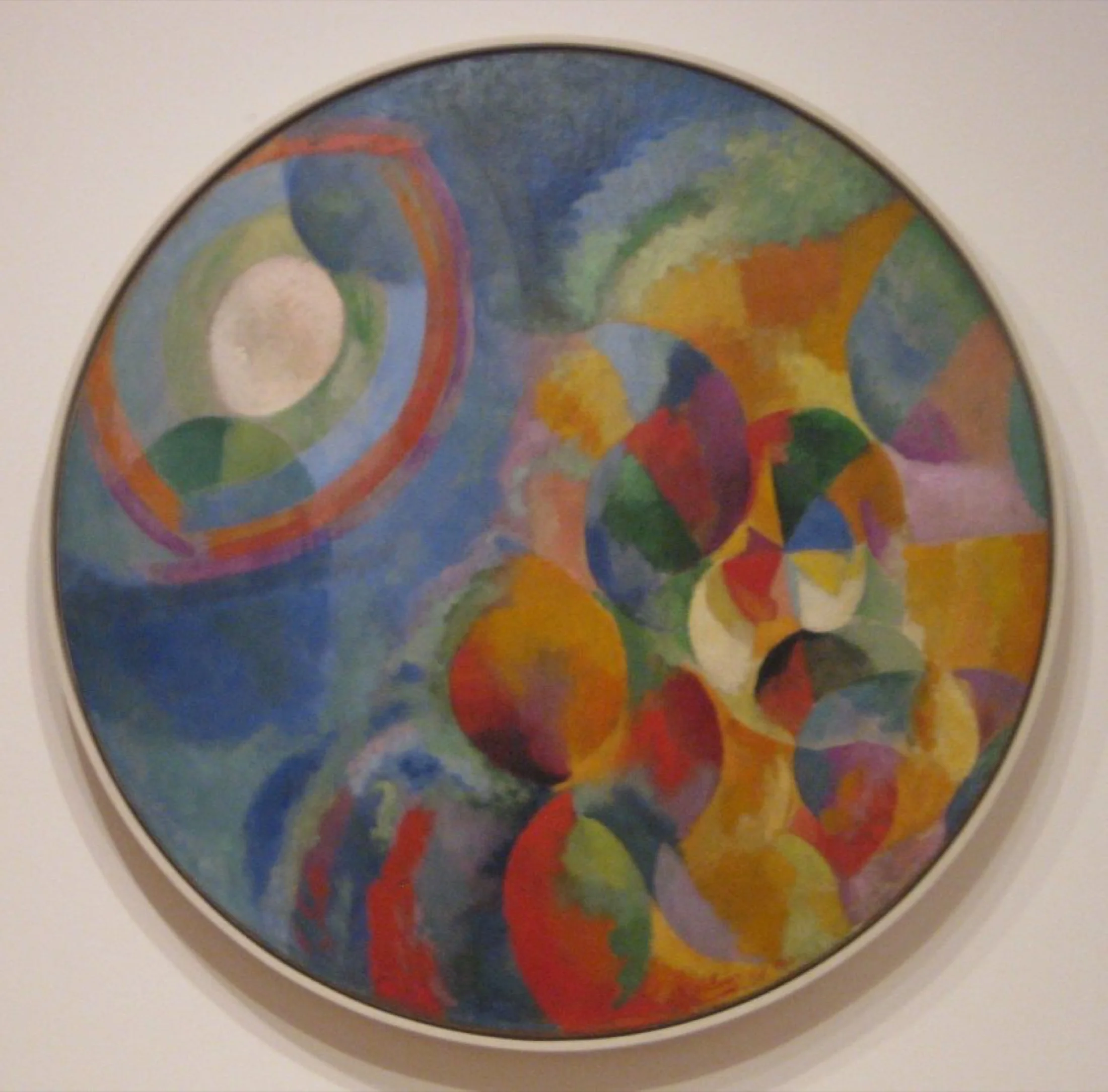
This is where Orphism becomes a useful historical label. Orphist painting centers luminous simultaneity, circular sequencing, and chromatic vibration. Narrative is reduced; perceptual tempo is amplified. The eye is not asked to decode a story but to inhabit a cycle of intensities.
Delaunay’s importance goes beyond one movement tag. He demonstrates that abstraction can be precise without becoming cold: highly calculated yet sensorially immediate. That balance is one reason these works still feel contemporary.
6) Why synesthesia alone is not enough
A serious account must resist monocausal history. Synesthetic models helped abstraction, but they were one engine among several: photography challenged painting’s documentary role, urban acceleration changed perceptual habits, new spiritual and philosophical frameworks shifted expectations, and political upheaval altered artistic institutions.
You can see this plurality inside the canon itself. Compare Kandinsky or Delaunay with Hilma af Klint’s The Ten Largest, No. 7: all are abstract, but not abstract for identical reasons. Synesthetic logic explains part of the field, not its totality.
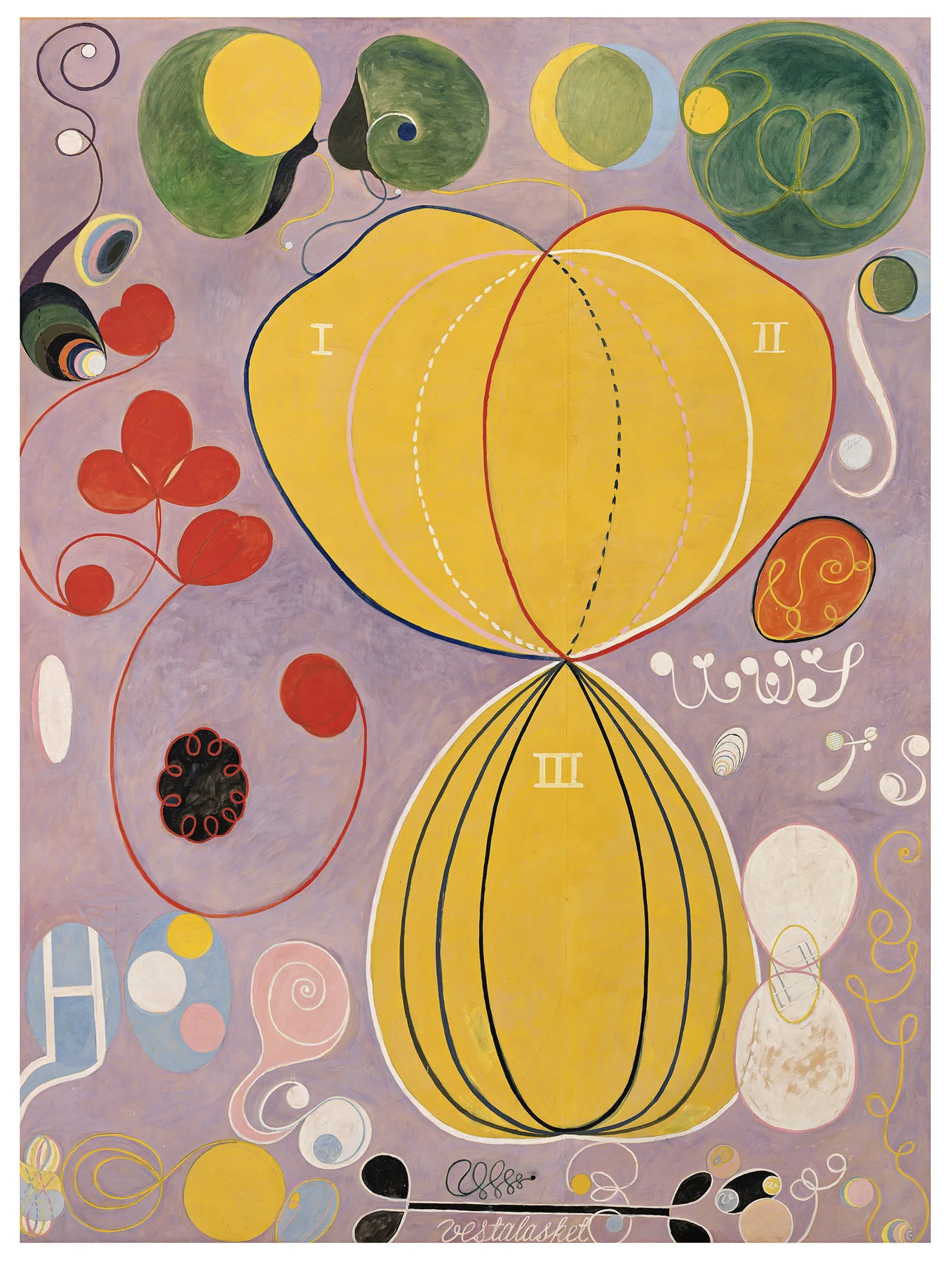
That is precisely why the synesthesia lens is valuable: not as a total explanation, but as a high-resolution tool for specific works and specific compositional decisions.
7) A practical method to read synesthetic abstraction
If abstraction still feels opaque, try this five-step method. It shifts interpretation from symbolism-hunting to perceptual analysis:
- Track direction first: where does your eye accelerate, stall, or rebound?
- Map chromatic roles: which colors behave like anchors, accents, or transitions?
- Identify recurrence: which forms return like motifs in music?
- Measure interval: where are the visual pauses and breathing spaces?
- Only then ask about meaning: what emotional or conceptual climate emerges from those relations?
Used on Kandinsky, Delaunay, and Čiurlionis, this method produces repeatable insights. Different viewers may disagree on symbolism, but they can still agree on structural behavior. That shared ground is what makes long-form analysis useful rather than purely subjective.
8) Why this matters in 2026 visual culture
We now navigate non-figurative systems constantly: app states, dashboard signals, transit maps, audio visualizers, alerts, animated interfaces, generative visuals, brand color grammars. Much of this communication works before language. It guides attention through hierarchy, contrast, and rhythm.
Early abstraction asked the same foundational question in another medium: how can form organize perception before object recognition? That is why these paintings feel unexpectedly current. They train a skill that contemporary media economies reward: reading relational structures quickly and accurately.
This is also one reason the topic attracts durable search interest. People arrive with curiosity about a neurological phenomenon, then discover a practical way to understand modern image culture.
9) A short timeline that makes the shift legible
One reason debates around abstraction stay confusing is that people collapse thirty years of experimentation into one date. A compact timeline helps:
- 1890s-1905: Symbolist and post-impressionist experiments intensify the emotional role of color.
- 1906-1910: Artists across Europe test non-naturalistic color systems and looser object boundaries.
- 1908-1912: Čiurlionis develops music-structured cycles; Kandinsky moves toward non-objective fields.
- 1912-1914: Orphism formalizes simultaneity and luminous rhythm through Delaunay and related circles.
- 1915-1920: Malevich and others push radical reduction, proving abstraction can survive with minimal means.
- 1920s onward: Bauhaus pedagogy and design culture systematize abstract visual grammar.
Seen this way, abstraction is less a sudden rupture than a chain of decisions about what painting should prioritize: depiction, sensation, structure, or cognition. Synesthetic thinking enters repeatedly in that chain whenever artists need to justify meaning without objects.
10) A concrete close-reading drill (2 minutes)
Try this on Improvisation 28 (Second Version). Set a timer for 120 seconds and divide the viewing into four 30-second passes. Pass 1: trace only diagonals. Pass 2: trace only warm color zones. Pass 3: track circular or curved returns. Pass 4: ignore form and watch transitions between dense and open areas.
Most viewers notice the same result: the work stops feeling arbitrary and starts behaving like composition under constraint. You begin to see “phrases,” “breaks,” and “modulations.” This exercise is simple, but it demonstrates the central argument of this essay better than theory alone: abstraction becomes readable when you treat it as organized time.
You can repeat the same drill on Delaunay and Čiurlionis. The patterns differ, but the reading logic holds. That repeatability is the sign that we are looking at method, not mysticism.
11) What scholars still debate
Two debates remain active. First: how directly should we connect neuroscience to interpretation? Serious historians avoid retroactive diagnosis, while cognitive researchers emphasize that cross-modal perception can still inform artistic method even without a clinical label. The productive middle ground is to distinguish biography from structure: we may not prove what an artist “had,” but we can analyze what a painting does.
Second: does musical analogy clarify abstraction or oversimplify it? Used lazily, it becomes vague (“this looks musical”). Used rigorously, it becomes operational: recurrence, interval, modulation, and contrast can be described with precision and compared across works. That precision is exactly what keeps the synesthesia lens useful instead of fashionable.
These debates are healthy. They force us to stay empirical in description while remaining open to perceptual complexity. For readers, the payoff is clear: better questions, better looking, fewer myths.
12) Frequent mistakes in this topic
- Reducing synesthesia to metaphor and ignoring research on consistency.
- Assuming every abstract artist was clinically synesthetic.
- Treating abstraction as random expression instead of organized structure.
- Telling a single-origin story and erasing parallel histories.
- Reading titles literally instead of compositionally.
If you keep one idea from this piece, keep this one: abstraction is easier to understand when you listen to it with your eyes. Once you read color and form as relational events, these paintings stop feeling distant and start feeling immediately legible.
A six-work route to study next
Primary sources
- Encyclopaedia Britannica - Synesthesia
- American Psychological Association - Synesthesia and perception research
- Frontiers in Psychology - Review on synesthesia and cognition
- Guggenheim - Kandinsky, Improvisation 28 (Second Version)
- Encyclopaedia Britannica - Orphism
- MoMA - Abstraction
- Tate - Abstract Art
- TheArtStory - Orphism movement context
- M.K. Čiurlionis resources - painting archive
- Wikimedia Commons - Yellow-Red-Blue metadata
- Wikimedia Commons - Simultaneous Contrasts: Sun and Moon
- Wikimedia Commons - Sonata of the Sea. Allegro
Next step: quiz
Open the art quiz to test how quickly you can recognize these abstract works by composition, color rhythm, and title cues.