
Artist Guide
Clarence Gagnon
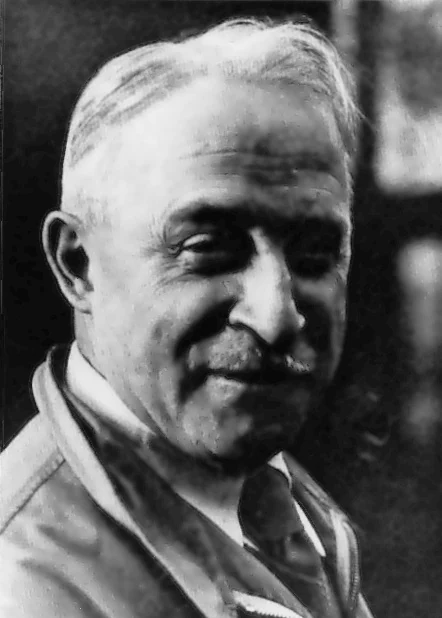
Clarence Gagnon made regional landscape think on a national scale. Clarence Gagnon occupies a strategic place in Canadian and Quebec art history because he solved a difficult problem with unusual consistency: how to paint a specific region without reducing it to mere folklore. His landscapes of Charlevoix became iconic, but their strength does not come from nostalgia alone. They combine close observation, formal economy, and chromatic intelligence to turn local geography into durable cultural memory.
From Montreal classrooms to Charlevoix roads
Born in Montreal in 1881, Gagnon trained locally, then refined his practice in Paris before returning repeatedly to Quebec. That rhythm between European modernity and local ground is central to his method. From France, he absorbed selective simplification and chromatic discipline; from Charlevoix, he drew recurring motifs that could be tested across seasons. He did not approach landscape as scenery. He approached it as a visual problem that had to remain readable after repeated encounters.
This circulation explains why his work can feel both regional and portable. He paints specific roads, roofs, and slopes, yet he structures them with enough formal clarity to travel beyond local audiences. In that sense, he stands between nineteenth-century documentary impulses and a more modern pictorial economy associated with Post-Impressionism.
How his winters hold together
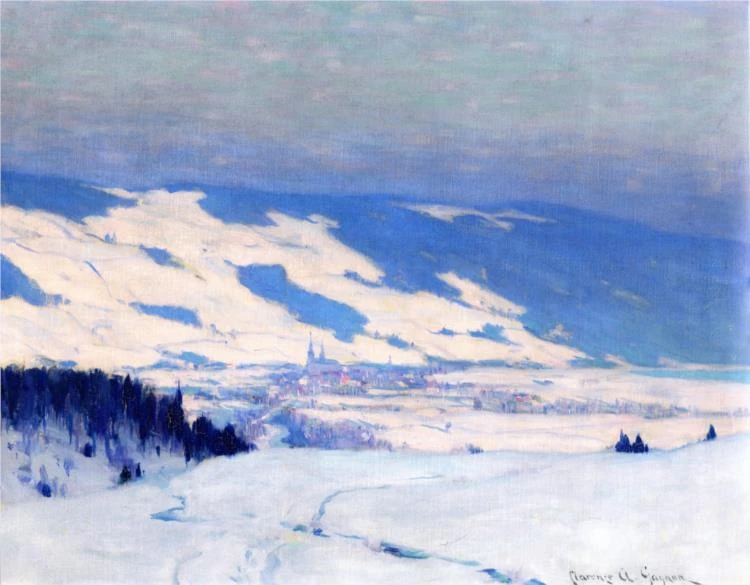
Gagnon is often remembered for atmosphere, but atmosphere is only half the story. His strongest canvases are built on spatial control: roof masses anchor the middle ground, routes and fences guide the eye, and tree rhythms keep movement from collapsing into blur. Snow is never blank white. It is articulated through warm and cool intervals that suggest time of day, temperature, and traffic without over-describing every detail.
That structural clarity is exactly what distinguishes him from lighter impressionist notation. Where many painters privilege a single optical instant, Gagnon preserves duration. Viewers sense weather and lived routine together, not as separate layers.
Baie-Saint-Paul as a memory machine
A work like Baie-Saint-Paul shows this balance clearly. The composition is compact but never rigid: settlement pattern, circulation routes, and climatic atmosphere stay legible at once. It is one reason the painting remained culturally memorable long after its original exhibition moment.
Placed beside Cornelius Krieghoff and Joseph Légaré, Gagnon marks a shift in Quebec painting. Légaré foregrounds civic rupture in works such as Cholera Plague, Quebec. Krieghoff stages social negotiation in scenes like The Habitant Farm. Gagnon, by contrast, turns repeated regional views into a long-duration visual grammar.
From canvas to print culture
Gagnon's impact also depended on circulation channels. Paintings, reproductions, and illustrated editions reinforced each other. A concrete example is his work on Louis Hémon's Maria Chapdelaine in the 1930s: he translated the same Charlevoix sensibility into book illustration, extending his imagery beyond gallery walls. This is not peripheral trivia; it shows how regional identity became durable through multi-format repetition.
Reading him historically therefore means following both form and distribution. His images worked because they were formally coherent and reproducible without losing their core structure.
Reading Gagnon without folklore shortcuts
A rigorous method is to compare two Gagnon landscapes first, then test the result against adjacent traditions. Against Krieghoff, Gagnon tends to reduce anecdotal incident and increase atmospheric cohesion. Against strict Realism, he simplifies more aggressively to preserve legibility. The key is to stay with painting decisions: spatial hierarchy, chromatic temperature, and circulation of attention.
This keeps interpretation concrete and avoids two dead ends: reducing him to picturesque nostalgia, or dissolving him into theory detached from what the canvases actually do.
Why Gagnon remains central in Quebec art history
Gagnon still matters because he made place durable without freezing it. His Charlevoix images continue to shape collective memory, but they also remain analytically useful for understanding how landscape participates in identity formation. His legacy lies in that double achievement: strong local anchoring with long-range formal transmissibility. For Explainary, he is not a secondary regional figure. He is a hinge between local geography, modern formal intelligence, and long-term cultural transmission.
Key works in Explainary
Associated movement
Continue with the art quiz to validate recognition, context, and comparison.
Primary sources
- Wikimedia Commons portrait metadata
- National Gallery of Canada: Clarence Gagnon
- McMichael Canadian Art Collection: Clarence Gagnon
- Art Canada Institute glossary: Clarence Gagnon
- Britannica: Clarence Gagnon
- The Met collection search: Clarence Gagnon
- Tate search: Clarence Gagnon
- Wikipedia: Clarence Gagnon