
Post-Impressionism
Baie-Saint-Paul
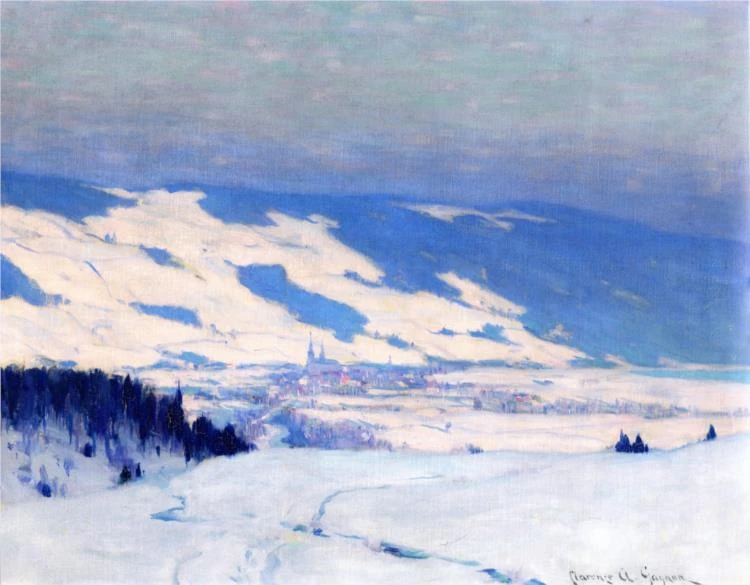
Baie-Saint-Paul looks quiet at first, but it is built as a strong statement about place. With this 1917 canvas, Clarence Gagnon turns a specific village in Charlevoix into a durable visual model of Quebec belonging: roads, rooftops, and snow are arranged to show how a community holds together, not just how winter looks.
What the painting actually shows
The composition is highly legible. Houses act as geometric anchors, circulation lines guide the eye through the settlement, and the horizon keeps the whole image stable. Gagnon avoids picturesque theatrics and instead organizes the scene so viewers can read habitation, movement, and social scale. That clarity is why the work remains readable beyond its original context: it is local in detail but transferable in structure.
1917 context: region, economy, and visual memory
The date matters. Painted in 1917, the work belongs to a period when Quebec was negotiating modernization while still anchored in strong rural networks. Charlevoix offered artists a landscape where settlement patterns, religious culture, and seasonal labor remained visible in compact form. Gagnon's decision to focus on Baie-Saint-Paul is therefore historical, not accidental. He chooses a place where architecture, roads, and climate record everyday social organization. In that sense, the canvas works like a memory device: it fixes a local world under pressure of change without reducing it to folklore. It also preserves a concrete map of work rhythms, not merely a scenic winter atmosphere.
Color as climate method
Snow is handled as a system of temperature shifts, not as neutral white. Blues, violets, and warmer reflections indicate weather, light, and time of day. In that sense, Gagnon sits between Impressionism and Post-Impressionism: he keeps optical sensitivity to light while stabilizing forms into a designed memory-image rather than a fleeting impression.
Why it matters for Quebec visual history
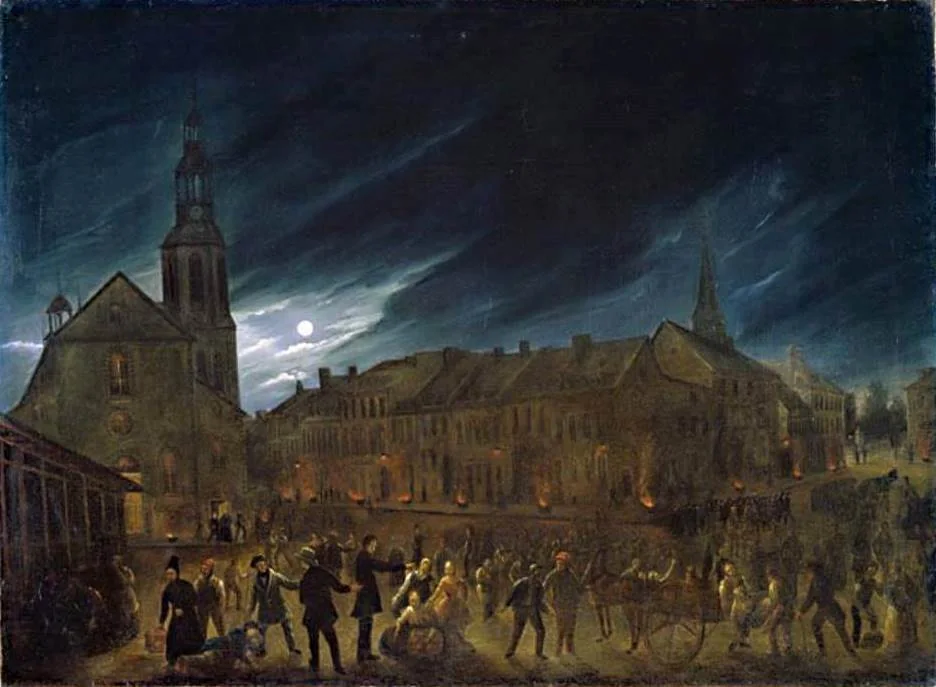
Within the broader sequence of Quebec images on Explainary, Cholera Plague, Quebec frames civic crisis, Krieghoff frames negotiation in daily winter life, and Gagnon consolidates continuity through atmosphere and structure. The result is more than regional charm. Baie-Saint-Paul becomes a repeatable visual grammar for collective memory, which is precisely why it still resonates in current debates about identity and territory.
For a wider historical thread, read How Painting Shaped Quebec Identity, which links Legare, Krieghoff, and Gagnon across crisis, daily life, and place-memory.
Gagnon's intention is not to dramatize catastrophe but to make ordinary continuity visible. His method is compositional: stable horizon, measured spacing between buildings, and circulation paths that tie private and shared spaces together. A useful cross-check is Impression, Sunrise: Monet builds modernity through atmospheric flux, while Gagnon builds belonging through social legibility. Both are location-specific; only their historical problem differs.
Gagnon turns winter from scenery into a social architecture of memory.
Related works
Primary sources
- WikiArt: Clarence Gagnon, Baie-Saint-Paul (1917)
- Wikimedia Commons file metadata: Baie-Saint-Paul (1917)
- National Gallery of Canada: Clarence Gagnon
- McMichael Canadian Art Collection: Clarence Gagnon
- Art Canada Institute glossary: Clarence Gagnon
- Tate: Post-Impressionism (historical framing)
- The Met: Post-Impressionism overview
- Encyclopaedia Britannica: Post-Impressionism
After this reading of Baie-Saint-Paul, open the art quiz to test if you can separate Clarence Gagnon's work from close visual look-alikes.
Frequently asked questions
Because it transforms a specific village into a durable image of collective life. The painting links climate, settlement, and social rhythm without flattening the scene into stereotype.
He sits between both. He keeps an Impressionist sensitivity to light while using stronger structural simplification and chromatic design associated with Post-Impressionist logic.
Use four passes: composition, color temperature, human scale, then historical context. This keeps your interpretation tied to visible evidence.