
Artist Guide
Utagawa Hiroshige
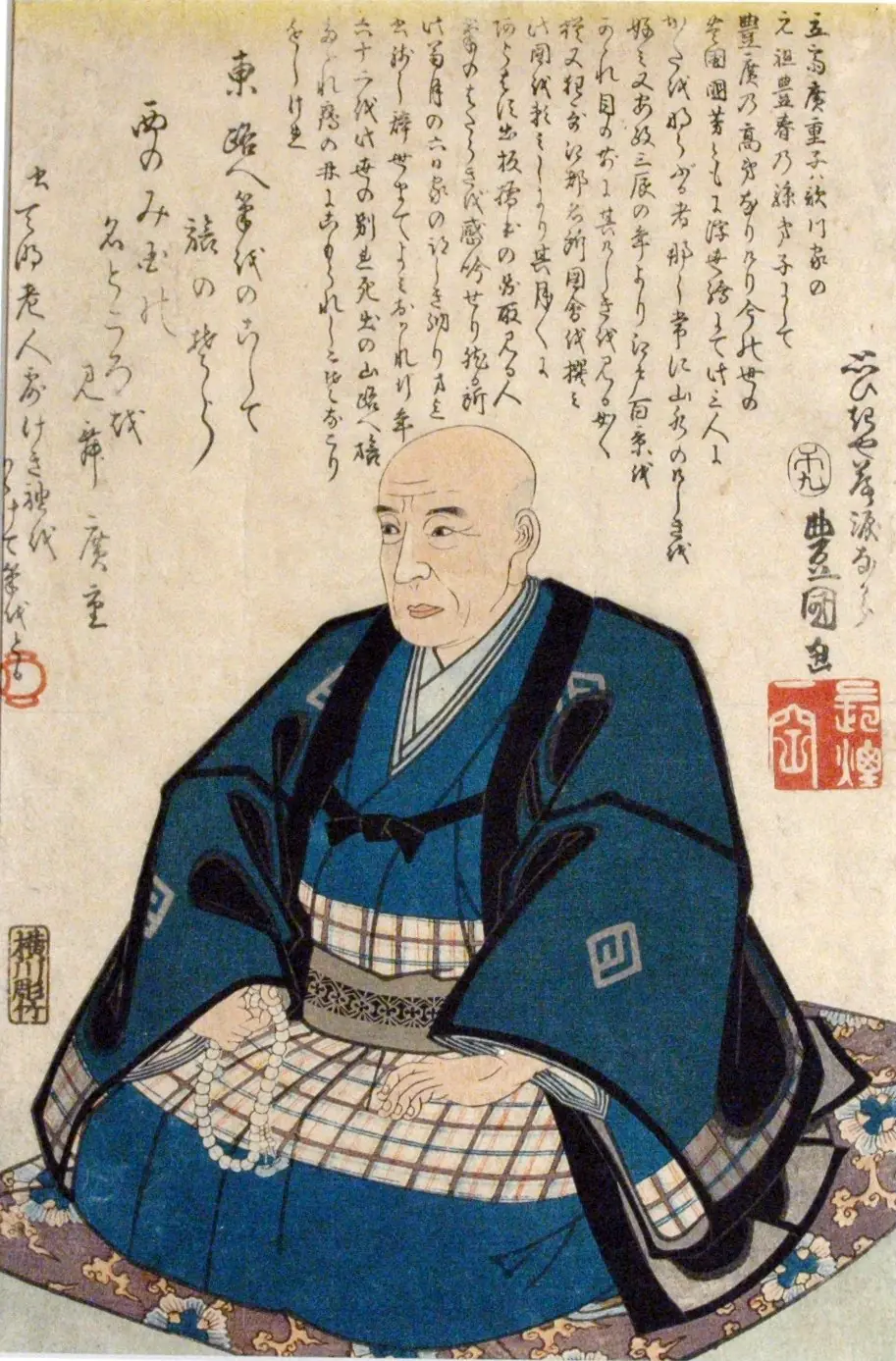
In Hiroshige's prints, weather is not scenery. It is the logic that tells you how to read the sheet. Rain, mist, snow, and late light do not arrive after composition; they organize it. They decide where the eye lands, how far space feels, and how quickly a scene turns from description into mood.
Edo, travel culture, and a career built for circulation
Hiroshige worked in a late Edo print world that already knew how to circulate images efficiently. Publishers, designers, carvers, printers, and urban buyers formed a mature visual economy, and famous places became one of its great subjects. What makes Hiroshige distinctive is not that he depicted recognizable routes and stations, but that he treated them as changing experiences rather than fixed views.
That matters because his career sits at the point where travel imagery, serial production, and lyrical atmosphere fuse into one method. Bridges, roads, ferries, and riverbanks give him a recurring structure. Weather and time of day give him variation. The result is a landscape art that feels exact without becoming dry, and poetic without drifting into vagueness.
Why atmosphere becomes structure
Hiroshige often seems economical: a diagonal of rain, a trunk cutting the image, a line of umbrellas, a strip of distant shore. But that apparent simplicity is tightly engineered. Cropped foregrounds bring the viewer in fast; color gradations lengthen space; silhouettes keep the picture legible even when the air is thick with weather.
That is why "atmosphere" is too weak a word if it is taken to mean decorative mood. In Hiroshige, atmosphere does the work of composition. A shower measures vulnerability. Fog thins distance. Evening blue slows the scene down. A blank area of sky or water is not empty; it is a calibrated reserve of space and time.
How to read Hiroshige closely
Start with the climate of the image before you name the place. Ask what the rain, haze, dusk, or snow is doing to visibility. Hiroshige does not merely place figures inside weather. He uses weather to redistribute importance, shrinking human presence in one print and letting it punctuate the whole design in another.
Then move to the framing devices. Bridges, branches, parapets, embankments, and boats often work like hinges between immediacy and distance. The eye catches a hard edge near the front, then travels outward through softer zones. This is one reason his prints feel both instantly readable and strangely durable in memory.
- Track the weather first: rain lines, haze, dusk, and gradation are structural cues.
- Watch how foreground anchors regulate depth rather than merely decorate it.
- Read series as shifts in tempo and perception, not just sets of related places.
The series as method, not packaging
For Hiroshige, the series is the real thinking tool. Returning to the same route or class of subject allows him to prove that a place never has a single visual truth. A station in fair weather is not the same place under driving rain. A bridge at dusk is not the same bridge at noon. Meaning accumulates through controlled variation.
That is why Sudden Shower over Shin-Ōhashi Bridge and Atake is such a useful test case. The print is famous for its rain, but the deeper achievement is the coordination of human trajectories, bridge angle, river depth, and falling weather. Set it beside Hokusai's Great Wave off Kanagawa within Ukiyo-e and the difference is immediate: Hokusai concentrates force; Hiroshige calibrates duration, air, and passing time.
Why Hiroshige still matters
Hiroshige remains central because he solved a very modern image problem early: how to make a picture immediately legible without exhausting it on first contact. You understand the scene quickly, but you understand its climate more slowly. That delay between recognition and full reading is a large part of his continuing power.
His influence therefore goes beyond style. It extends to pacing, framing, serial thinking, and attention design. Read him next to Katsushika Hokusai, then continue through How Mount Fuji Became Iconic, The Fuji from Kanaya on the Tokaido, Red Fuji, and Mishima Pass in Kai Province. The broader lesson becomes clear: in nineteenth-century Japanese print culture, the motif gains its deepest force through circulation, repetition, and variation.
Key works in Explainary
Associated movements
The art quiz is a useful final check: can you recognize Hiroshige not only by subject matter, but by the way he organizes air, distance, and passing time?