
Essay
Why Étretat Matters in the History of Painting
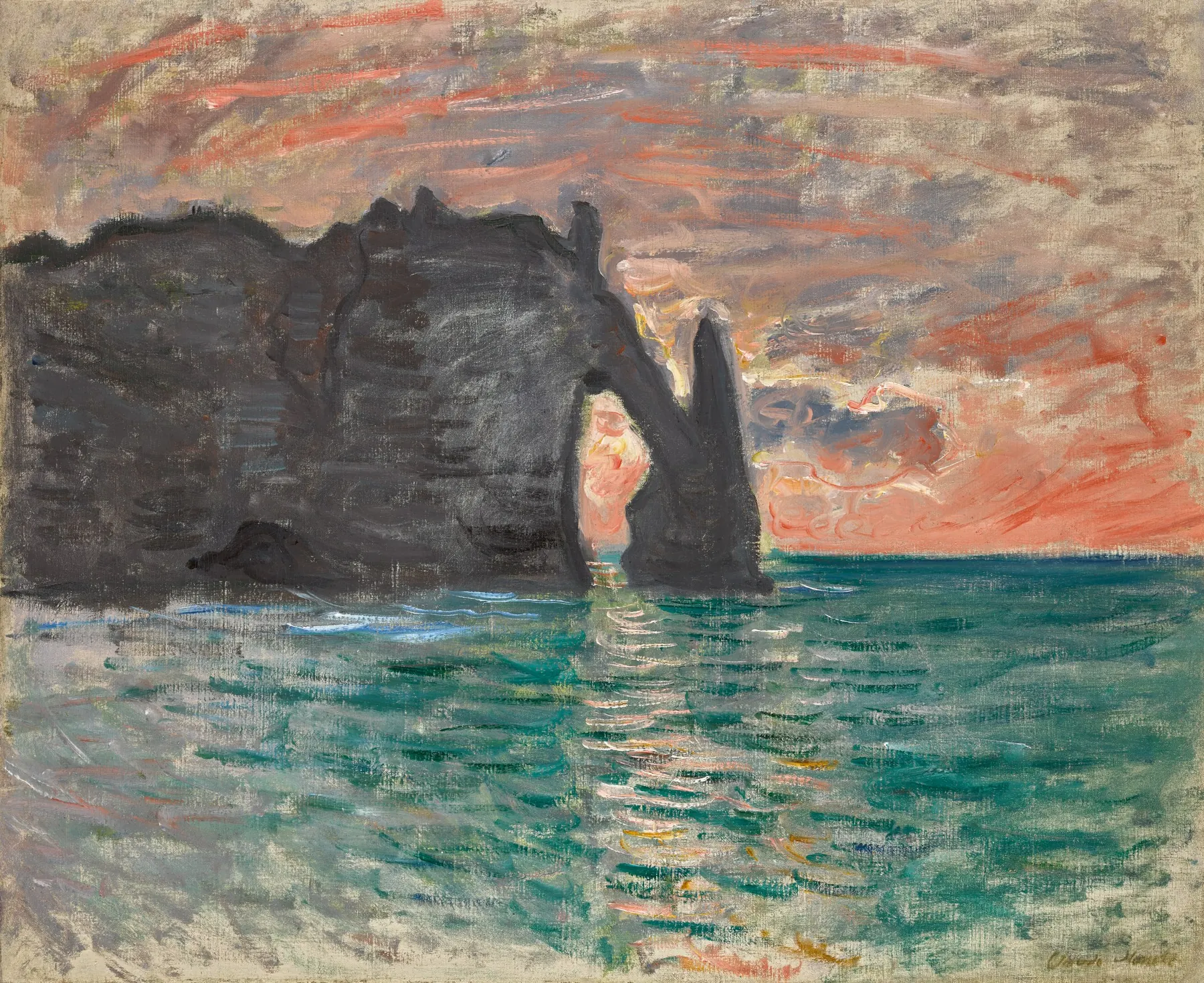
Étretat mattered because it gave painters something rare: a motif that stayed put while everything around it kept changing. The arches, cliff edges, and needle are structurally clear. The weather is not. Sea color, tide level, cloud cover, haze, and the angle of light can shift within hours. That combination makes Étretat more than a beautiful site. It makes it a working problem.
Its place in art history comes from that structure. The site shows why modern landscape painting moves away from the single “best view” and toward repeated comparison. At Étretat, painters can hold the main forms constant and study what changes. The place stops looking like a postcard and starts looking like a laboratory.
A coastline built for comparison
Many landscapes are dramatic. Fewer are analytically useful. Étretat is useful because its geology is easy to recognize and hard to exhaust. The Porte d'Amont, the Porte d'Aval, the Manneporte, the beach, and the horizon line give a painter a strong framework almost immediately. Once that framework is in place, attention can move to atmosphere, distance, value shifts, wave rhythm, and the behavior of light across chalk and water.
The balance is practical. If a motif is too unstable, comparison becomes vague. If it is too rigid, repetition becomes dead. Étretat sits between those two failures. It allows variation without collapse. A painter can return to nearly the same viewpoint and still produce a genuinely different image because the visual problem has changed.
Monet finds a repeatable problem, not just a fine view
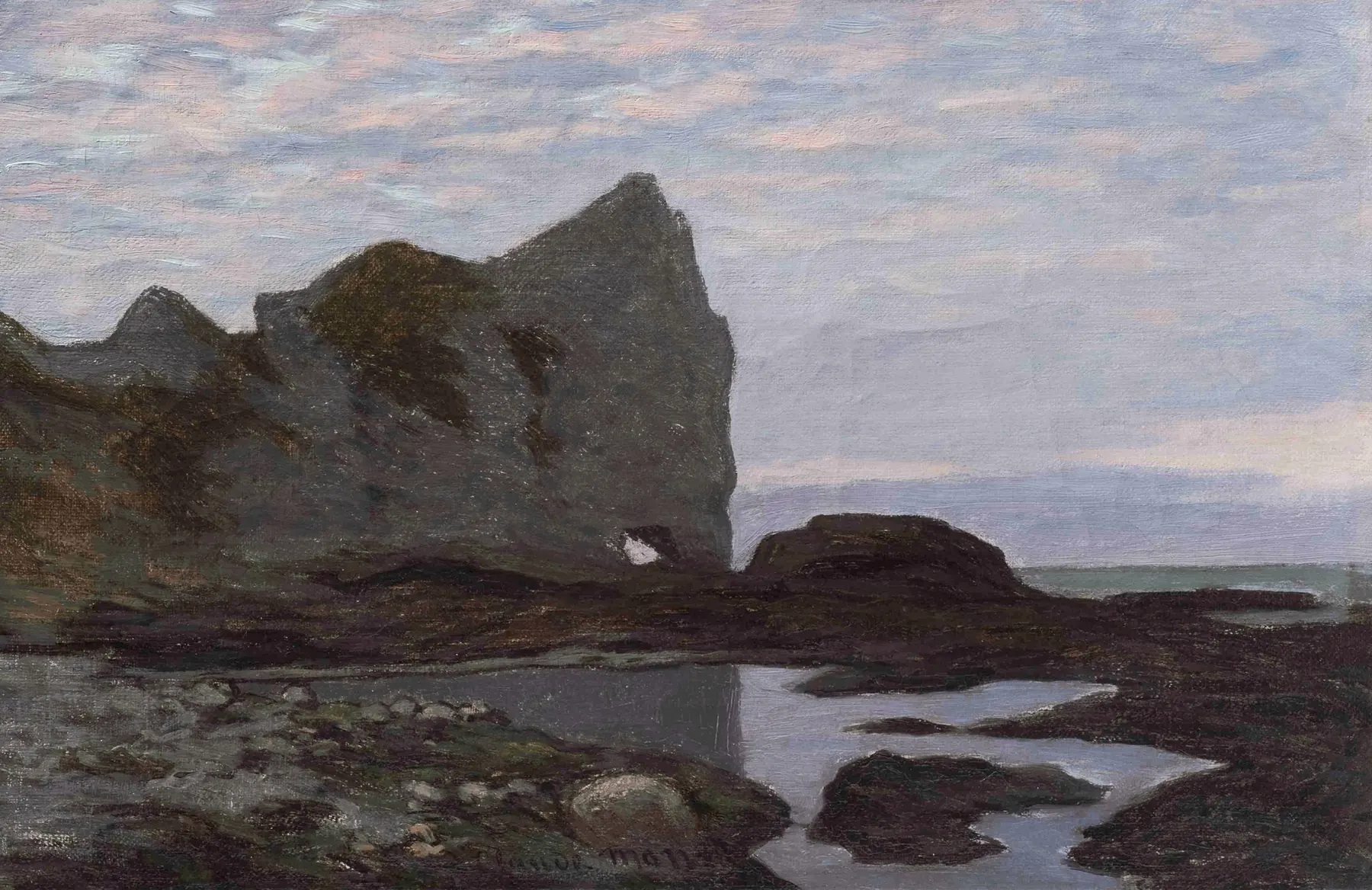
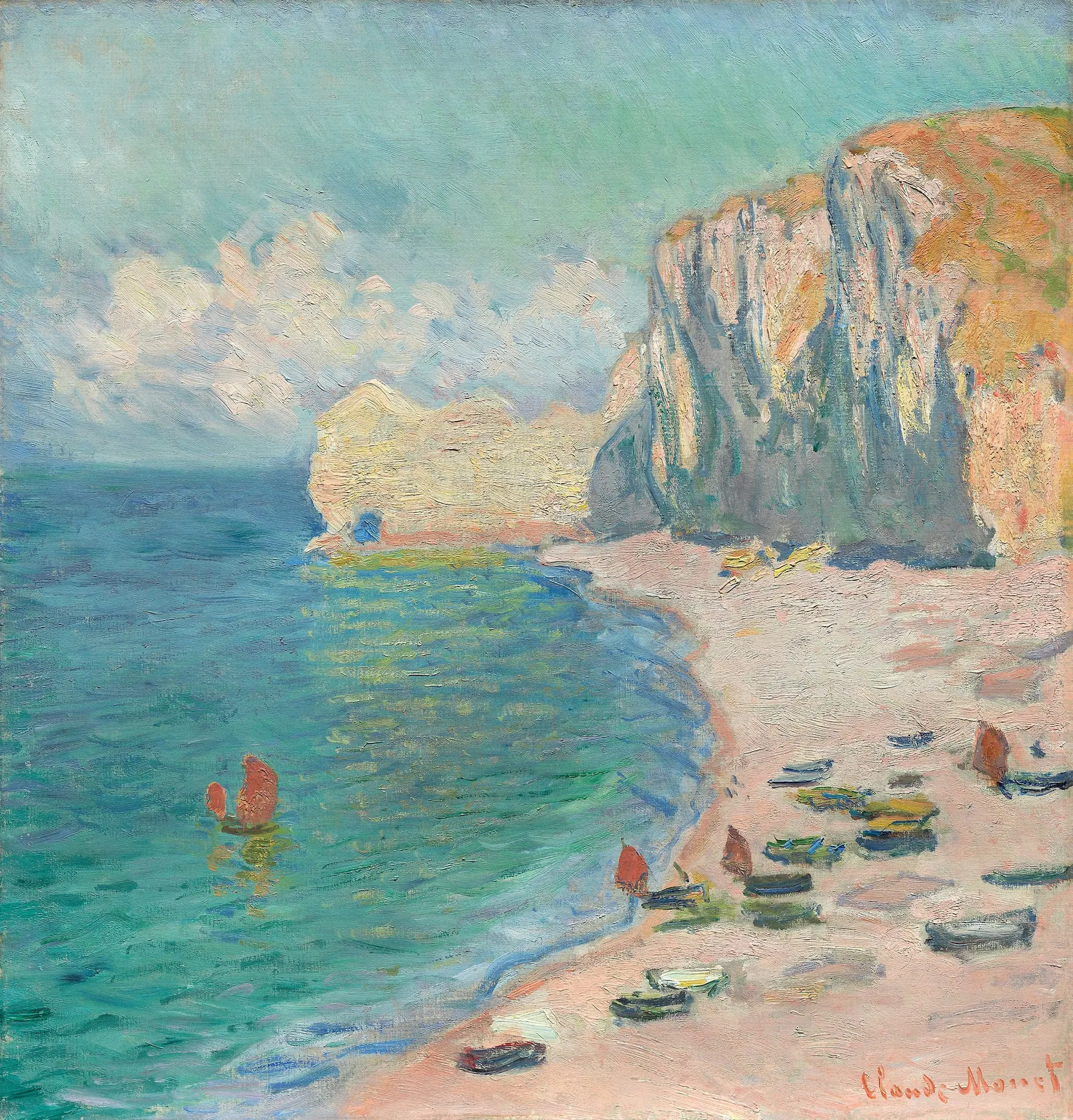
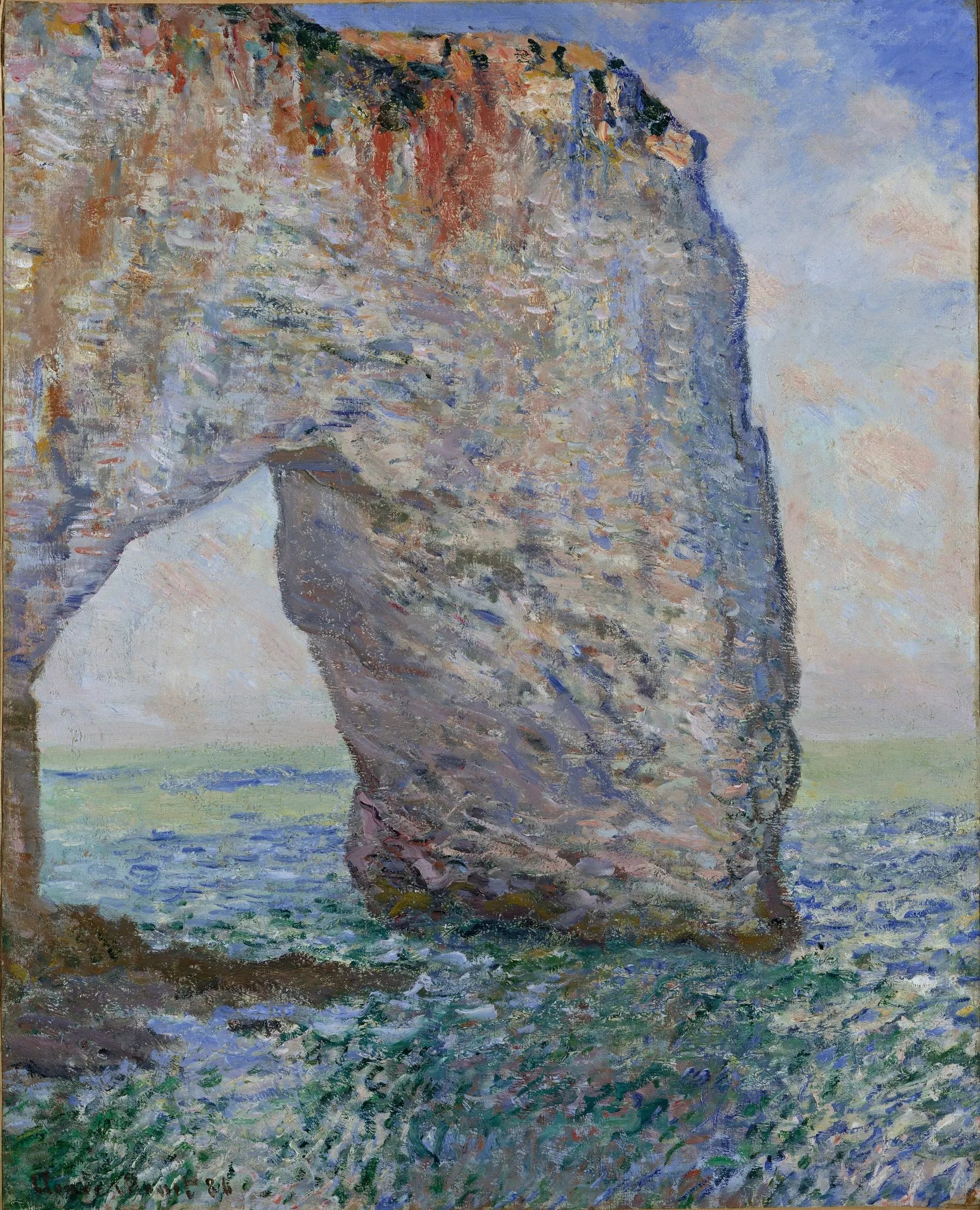
Claude Monet is the central figure here because he understands that the site is not only picturesque. It is serial. In works such as Étretat (1864), Étretat, Coucher de Soleil, Étretat: The Beach and the Falaise d'Amont, The Manneporte (Étretat), and The Manneporte near Étretat, the point is not to prove that the cliffs are famous. The point is to keep asking what changes when time, weather, and viewpoint shift.
The Étretat paintings should be read together. Individually, each canvas can look like a strong coastal image. In sequence, they reveal a method. Monet is not repeating himself for recognition value. He is using repetition to expose difference. That logic becomes decisive later in his Haystacks, poplars, Rouen Cathedral paintings, and Water Lilies, but Étretat already shows the core procedure clearly.
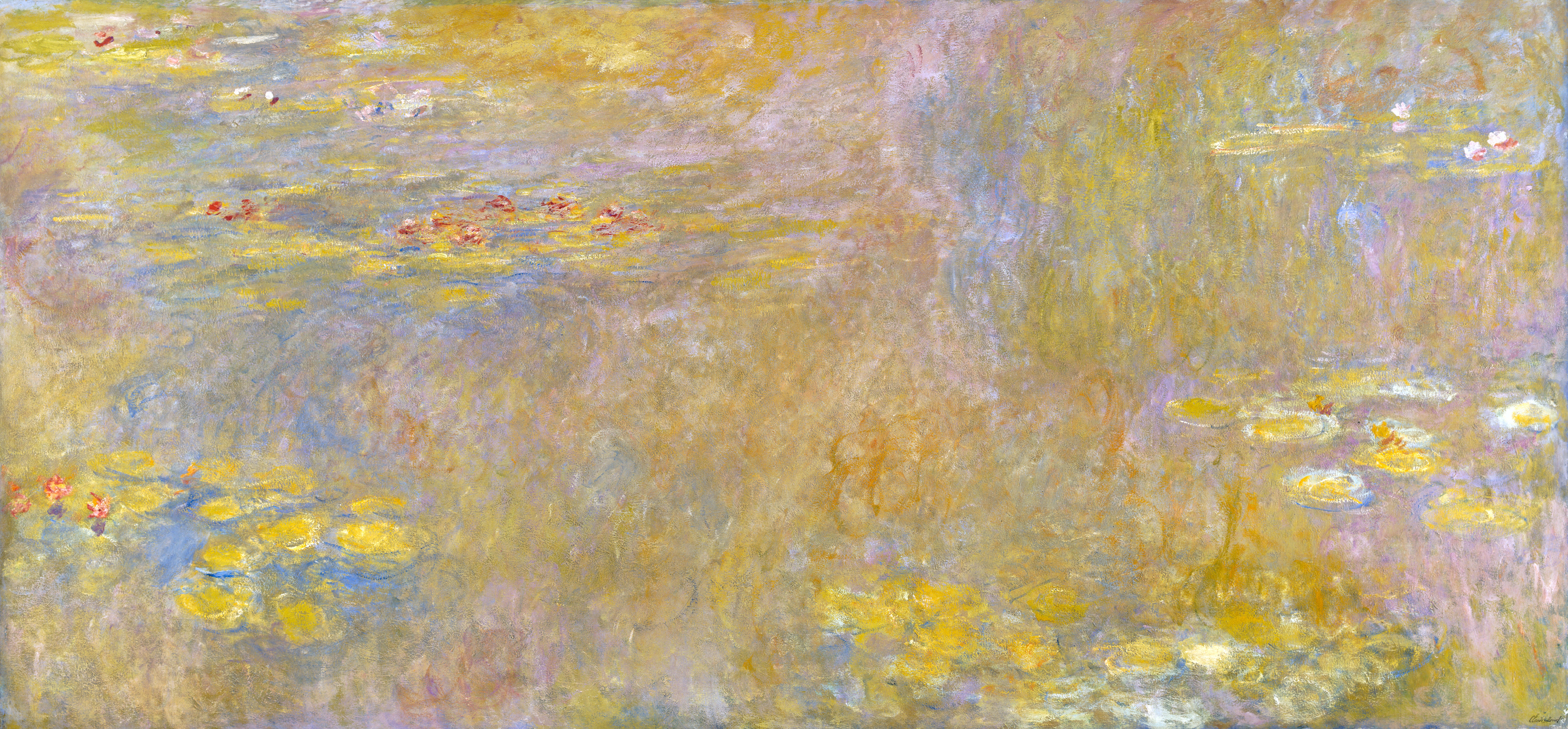
The later Water Lilies carry the same serial thinking into a different kind of motif. Étretat gives Monet a cliff that stays fixed while light, tide, and weather shift around it. Giverny gives him water, reflections, and floating plants, so the repeated subject no longer has a hard geological armature. Reading the two bodies of work together makes Monet's method clearer: serial painting is a way to make difference visible, not a habit of repeating a successful view.
Monet did not arrive at an untouched subject
Monet does not invent Étretat out of nothing. By the time he works there intensively, the Normandy coast already exists in travel culture, print culture, and coastal painting. The site is already legible. People know how to recognize it. One reason it circulates so easily is that its silhouette survives reduction well: even in a small image, the arch and the needle remain identifiable.
What Monet changes is not the existence of the subject, but the terms on which it matters. Earlier viewers can admire the site for drama or local identity. Monet turns that recognizability into a discipline. Because the motif is stable, the painting can become more analytical. The question is no longer “What does Étretat look like?” but “What happens to the same motif under different conditions of seeing?”
Étretat was also a place where artists stayed and met
That history becomes even more interesting once you remember that Étretat was not only a motif. By the second half of the nineteenth century, it was also a resort with hotels, villas, bathing culture, and a casino. The recent Lyon exhibition dossier notes that, compared with more overtly fashionable seaside destinations, Étretat kept a more artistic and intellectual profile. Painters, writers, composers, sculptors, summer visitors, and art amateurs could cross paths in the same small place.
The site functioned as a working environment. Artists did not simply arrive, paint one sublime cliff, and leave. They stayed for stretches, watched the weather, compared viewpoints, met other artists, and worked in front of a public already interested in the place. Gustave Courbet spent several weeks there in 1869. A journalist could already remark in 1885 on the number of painters setting up on the beach in the morning. Later, Eugène Boudin, Guy de Maupassant, and others extend the sense that Étretat is both an image and a milieu.
What actually changes from one Étretat canvas to the next
The quickest mistake is to say that Monet painted the same cliffs again and again. He did not. He painted different versions of the same visual problem. At least four variables matter every time: tide height, weather density, the temperature of the light, and the exact relation between cliff mass and open sky. Change one of those variables and the whole picture can rebalance itself.
Close comparison pays off. In one version, a low horizon gives the rock mass authority. In another, a stronger sky pushes the cliffs into silhouette. In one picture the sea acts as reflective light; in another it thickens into resistance and weight. The motif stays recognizable, but the structure of attention moves. That movement is the real subject.
Étretat changes painting technique, not just subject matter
The site also becomes technically important. A strongly legible coastline frees the painter from having to invent the whole composition from scratch each time. That shifts labor elsewhere. Drawing decisions can be made faster. The harder work moves to calibration: how warm the sky should run, how far the sea reflects that warmth, how sharply the cliff edge should hold, and how much haze the distance can tolerate before the structure dissolves.
In other words, Étretat encourages painters to simplify one part of the problem so they can intensify another. The modern move lies there. The aim is no longer to finish every passage to the same degree. The aim is to decide what must remain stable and what must remain open. The paintings stop looking loose in a generic way and start looking exact in a different register.
Why the site matters beyond Monet
Even if Monet is the main guide, the importance of Étretat exceeds one artist. The site helps normalize a broader way of thinking in which one motif can support multiple states rather than one definitive image. That serial logic becomes increasingly important in late nineteenth-century painting and remains active far beyond painting, in photography, film, and contemporary image culture.
The same logic connects Étretat to Japonisme. Japanese print culture, especially ukiyo-e series by artists such as Hokusai and Hiroshige, had already shown that a motif can gain force through repetition, cropping, and controlled variation. Monet's Étretat paintings do not simply imitate Japanese prints, but they belong to the same nineteenth-century loosening of the single definitive view.
Étretat belongs inside the history of Impressionism but should not be reduced to an Impressionist travel stop. It is a place where landscape becomes comparative. That shift weakens the old expectation that a painting must resolve a subject once and for all. Instead, the subject becomes something you can return to, test, and reframe.
How to read Étretat paintings without repeating clichés
Most weak commentary on Étretat repeats three words: light, cliffs, sea. A better method is simple. Lock the stable geometry first. Then ask what has been made unstable. Is the horizon clearer or more absorbed? Does the sea reflect the sky or resist it? Is the cliff contour firm or softened by air? Has the viewpoint made the coast feel massive, distant, or porous?
Once you work that way, the paintings become easier to separate. You stop saying “beautiful atmosphere” and start naming a real decision. You can see when Monet uses sunset to compress distance, when he uses haze to soften form, or when he lets the beach create a slower rhythmic entry into the picture. Étretat teaches the eye to compare structure and variation at the same time.
Why the place is still useful now
Étretat remains useful for the same reason it mattered in the nineteenth century: it trains comparison. If you look at the site itself, or at a group of paintings made there, you can practice the exact move the painters were practicing. Hold the motif steady. Watch what changes first. In one hour, the sky may change the hierarchy of the whole image. On another day, the tide may do more than the sky. The method is portable far beyond Normandy.
Its afterlife also runs through popular culture. Maurice Leblanc's The Hollow Needle, published in 1908, turns the site into part of Arsène Lupin's mythology. The cliffs stop belonging only to painters and start belonging to readers as well. In the 2020s, Netflix's Lupin pushed that association back into global circulation and made Étretat newly legible to audiences far beyond art history.
That fame now has a cost. The Lyon exhibition dossier describes Étretat as suffering from overtourism, with nearly 1.5 million visitors a year, and notes that access to the cliffs and much of the beach has been restricted since April 2025. Euronews reported on June 20, 2023 that the town could receive up to 10,000 tourists a day in high season. Étretat therefore remains a live cultural case: first a laboratory for painters, now an example of how image culture can turn a landscape into a site under pressure.
Primary sources
- Musée d'Orsay: Etretat, la Manneporte, reflets sur l'eau
- Musée d'Orsay: Etretat, la falaise Amont
- Musée des Beaux-Arts de Lyon: Étretat, par-delà les falaises
- The Met: Impressionism: Art and Modernity
- Tate: Impressionism
- The Art Institute of Chicago: Étretat: The Beach and the Falaise d'Amont
- The National Gallery: Claude Monet
- The National Gallery: Monet's Water-Lilies
- About Netflix: Lupin as a worldwide phenomenon
- Euronews: overtourism pressure at Étretat
Where to continue on Explainary
Keep exploring with the quiz
Open the art quiz and see whether you can separate the Étretat works by light, viewpoint, and atmospheric density rather than by title alone.
FAQ: Étretat and painting
Étretat gave Monet a rare combination: stable cliff geometry and constantly changing light, tide, cloud, and sea color. That made it ideal for repeated comparison.
No. The Normandy coast already circulated through travel imagery and earlier coastal painting. Monet's achievement was to turn Étretat into a more rigorous laboratory for serial seeing.
A good starting trio is Étretat (1864), Étretat, Coucher de Soleil, and The Manneporte near Étretat. They show how one site can support different decisions about light, structure, and time.
It helped painters treat landscape as a repeatable visual problem rather than a single finished view. That shift supports serial painting and a more analytical way of working with light and atmosphere.
Because Maurice Leblanc's 1908 novel The Hollow Needle turned the site into part of Lupin's mythology. In the 2020s, Netflix's Lupin revived that association for a global audience and pushed Étretat further into mass tourism.